
Ergonomic Patient Transfer Solutions: A 2026 Guide to Safer Hospital Mobility
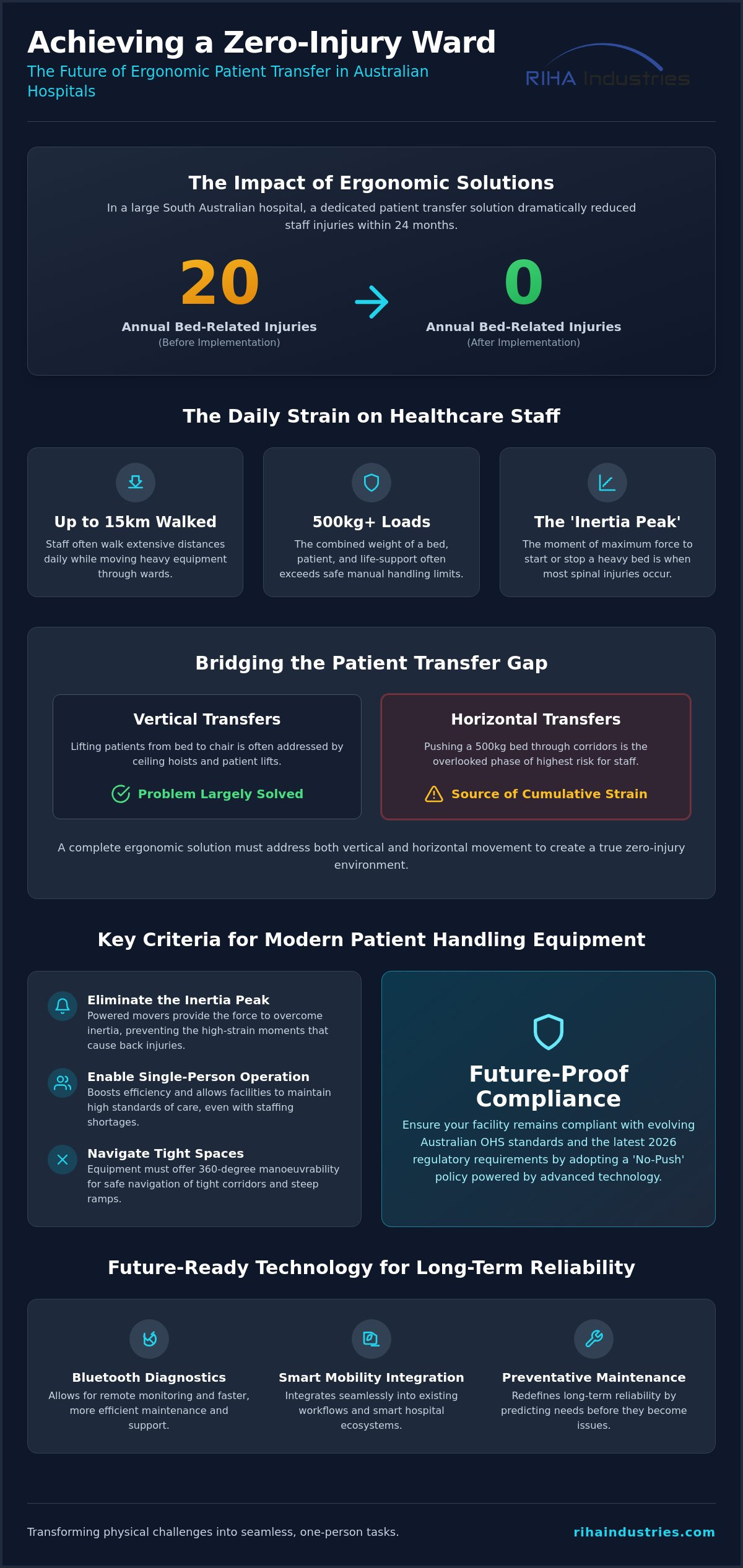
In a large South Australian hospital, bed-related staff injuries plummeted from twenty per year to zero within just twenty-four months of introducing a dedicated ergonomic patient transfer solution. You likely recognise the heavy physical burden your own team carries, often walking up to 15 kilometres a day while struggling to manoeuvre heavy beds through cramped wards. This constant strain leads to significant fatigue and rising workers' compensation premiums that drain hospital resources. It's a challenge that requires more than just better manual handling techniques; it demands a fundamental shift in how we approach facility mobility.
We'll show you how to achieve a zero-injury environment through single-person operation and universal equipment compatibility. This guide examines the latest 2026 regulatory requirements and explains how advanced technology like the StaminaLift series ensures your facility remains compliant with Australian OHS standards. Discover how thoughtful engineering can turn complex physical challenges into seamless, one-person tasks that protect your staff and improve patient care across every ward.
Table of Contents
Defining the Scope of Ergonomic Patient Transfer Solutions
An effective ergonomic patient transfer solution encompasses more than just the moment a patient leaves their bed. It represents a comprehensive strategy for safe movement across both vertical and horizontal planes throughout a clinical facility. While traditional methods focused almost exclusively on the physical act of lifting, 2026 healthcare standards now prioritise powered assistance to eliminate the mechanical stress placed on nursing and porterage staff. This shift reflects a deeper understanding of workplace safety, moving the benchmark from merely avoiding accidents to achieving a genuine zero-injury environment in Australian hospitals.
Protecting staff requires a focus on cumulative strain, not just acute, one-off injuries. When a staff member manoeuvres heavy equipment manually over a twelve-hour shift, the repetitive pressure on joints and the spine builds up. By 2026, the industry has recognised that even 'minor' tasks contribute to long-term disability if they aren't supported by appropriate technology. Our goal is to provide tools that act as a protective ally, ensuring that healthcare professionals can focus on patient care without sacrificing their own physical well-being.
The Vertical vs. Horizontal Transfer Gap
Many facilities invest heavily in a mechanical Patient lift or ceiling hoist to manage vertical movement, yet they often overlook the risks inherent in horizontal transport. Hoists solve the puzzle of getting a patient into a chair or onto a stretcher, but they do nothing to alleviate the strain of pushing a 500kg bariatric bed down a long corridor. We categorise the 'Transport Phase' as the period of highest risk for porters and nurses. It isn't just the large transfers that cause damage; minor repositioning tasks performed dozens of times per shift create cumulative strain. This repetitive micro-trauma often leads to chronic back pain that forces experienced staff out of the profession prematurely. A truly integrated ergonomic patient transfer solution must bridge this gap by providing motorised assistance for every metre of the journey.
Australian OHS Standards for Patient Handling
Current Australian OHS requirements have evolved to demand rigorous risk assessments for every aspect of patient mobility. Modern metropolitan health centres are rapidly adopting 'No-Push' policies to protect their workforce from predictable mechanical loads. To meet these stringent benchmarks, facilities must evaluate their patient handling equipment selection criteria to ensure every motorised unit integrates seamlessly into existing workflows. By replacing manual exertion with precise engineering, hospitals can reduce injury rates significantly. In South Australian trials, moving from manual pushing to powered bed movers saw injury rates drop from 20 per year to zero, proving that the right technology makes a zero-injury workplace a realistic goal rather than just a target.
The Biomechanics of Bed Mobility: Why Pushing is a Critical Risk
Moving a modern hospital bed is a complex mechanical challenge that frequently exceeds the safe limits of the human body. When you combine the weight of a specialised bariatric bed, a patient, and attached life-support equipment, the total mass often reaches 500kg. The most dangerous moment for a healthcare worker occurs during the 'Inertia Peak'. This is the exact second they must exert maximum force to get a stationary bed moving or to bring a heavy load to a controlled stop. It's during these moments of peak exertion that the spine is most vulnerable to acute injury, particularly when the wheels are caught on uneven floor surfaces or high-friction hospital carpets.
An effective ergonomic patient transfer solution must provide the mechanical power to overcome this inertia without requiring physical effort from the operator. Proper equipment design also accounts for the awkward postures staff often adopt when navigating tight corridors or older hospital layouts. By providing 360-degree manoeuvrability, advanced bed movers allow staff to maintain a safe, forward-facing position while the equipment handles the heavy rotation. This eliminates the need for the dangerous twisting and side-loading movements that contribute to long-term joint degradation. Adopting these technologies is a central pillar of any modern Safe Patient Handling programme.
The Cumulative Impact of Ward Transfers
The physical toll on hospital porters and nurses is compounded by the sheer distance they cover every shift. It's common for staff to walk up to 15km per day, much of which involves the strenuous task of guiding heavy equipment. This constant activity leads to profound fatigue, which significantly increases the likelihood of handling errors and workplace accidents. Beyond the immediate risk of injury, the long-term cost of staff turnover due to physical burnout remains a significant burden for healthcare facilities. When staff feel physically exhausted and unsupported, they're more likely to leave the profession, taking their valuable clinical experience with them.
Eliminating Shear Force and Spinal Compression
Powered bed movers are designed to take 100% of the initial push force, ensuring the operator's spine remains protected from the start of the transfer. These systems utilise ergonomic joystick controls that allow for precise movement while keeping the operator's wrists and spine in a neutral, relaxed position. Shear force is the unaligned pressure that causes one part of the spine to slide over another during manual bed handling. By removing the need for manual pushing, we effectively eliminate this dangerous force and the resulting spinal compression. To see how these engineering principles are applied in clinical settings, you can explore the range of Australian-made bed movers designed specifically for high-acuity environments.
Comparing Transfer Technologies: Manual Aids vs. Powered Movers
While manual aids like slide sheets and transfer boards are essential for repositioning patients in bed, they don't address the significant physical risks associated with moving the bed itself. Choosing a comprehensive ergonomic patient transfer solution requires a focus on the transport phase, where the weight of the patient and equipment is most likely to cause injury. Traditional manual bed pushing often relies on the 'Two-Staff Rule', which requires two porters or nurses to manage a single transfer. This method is increasingly unsustainable in the face of modern healthcare staffing shortages and the rising incidence of musculoskeletal disorders. By replacing manual exertion with motorised power, facilities can reclaim valuable staff time while ensuring a higher level of safety.
In high-acuity environments, the difference between manual and powered transport is stark. Motorised bed movers enable a single operator to manage even the heaviest bariatric loads with precision and ease. This transition to single-person operation doesn't just protect the staff; it improves the entire clinical workflow by reducing transfer wait times and accelerating patient flow through the hospital. Implementing these systems aligns with the best practices for Safe Patient Handling and Mobility, providing a structured way to eliminate the dangerous physical peaks associated with manual handling.
Manual vs. Motorised: The Efficiency Audit
The financial case for motorised technology is built on long-term operational savings. While hospital bed mover prices represent an initial capital outlay, this investment is typically offset by a dramatic reduction in labour costs and workers' compensation claims. When one staff member can safely perform a task that previously required two, the facility's efficiency effectively doubles for every transfer. In South Australian hospital trials, this shift contributed to reducing injury rates to zero, proving that the right ergonomic patient transfer solution pays for itself through improved staff retention and reduced downtime.
Attachment Mechanisms and Bed Compatibility
A critical challenge for many facilities is the diversity of their bed fleet. Brand-specific movers often lack the flexibility to handle different models, leading to equipment that sits idle because it won't fit a particular stretcher or bariatric bed. To solve this, advanced systems like the StaminaLift series utilise a patented 'connect and lock' jaw system. This universal hitch allows a single mover to secure a wide range of equipment, including those with complex plastic shrouds or varied widths. Choosing FDA-registered technology ensures that these attachment points meet the highest global standards for safety and reliability, providing peace of mind for both the operator and the facility manager. Furthermore, the integration of Bluetooth diagnostics ensures that maintenance teams can monitor equipment health remotely, further increasing uptime and reliability across the ward.
Selecting the Right Ergonomic Solution for Your Facility
Selecting the right ergonomic patient transfer solution isn't just about the patient; it's about the facility's physical DNA. You must map out your specific ramps, lift dimensions, and corridor widths before committing to a new fleet. Many older Australian hospitals feature narrow thoroughfares and tight corners that require equipment with a zero-degree turning radius to operate safely. If your staff cover vast distances between buildings, a ride-on platform becomes a necessity rather than a luxury to prevent fatigue-related errors. High-use environments should also evaluate lithium battery upgrades to ensure equipment remains operational across multiple shifts without frequent recharging.
Identifying your primary load types is the next step in this assessment. While standard beds are the most common, you may also need to move heavy meal trolleys, bariatric stretchers, or specialised imaging tables. Each of these assets presents a different mechanical challenge. By matching the equipment's power and hitching mechanism to these specific loads, you ensure that staff never feel the need to revert to manual pushing. To find the best fit for your ward's unique layout, you can consult our technical team for a tailored facility assessment.
Matching Equipment to Patient Acuity
Clinical needs vary significantly by department. The StaminaLift Transfer System 5000 serves as a versatile workhorse for general ward transfers, offering compatibility with 95% of global hospital beds. For intensive care units or bariatric wards, the StaminaLift Transfer System 6000 provides the necessary power to handle one-ton loads with precision and ease. In the aged care sector, where corridors are often more residential in style and space is at a premium, the compact StaminaLift 2100 Bed Mover allows for nimble navigation without sacrificing the mechanical strength required for safe transport.
The Logistics of Non-Patient Loads
Efficiency in a hospital environment extends far beyond patient beds. Managing the flow of linen, meals, and pharmacy supplies is just as critical to daily operations. The Easi Rider tug allows porters to move heavy trolleys with minimal physical effort, significantly reducing the risk of strain during these high-frequency tasks. This specialised hospital porter equipment integrates seamlessly with your existing fleet management strategy. For unique requirements like theatre tables or specialised diagnostic equipment, custom hitches ensure that your ergonomic strategy covers every mobile asset within the facility, leaving no room for manual handling risks.
Future-Proofing Safety with RIHA Industries Technology
RIHA Industries is leading the shift toward 'Smart Mobility' by integrating Bluetooth-enabled diagnostics into every ergonomic patient transfer solution we manufacture. This technology allows facility managers to move beyond reactive repairs; instead, they can monitor fleet health in real-time to prevent unexpected downtime. As a global leader in caregiver-centric engineering, our focus remains on providing a stable, long-term partnership that evolves with the shifting needs of the healthcare sector. National service coverage ensures that regardless of your location in Australia, expert support and preventative maintenance remain readily accessible. This high level of technical support transforms the equipment from a simple tool into a reliable, long-term safety asset for your ward.
Sustainability in 2026 is about more than just energy efficiency; it is about extending the lifecycle of every piece of equipment in your facility. We utilize advanced 3D-printing capabilities to produce precision replacement parts for older models, ensuring your existing assets remain safe and functional. This approach prevents the unnecessary decommissioning of perfectly viable hospital beds simply because a specific bracket or handle is no longer in mass production. By choosing a partner dedicated to engineering longevity, you protect both your staff and your facility's capital investment over the coming decade.
Innovations in Power and Connectivity
Lithium battery technology has transformed the performance of motorised movers, offering significantly faster charging cycles and extended operational windows compared to traditional lead-acid alternatives. These advanced power systems provide the consistent torque required for heavy bariatric transfers throughout a demanding double shift. By utilising Bluetooth data, hospital administrators can now identify specific staff training needs by reviewing equipment utilisation patterns and identifying where manual overrides might still occur. Looking ahead, the next generation of ergonomic patient transfer solution technology will feature 'hands-free' bed connection systems that allow operators to secure loads automatically with zero manual contact. This progress ensures that the physical burden on nurses continues to decrease as technology advances.
The RIHA Commitment to Caregivers
Our commitment to caregivers is grounded in the belief that no healthcare professional should finish their shift in pain. This mission-driven approach is why we prioritise 24-hour parts shipping across Australia, helping you maintain 100% fleet availability even during peak admission periods. We recognise that a bed mover sitting in a maintenance bay is a mover that isn't protecting your staff. By providing a reliable, world-class service network, we act as a protective ally for your team. To see how these engineering innovations can be integrated into your specific clinical environment, you can explore the StaminaLift Transfer System 5000 buying guide for your facility.
Transforming Hospital Mobility for a Safer Future
Achieving a zero-injury workplace is no longer a distant aspiration; it's a practical reality made possible through thoughtful engineering. By addressing the physical risks of the 'Inertia Peak' and the 'Transport Phase', facilities can eliminate the primary causes of musculoskeletal disorders among nursing and porterage teams. We've seen how South Australian clinical trials achieved zero injuries by replacing manual exertion with motorised power. This shift doesn't just protect your staff; it optimises your entire clinical workflow by enabling safe, single-person operation for even the heaviest bariatric loads.
Implementing a comprehensive ergonomic patient transfer solution that is Australian-made and FDA-registered ensures your facility meets the highest global standards for safety and reliability. Our commitment to your team's well-being is reflected in every StaminaLift unit, providing the 360-degree manoeuvrability needed for our unique local hospital layouts. You have the power to transform the daily experience of your caregivers, turning a high-risk environment into one defined by safety and efficiency.
To see these benefits in action, you can book a hands-on demonstration of StaminaLift at your hospital. We look forward to helping you build a safer, more sustainable future for your facility and its dedicated staff.
Frequently Asked Questions
What is an ergonomic patient transfer solution?
An ergonomic patient transfer solution is a comprehensive system designed to move patients safely across both vertical and horizontal planes while minimising physical strain on healthcare staff. It integrates mechanical power to handle heavy loads; such as beds and stretchers; ensuring the facility meets OHS standards. By removing the need for manual pushing or lifting, these solutions protect workers from the cumulative strain that leads to chronic injury.
How do motorised bed movers reduce nurse back injuries?
Motorised bed movers reduce injuries by eliminating the 'Inertia Peak', which is the force required to start or stop a heavy bed. By using a motorised drive, nurses avoid the dangerous spinal compression and shear forces caused by manual pushing. This protective technology has been proven to reduce bed-moving injuries to zero in clinical trials, allowing staff to maintain a neutral posture throughout the transfer.
Are StaminaLift bed movers compatible with all hospital beds?
The StaminaLift TS5000 is compatible with 95% of global hospital beds thanks to its patented universal jaw system. It connects securely to various frame styles, including those with complex plastic shrouds or bariatric widths. This universal compatibility ensures that your facility doesn't need to purchase multiple, brand-specific movers for different ward types, simplifying fleet management and staff training.
Can a single person operate a powered patient transfer system?
Yes, these systems are specifically engineered for single-person operation to help manage healthcare staffing shortages effectively. A single porter or nurse can safely move a 500kg load without any additional assistance or physical exertion. This efficiency allows hospitals to maintain high standards of care while significantly reducing the labour required for every patient transfer across the facility.
Do motorised tugs work on hospital ramps and inclines?
Motorised tugs like the Easi Mover are equipped with high-torque motors designed to handle typical hospital inclines and ramps safely. They provide controlled braking and acceleration to ensure the load remains stable and secure on sloped surfaces. This capability is essential for navigating the complex architectural layouts and steep ramps often found in older Australian health centres.
What is the difference between the StaminaLift 5000 and 6000 models?
The StaminaLift Transfer System 5000 is a versatile workhorse for general ward beds, while the TS6000 is a heavy-duty specialist for bariatric care. The 6000 model is engineered to handle massive loads up to 1000kg, including specialised sand or water flotation beds. Both models utilise an intuitive ergonomic patient transfer solution framework, featuring 360-degree manoeuvrability and simple joystick controls for precise movement.
How long does the battery last on a powered bed mover?
Modern lithium battery systems provide enough power for a full double shift under standard hospital usage conditions. These batteries are designed for rapid charging, allowing them to be topped up during staff breaks to ensure the equipment remains available 24/7. Integrated Bluetooth diagnostics help maintenance teams monitor battery health and charging cycles to prevent any unexpected downtime during busy periods.
Is staff training required for ergonomic transfer equipment?
Initial training is necessary to ensure staff are comfortable with the joystick controls and the patented hitching mechanisms. These systems are designed to be highly intuitive, typically requiring only a brief session for an operator to achieve full proficiency. Ongoing support and refresher training ensure that the equipment is used correctly, maintaining the goal of a zero-injury environment across the ward.


