
How to Reduce Porter Back Injuries: A Comprehensive 2026 Guide
If you believe that another round of manual handling training will finally solve your staff turnover issues, you're likely overlooking the root cause of the problem. While ergonomics matter, the reality is that body stressing now accounts for 34.5% of all serious workers' compensation claims in Australia. You've likely seen the impact firsthand through rising insurance premiums, exhausted teams, and the constant stress of operational delays. It's a heavy burden for any healthcare manager to carry, especially when 87.5% of Australian men reported suffering from back pain in the last year.
We understand that your goal is to foster a zero-harm workplace culture where your team feels protected and empowered. This comprehensive 2026 guide explains exactly how to reduce porter back injuries by moving beyond outdated lifting techniques and embracing powered integration. By prioritising mechanical assistance over manual labour, you can eliminate musculoskeletal strain while improving porter efficiency and morale. We'll examine the latest WHS compliance standards, the financial cost of chronic pain, and the advanced technologies, such as the StaminaLift TS5000, that are currently setting new benchmarks for hospital safety across the country.
Table of Contents
The Hidden Toll of Hospital Portering in Australian Healthcare
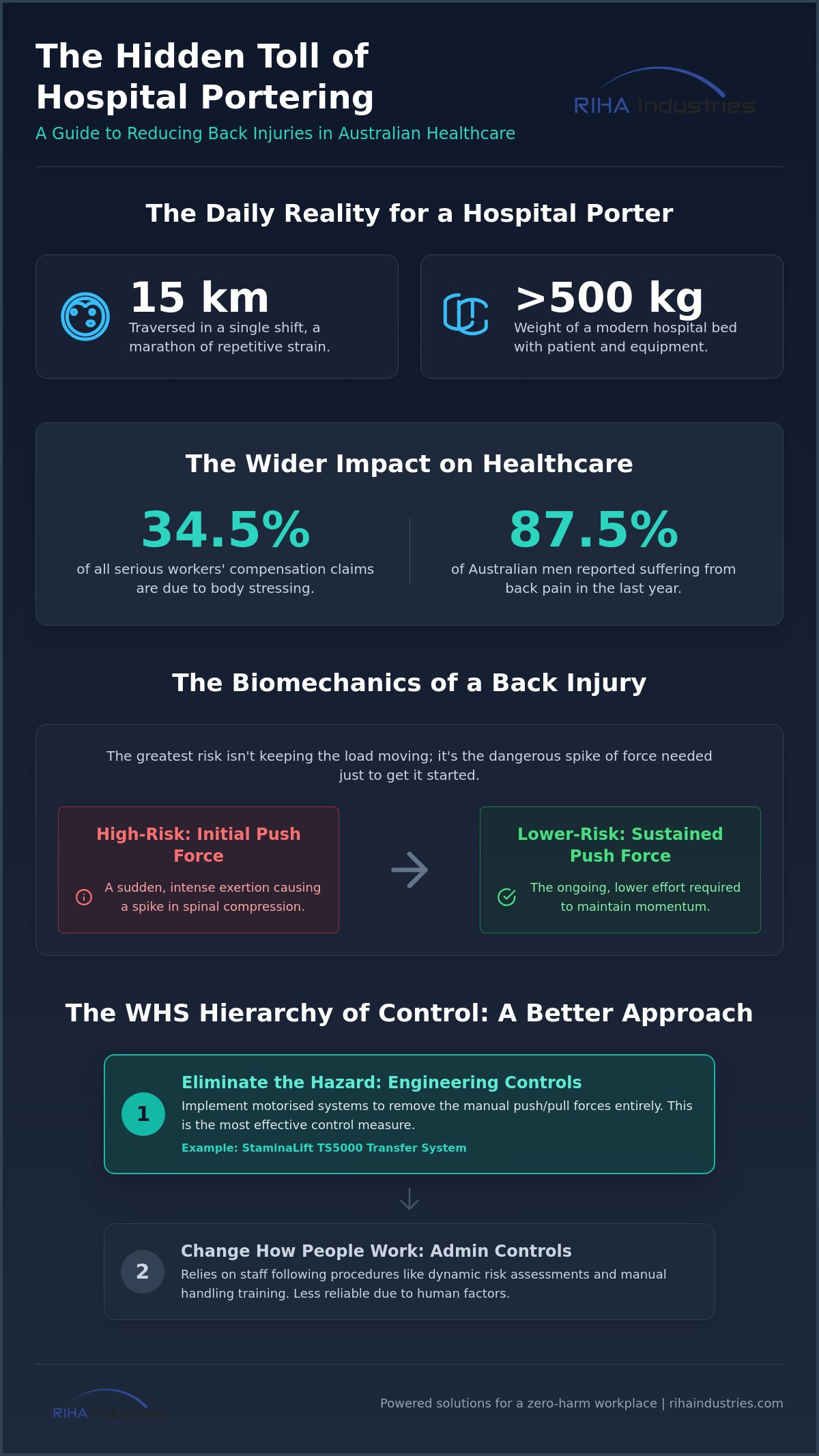
Hospital porters serve as the vital engine room of patient flow, yet their physical contribution often goes unnoticed until a systemic breakdown occurs. In a typical Australian clinical environment, a porter can traverse up to 15 kilometres in a single shift. This distance represents more than just a high step count; it's a marathon performed whilst pushing and pulling heavy equipment through crowded corridors. Modern hospital beds, when combined with patient weight and necessary clinical accessories, can frequently exceed 500kg. Moving these massive loads manually places an immense, repetitive strain on the lumbar spine. A deep dive into the biomechanics of manual handling reveals that these forceful exertions are the primary drivers of long-term musculoskeletal disorders (MSDs) that plague the industry.
The 15-Kilometre Daily Grind
Physical fatigue acts as a silent precursor to acute injury. When a porter spends hours transporting heavy linen skips or meal trolleys across sprawling hospital campuses, their muscles eventually reach a point of exhaustion. This cumulative tiredness compromises their posture and lifting technique. By the final hours of an eight-hour shift, even a minor lapse in form while navigating a tight corner or a slight incline can result in a debilitating strain. Healthcare managers are increasingly investigating how to reduce porter back injuries by adopting ride-on solutions like the Easi Rider. These systems remove the physical toll of long-distance transport, ensuring staff remain fresh and capable of performing their duties safely from the first minute of their shift to the last.
The Economic Impact on Australian Hospitals
The consequences of porter injuries extend far beyond the individual's physical pain. For hospital administrators, the economic reality is stark and demanding. In 2023-24, body stressing accounted for 34.5% of serious workers' compensation claims in Australia, with the healthcare sector being one of the most affected industries. High staff turnover due to physical burnout forces hospitals into a cycle of constant recruitment and training, which is both costly and disruptive to ward culture. When experienced porters are sidelined by back injuries, patient flow stalls and discharge times inevitably increase.
Investing in the right hospital porter equipment is a strategic move that protects operational stability. By reducing injury-related absenteeism, hospitals can maintain a reliable workforce and ensure that clinical teams aren't left waiting for essential patient transfers. Understanding how to reduce porter back injuries is a matter of financial sustainability as much as it is a fundamental duty of care. Protecting your team from the cumulative impact of heavy lifting is the only way to ensure a resilient and efficient healthcare service.
Understanding the Biomechanics of Manual Handling Injuries
To address the physical risks in a clinical setting, we must first look at the legal and physiological frameworks that govern workplace safety. Under Australian WHS regulations, manual handling covers any task where a worker is required to lift, lower, push, pull, or carry a load. In the high-stakes environment of a hospital, this translates to the constant movement of patients and heavy equipment through high-traffic zones. Within the context of hospital portering, a Musculoskeletal Disorder is a cumulative injury to the body's physical structures caused by the repetitive strain of moving heavy patients and equipment. Understanding the biomechanics of these movements is essential for anyone looking at how to reduce porter back injuries in a high-pressure environment.
When a porter moves a bed, the lumbar spine is subjected to two distinct types of stress. The "initial push force" is the surge of energy needed to overcome static friction and inertia, while the "sustained push force" is the ongoing effort required to keep the bed in motion. If the initial force is too high, it creates a sudden spike in intra-abdominal pressure and spinal compression. By moving away from manual steering and adopting motorised assistance, facilities can see exactly how to reduce porter back injuries whilst maintaining operational speed. Understanding these biomechanical risks is the first step toward building a safer ward; you can explore specialised equipment designed to mitigate these forces at RIHA Industries.
The Danger of the "Initial Push"
The moment of transition from a stationary state to motion is where the body is most vulnerable. Overcoming the inertia of a bariatric bed requires a porter to recruit the erector spinae, abdominals, and gluteal muscles with explosive force. This is particularly dangerous when the load exceeds 16kg, which Safe Work Australia identifies as a high-risk threshold for manual tasks. If the porter's core isn't perfectly engaged, this burst of energy can cause acute back strain or ligament tears. Inertia doesn't just make the job harder; it creates a mechanical threshold that the human body isn't designed to cross repeatedly.
Navigating Tight Corners and Confined Spaces
Navigating tight hospital corners introduces the danger of torsion, or twisting under load. When a porter twists their torso whilst steering a heavy bed through a narrow doorway, the spinal discs are compressed and rotated simultaneously. This specific movement is a primary cause of disc herniation and chronic nerve pain. Modern Safe Patient Handling and Mobility (SPHM) guidelines emphasise that technology should replace manual effort to prevent these complex mechanical strains. Lateral movements when manually steering are physically taxing because the porter must use their own body weight as a lever. True 360-degree manoeuvrability is a safety requirement, and joystick-controlled precision allows the machine to handle the directional change, effectively removing the threat of spinal torsion.
5 Core Techniques for Safer Manual Transfers
Whilst we have established that powered equipment is the gold standard for safety, manual handling skills remain a fundamental requirement for every healthcare professional. They act as a critical safety net for those moments when mechanical aids are being serviced or are temporarily unavailable. Mastering these techniques is an essential component of how to reduce porter back injuries during everyday ward movements. Even when using the best equipment, a porter must understand the physical baseline of safe movement to prevent acute strains. These practices reflect the core principles found in the OSHA safe patient handling guidelines, which advocate for a combination of proper technique and mechanical assistance.
A primary rule for all manual transfers is to push rather than pull. Pulling a heavy bed or trolley forces the body into an overextended, asymmetrical position that places extreme stress on the delicate structures of the shoulders and lower back. By pushing, a porter can lean into the load, using their body weight and the powerful muscles of the legs to generate momentum. This method keeps the spine in a much safer, more stable alignment. It's a simple change that yields significant protective benefits over the course of a long career.
The Dynamic Risk Assessment
A Dynamic Risk Assessment (DRA) is a mental checklist performed in seconds before any move begins. Porters should assess the floor surface; moving a heavy load from smooth lino onto thick carpet requires a significantly higher force. You must also scan for path obstructions such as loose power cords, cleaning trolleys, or narrow doorways. Crucially, always verify that all bed brakes have been fully released. Attempting to move a bed with even one brake engaged is a leading cause of sudden, high-impact back injuries. If a load feels beyond your personal threshold or involves a bariatric patient, the only safe response is to stop and seek additional help or mechanical support.
Ergonomic Body Positioning
Achieving the correct body positioning is vital for initiating any movement safely. Porters should position their feet shoulder-width apart to create a stable, wide base of support. Keep the spine in a neutral position, avoid slouching, and actively engage the core muscles before applying force. Keeping the load as close to the body as possible ensures that your centre of gravity remains stable. When two porters are required for a move, clear communication is non-negotiable. Using a simple "ready, brace, push" command ensures that both staff members apply force simultaneously, preventing one person from bearing an unexpected portion of the weight. This collaborative approach is a key strategy in how to reduce porter back injuries when mechanical movers aren't immediately to hand.
Implementing Systemic Change: From Manual to Powered Handling
Whilst training provides a vital baseline, systemic safety requires a fundamental shift in how we approach the task itself. Under Australian WHS legislation, the Hierarchy of Control dictates that we should aim to substitute hazardous tasks or implement engineering controls before relying on administrative measures like training. This is the most effective strategy for how to reduce porter back injuries because it removes the physical hazard entirely rather than just teaching staff how to manage it. By prioritising engineering solutions, you move from a culture of managing risk to one of eliminating it.
Motorised bed movers are specifically designed to eliminate the high-risk "initial push" force that we analysed in previous sections. By allowing a machine to overcome inertia, the porter is shielded from the sudden spinal compression that leads to acute injury. From a management perspective, the return on investment is undeniable. A single serious back injury claim in Australia can easily exceed $50,000 in direct costs and lost productivity. Investing in powered equipment isn't just a safety choice; it's a financial safeguard for the hospital's organisational budget that pays for itself by preventing just one major incident.
Some facility managers worry about the footprint of additional equipment in already crowded environments. However, modern designs prioritise compact, underneath-bed profiles that don't obstruct narrow corridors or busy ward entries. These systems are engineered to be as unobtrusive as possible whilst providing maximum mechanical advantage. You can explore the range of compact movers at RIHA Industries to see how these systems integrate seamlessly into existing healthcare workflows.
Engineering Out the Risk
True safety comes from engineering the human out of the high-force equation. Powered tugs and movers are capable of taking 100% of the strain, allowing for efficient single-person operation even in resource-stretched environments. This reduces the need for "team lifting," which is often difficult to coordinate during peak periods. The StaminaLift Transfer System 5000 serves as an industry benchmark here, offering universal compatibility that ensures almost any bed in your facility can be moved without manual effort.
Safe Bariatric Transport
Bariatric transfers represent the highest level of risk for manual handling injuries in modern healthcare. Attempting to manually move a patient and bed combination that exceeds 500kg is a physical impossibility for a single porter to perform safely. High-capacity movers are engineered to handle up to 900kg of push and pull force with precision. These machines include critical safety features like automatic braking and safety lockouts, ensuring that even the most acute care transfers are completed with zero harm to the staff. By using specialised equipment for these high-stakes moves, you provide your team with the protection they deserve. Similar standards of high-performance engineering are found in other demanding sectors; for those interested in specialised vehicle fabrication and conversions, you can check out Auto Industries Factory LLC.
Future-Proofing Porter Safety with StaminaLift Technology
As we look toward the future of healthcare logistics, the emphasis shifts from merely managing risk to actively engineering it out of the ward. The StaminaLift range represents the pinnacle of Australian-made innovation; it is designed specifically for the unique demands of local clinical environments. Integrating these systems is a definitive answer to how to reduce porter back injuries whilst maintaining a high pace of patient movement. By replacing manual exertion with thoughtful engineering, facilities can protect their most valuable assets: their people.
The "Connect and Lock" jaw mechanism is a primary feature that sets this technology apart. It allows for a hands-free connection to 95% of global hospital beds, which effectively eliminates the need for awkward bending, kneeling, or manual strapping. These repetitive movements are often the hidden culprits behind chronic lower back strain. Additionally, the 360-degree turning radius allows porters to navigate the most challenging hospital corridors and tight elevators with precision. This level of manoeuvrability addresses the torsion and lateral strain risks that occur when staff are forced to manually steer heavy loads around corners.
Fleet reliability is equally important for maintaining safety standards. StaminaLift machines feature Bluetooth diagnostics and intelligent battery monitoring to ensure that equipment is always ready for service. This technology allows facility managers to oversee fleet health in real-time, preventing the operational delays that occur when a bed mover is out of action. When your team has access to reliable, world-class equipment, the culture of the workplace shifts from one of physical burnout to one of professional empowerment.
The StaminaLift Advantage
The ergonomic joystick controls allow for fingertip manoeuvring, which means the porter can focus on the path ahead rather than the weight behind them. This intuitive interface reduces the cognitive and physical load on the operator. The sleek, low-profile design ensures the unit fits neatly underneath beds, which prevents tripping hazards in crowded ward entries. At a quiet 65 dB, the operation is barely louder than a normal conversation; this ensures a healing environment for patients is maintained even during peak transport periods.
Comprehensive Support and Maintenance
Safety equipment is only effective if it is kept in peak condition. Implementing a schedule of preventative maintenance is the best way to ensure your fleet remains safe and operational for years to come. RIHA Industries supports Australian hospitals with national service coverage and 24-hour parts shipping to minimise any downtime. We encourage facility managers to utilise our ROI calculator to see how these safety investments protect the hospital's budget and its people. By choosing a long-term partner dedicated to technical excellence, you are securing a safer future for every member of your portering team.
Securing a Safer Future for Your Healthcare Team
Prioritising the well-being of your portering staff is no longer just a matter of technique; it's a commitment to modern engineering. We've seen how the cumulative physical toll of hospital transport can lead to chronic burnout and high turnover. By understanding the biomechanical thresholds of the human body and moving toward the top of the WHS Hierarchy of Control, you can effectively eliminate the primary causes of musculoskeletal strain. Implementing these systemic changes is the most reliable way to discover how to reduce porter back injuries whilst enhancing the overall efficiency of your facility.
Choosing the right partner in this transition is essential for long-term success. Our FDA-registered and Australian-made solutions are designed with 360-degree manoeuvrability to handle the tightest healthcare spaces with ease. In major hospitals, our systems have been proven to reduce bed-moving injuries to zero within just two years. We invite you to protect your team and request a StaminaLift demonstration today to see these results firsthand. Together, we can create a workplace where safety is a standard, not just a goal, and where every member of your team feels empowered to perform their best.
Frequently Asked Questions
What is the most common cause of back injuries among hospital porters?
The most common cause of injury is the high initial force required to overcome inertia when moving heavy hospital beds. This sudden, explosive exertion often leads to acute lumbar strain or long-term musculoskeletal disorders. Repetitive movements combined with physical fatigue during a 15km shift further increase the risk of a debilitating injury occurring.
How much weight can a hospital porter safely push manually?
Safe Work Australia guidelines recommend that a formal risk assessment be conducted for any load exceeding 4.5kg. Whilst there's no strict legal maximum, any load over 16kg is considered high risk. It's generally advised that staff shouldn't manually handle loads over 55kg without mechanical aids or team assistance to prevent spinal compression.
Do motorised bed movers really reduce injury rates in large hospitals?
Evidence from major Australian clinical environments shows that implementing motorised movers is the most effective way for how to reduce porter back injuries. Some facilities have reported reducing bed-moving injuries to zero within two years of adopting this technology. These systems work by taking 100% of the physical burden off the human operator.
What are the Australian WHS requirements for manual handling in healthcare?
Under the Work Health and Safety Act, employers must eliminate or minimise risks from hazardous manual tasks as far as is reasonably practicable. This involves following the Model Code of Practice provided by Safe Work Australia. The regulations prioritise engineering controls, such as powered movers, over administrative controls like manual handling training or signage.
Can powered bed movers fit into small hospital lifts and narrow corridors?
Modern equipment is specifically engineered to navigate the confined spaces of older hospital wards. The StaminaLift 2100 Bed Mover features a compact, underneath-bed profile and a 360-degree turning radius. This allows it to operate seamlessly within small hospital lifts and navigate narrow corridors that would be difficult to manage with a manual team lift.
Is training enough to prevent back injuries when moving bariatric patients?
Training alone is insufficient when dealing with bariatric loads that can exceed 500kg. At these weights, the physical demand simply exceeds human capability, making it a vital part of how to reduce porter back injuries to use specialised engineering controls. High-capacity movers like the StaminaLift TS6000 are required to ensure these transfers are performed without harm.
How does the StaminaLift system attach to different types of hospital beds?
The system utilises a patented "Connect and Lock" jaw mechanism that ensures universal compatibility with 95% of global hospital beds. This technology allows the mover to securely grip the bed frame without the porter needing to bend, kneel, or use manual straps. It creates a stable, motorised connection in seconds, protecting the operator's spine from awkward postures.
What is the difference between an Easi Mover and an Easi Rider tug?
The Easi Mover is a pedestrian-operated tug designed for precise manoeuvring of heavy trolleys and equipment in tight spaces. The Easi Rider is a ride-on solution built to eliminate staff fatigue during long-distance transport. By allowing the porter to ride with the load, the Easi Rider prevents the physical exhaustion that often leads to poor form and injury.


