
Manual Handling Code of Practice in Healthcare: A 2026 Compliance Guide
- Jul 10
- 12 min read
Relying on "safe lifting" techniques is no longer a sufficient strategy to meet your legal obligations in 2026. While many facilities still focus on administrative training, the Australian manual handling code of practice healthcare guidelines increasingly prioritise the elimination of hazards through high-order engineering controls. You likely feel the constant pressure of rising WorkCover premiums and the frustration of losing experienced staff to preventable musculoskeletal injuries. It's a taxing cycle that compromises both team morale and the quality of patient care.
We recognise that navigating complex WHS regulations while managing ageing equipment can feel overwhelming. This guide provides a clear roadmap to mastering the latest Australian requirements so you can confidently pass WorkSafe audits and achieve a zero-injury status for bed transfers. We'll explore the transition to "no-lift" policies and examine how implementing the right mechanical assistance, such as the StaminaLift TS5000, protects your workforce while improving operational efficiency across your facility.
Table of Contents
Decoding the Manual Handling Code of Practice for Australian Healthcare (2026)
The Work Health and Safety (WHS) Act establishes a broad legal framework, but the manual handling code of practice healthcare provides the specific, actionable standards used to measure compliance in Australian facilities. In a legal setting, this Code serves as an admissible standard. This means that if an injury occurs, a court will look at whether you followed these guidelines as a baseline for meeting your duty of care. For facility managers, the Code is a protective shield as much as a regulatory requirement; it defines the expected level of safety in an increasingly complex industry.
To validate that your facility meets these rigorous benchmarks through independent assessment, you can discover International Associates Limited for expert auditing and certification services.
At its core, the Code addresses the Manual handling of loads, which includes any activity requiring a person to lift, lower, push, pull, or carry an object or person. In a clinical environment, these tasks are inherently hazardous because they often involve "live" loads, such as patients who may be unstable, frail, or bariatric. These movements frequently require awkward postures and high force, creating a perfect storm for musculoskeletal disorders (MSDs). Unlike a static box in a warehouse, a patient requires dignity and care, which adds a layer of psychological and physical complexity to every transfer.
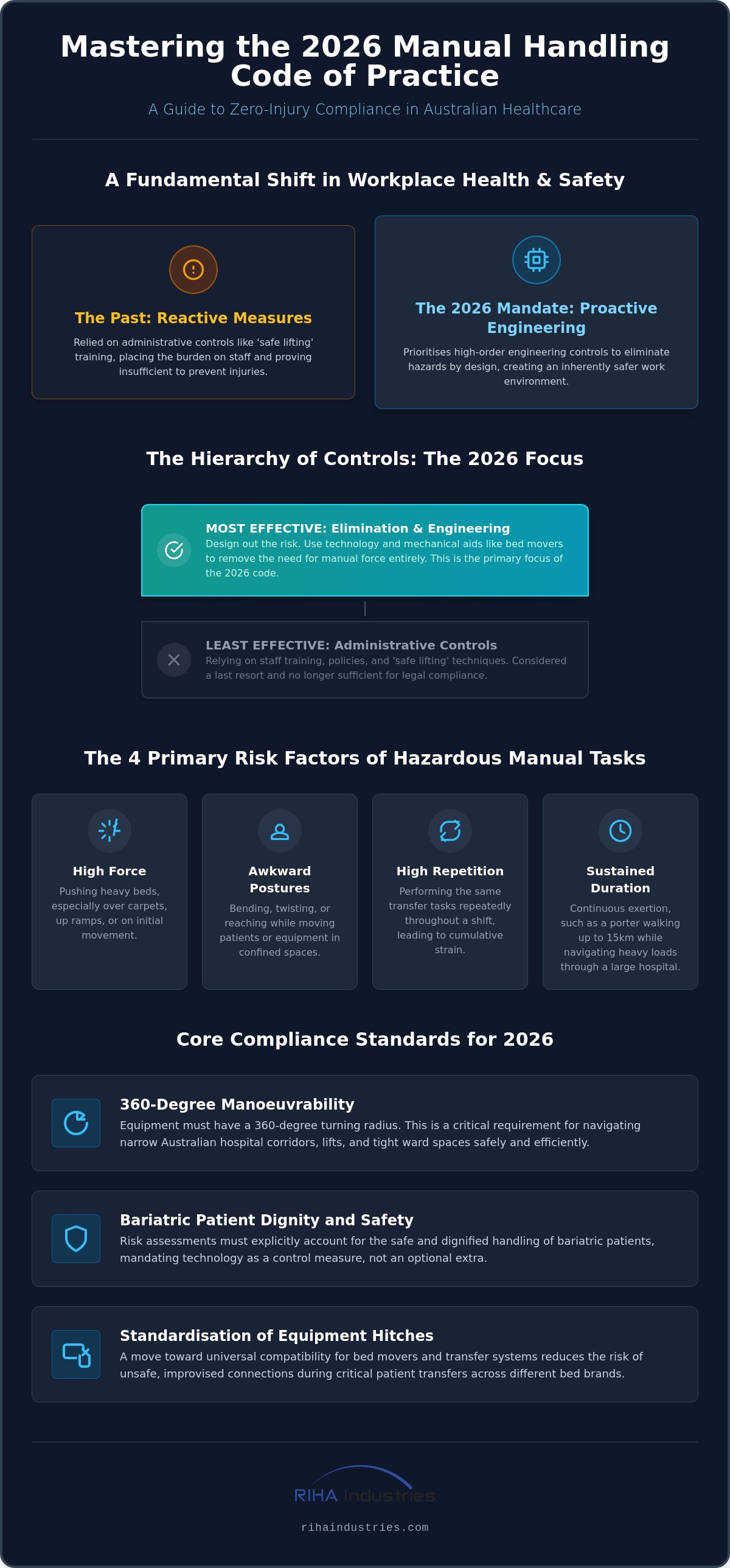
Despite decades of manual handling training, healthcare workers remain the highest-risk group for body stressing injuries in Australia. Data from Safe Work Australia for the 2023-24 period recorded 146,700 serious workers' compensation claims, with a significant portion stemming from manual handling tasks. This reality has triggered a shift in 2026 toward "Safety by Design." Rather than asking nurses to lift better, the industry is now focused on designing clinical environments where the need for manual exertion is eliminated entirely through engineering controls and automated systems.
Legal Obligations for Facility Managers
Facility managers hold a primary duty of care to provide a safe working environment. This includes a mandatory requirement to consult with staff when selecting new handling equipment. Consultation ensures that the tools provided actually solve the physical challenges faced on the ward. Failing to meet these obligations leads to more than just legal liability. It results in skyrocketing WorkCover premiums and the loss of skilled staff who can no longer perform their duties due to chronic back pain.
Key 2026 Updates to Healthcare Safety Standards
Recent updates to safety standards place a heavy emphasis on bariatric patient dignity alongside worker safety. Risk assessments must now explicitly consider technology as a mandatory control measure rather than an optional luxury. There is also a move toward the standardisation of equipment hitches. This ensures that bed movers and transfer systems are universally compatible across different bed brands, reducing the risk of improvised, unsafe connections during emergency patient transfers.
Identifying Hazardous Manual Tasks: A Risk Management Framework
Identifying a hazard is the critical first step in protecting your clinical team. Under the manual handling code of practice healthcare, a task is considered hazardous if it involves high force, awkward postures, sustained duration, or high repetition. These four factors often overlap during a single patient transfer. For example, pushing a bed through a carpeted corridor requires high initial force while maintaining a sustained effort to keep the load moving. By referencing the Model Code of Practice: Hazardous Manual Tasks, facility managers can establish a robust framework for ward-based risk assessments that account for these variables.
Many hazards remain hidden until an injury occurs. Consider the physical layout of your facility. Ramps, thick-pile carpets, and narrow elevator entries significantly increase the force required to move equipment. Then there is the cumulative trauma of porting. A porter in a large metropolitan hospital may walk up to 15km in a single shift. This constant movement, combined with the strain of steering heavy beds, leads to fatigue and long-term musculoskeletal damage. Recognising these environmental stressors is essential for a complete safety audit. Adhering to the manual handling code of practice healthcare framework ensures that your facility moves beyond reactive safety and enters a phase of proactive risk mitigation.
Patient Handling vs. Equipment Transport
It's easy to focus solely on "people handling" while overlooking the risks associated with "load moving." Transporting linen trolleys, meal carts, and even empty beds presents significant danger. An empty hospital bed still weighs between 120kg and 160kg; moving multiple beds daily without assistance creates a high-repetition hazard. Using the patient handling equipment selection criteria helps you categorise these risks and choose the right mechanical aid for each specific task. If you're unsure where to start, conducting a comprehensive equipment audit can reveal gaps in your current safety protocols.
The Bariatric Challenge
Managing bariatric patients requires a specialised risk management approach. When a load exceeds 250kg, the physical demand on a single staff member surpasses safe human limits. For these high-stakes transfers, the StaminaLift Transfer System 6000 provides the necessary engineering control to manage nearly one ton of weight safely. Hazardous force is defined as any physical effort that requires a staff member to use their full body weight or jerking movements to overcome the initial friction of a heavy load. By substituting manual effort with motorised power, you protect your staff from the catastrophic injuries often associated with heavy patient care.
The Hierarchy of Controls: Moving Beyond 'Safe Lifting' Techniques
The hierarchy of controls provides a clear, mandatory framework for managing Manual tasks in healthcare. Under the manual handling code of practice healthcare, facility managers are required to prioritise higher-order controls that physically remove or isolate the hazard. While many organisations still rely heavily on administrative measures like signage and posters, these are the least effective tools for preventing injury. Real compliance in 2026 is achieved by moving up the hierarchy toward elimination, substitution, and engineering controls.
Elimination involves removing the need for manual movement entirely, such as using pneumatic tube systems for small samples or automated guided vehicles for waste. Substitution follows, where manual equipment is replaced with powered alternatives like the Easi Mover for heavy linen trolleys. However, the true gold standard for healthcare compliance lies in engineering controls. These solutions redesign the task to ensure the worker is protected by the equipment itself, regardless of their individual physical strength or lifting technique.
Why Engineering Controls are the Primary Compliance Strategy
Engineering controls are the most reliable way to bridge the gap between mechanical capability and human safety. Motorised bed movers, such as the StaminaLift TS5000, are designed to eliminate the high-force push and pull movements that lead to chronic back pain. These systems use intuitive joystick controls to provide precision movement, while auto-braking features ensure the load remains under control at all times. This technology empowers staff by removing the physical burden of the task. Because the TS5000 is compatible with 95% of global hospital beds, it provides a universal solution for facilities with mixed equipment fleets. The impact of this shift is documented; a South Australian hospital case study showed that by implementing these engineered solutions, manual handling injuries were reduced from 20% to zero. This level of safety is impossible to achieve through training alone.
The Failure of 'Safe Lifting' Training
Decades of reliance on "safe lifting" workshops haven't stemmed the tide of musculoskeletal disorders in the healthcare sector. Research consistently shows that even with perfect technique, the human spine has clear physiological limits that are easily exceeded when moving modern hospital beds. When a nurse or porter attempts to steer a heavy load, the compressive forces on the lumbar spine often surpass safe thresholds. The manual handling code of practice healthcare recognises this reality by categorising training as an administrative control. This means it should only be used as a last resort or to support higher-level measures. Moving toward a "don't lift at all" culture is the only way to ensure long-term staff retention and morale in a high-pressure environment.
Practical Implementation: Standards for Bed and Load Movers
Integrating hardware that aligns with the manual handling code of practice healthcare requires more than just motorised power. It demands equipment built to rigorous Australian Standards that can withstand the unique pressures of a clinical environment. For many facilities, the biggest hurdle is manoeuvrability. Australian hospital corridors are often tight and congested, making a 360-degree turning radius essential for safe navigation. Equipment that can spin on its own axis allows staff to move heavy beds into lifts or around corners without the awkward shunting that leads to shoulder strain.
Efficiency and safety go hand in hand when equipment is designed for single-person operation. Traditionally, moving a bariatric patient or a heavy theatre table required two or even three staff members. This not only increases labour costs but also multiplies the risk of injury. Adhering to the manual handling code of practice healthcare guidelines means moving away from these multi-person pushes toward automated, single-user systems. Modern bed movers eliminate the strain, allowing a porter to manage the heaviest loads with total control. To maintain this level of safety, battery and diagnostic monitoring systems ensure the equipment is always fit for purpose. A mover that fails mid-transfer becomes a hazard itself, so real-time health checks are a non-negotiable feature for 2026 compliance.
Navigating Ramps and Confined Spaces
Ramps and inclines are notorious for causing runaway loads or requiring excessive physical force. Calculating gradient safety is a core part of any risk assessment. The StaminaLift Transfer System 6000 is engineered to handle 7-degree inclines under full load, providing an essential safety margin for facilities with older infrastructure. Space-saving designs are equally important; movers that fit partially underneath the bed frame reduce the overall footprint of the transport unit. This ensures the system remains compact enough for small patient rooms while non-marking wheels protect expensive facility flooring from damage during high-frequency use.
The Role of Universal Compatibility
A safety system is only effective if it works with every piece of equipment in your facility. Patented attachment mechanisms, like those found in RIHA Industries' range, are critical for managing mixed fleets. Whether you're connecting to beds, stretchers, or specialised theatre tables, the connection must be secure and instantaneous. This universal compatibility prevents staff from reverting to manual handling when a specific bed doesn't fit the mover. For more on large-scale facility needs, see our safety and efficiency guide for aged care to understand how these standards apply to long-term care environments.
Ready to upgrade your facility's safety standards? Explore the full range of StaminaLift bed movers to find the right fit for your clinical needs.
Achieving Zero-Injury Compliance with StaminaLift Technology
RIHA Industries was founded on a singular, mission-driven commitment: to eliminate the physical burden of patient transport through thoughtful engineering. By aligning our innovation with the manual handling code of practice healthcare, we provide solutions that protect the longevity of healthcare careers. We understand that your staff are your most valuable asset; our goal is to ensure they return home every day without the lingering pain of a musculoskeletal injury. Achieving zero-injury status is no longer a distant ideal; it is a practical reality for facilities that prioritise high-order engineering controls.
The StaminaLift TS5000 serves as the cornerstone of this safety strategy. It offers universal compatibility with 95% of global hospital beds, ensuring that your compliance efforts remain consistent even across a mixed equipment fleet. For the most demanding tasks, the StaminaLift TS6000 addresses the bariatric safety gap that many facilities struggle to manage. It allows a single staff member to move loads of nearly one ton with precision and ease, removing the high-force risks associated with heavy patient transfers. For long-distance porting in large metropolitan centres, the Easi Rider and Easi Mover provide the necessary power to optimise hospital porter equipment fleets, reducing the cumulative fatigue that leads to long-term trauma.
The ROI of Safety Compliance
Investing in advanced transfer technology is a strategic business decision that yields significant financial returns. By using the RIHA ROI calculator, facility managers can justify equipment investment by looking at the total cost of injury. Reducing WorkCover premiums and minimising staff absenteeism directly improves your bottom line. Beyond the numbers, providing world-class equipment enhances staff retention and morale, positioning your facility as an employer of choice. To ensure your investment remains a long-term asset, we provide comprehensive preventative maintenance programs and utilise Australian-made parts for maximum reliability.
Next Steps: Consultation and Trial
Mastering the manual handling code of practice healthcare requirements in 2026 starts with a practical assessment of your current challenges. We invite you to organise a hands-on demonstration within your facility to see how our systems perform in your specific corridors and ramps. Our team will work with you to customise hitches and attachments, ensuring a seamless connection to your existing beds and stretchers. We back our technology with a commitment to technical excellence, including a 24-hour response for support and parts to keep your facility moving safely.
Future-Proofing Your Facility and Protecting Your Workforce
Securing your facility's future requires a decisive move beyond traditional training toward integrated engineering solutions. We've explored how the manual handling code of practice healthcare framework prioritises the elimination of hazards, especially when managing high-stakes bariatric transfers or navigating complex ward environments. By choosing technology that acts as a protective ally, you don't just meet regulatory standards; you empower your team to focus on their primary mission of patient care. This shift from manual effort to mechanical precision is the only sustainable way to manage the physical demands of modern healthcare.
Our FDA-registered and Australian-made equipment is built for reliability, having already achieved zero injury rates in South Australian hospital trials. With national service coverage across Australia, RIHA Industries provides the long-term support needed to maintain a compliant and efficient facility. It's time to eliminate the risk of body stressing and foster a culture of safety that values every staff member. Book a hands-on demonstration of the StaminaLift TS5000 today to see these benefits in action. We're ready to help you achieve a safer, more resilient workplace for your dedicated team.
Frequently Asked Questions
What is the Manual Handling Code of Practice in healthcare?
The manual handling code of practice healthcare is a practical guide that explains how to achieve the standards of health, safety, and welfare required under Australian WHS laws. It focuses specifically on identifying and managing hazardous manual tasks, such as patient transfers and equipment transport, to prevent musculoskeletal disorders. This document provides a baseline for facilities to develop their safety protocols while ensuring they meet their legal duty of care to employees.
Is the Manual Handling Code of Practice legally binding in Australia?
While a code of practice itself isn't a regulation, it is an admissible standard in court. If an injury occurs, regulators use the Code to determine if a facility manager has done what is "reasonably practicable" to ensure safety. Following the Code provides a level of legal protection, as it demonstrates that you've implemented industry-recognised controls to mitigate risk. Failing to follow it often results in higher liability and increased WorkCover premiums.
How do I conduct a risk assessment for moving hospital beds?
Effective risk assessments begin by identifying the four primary risk factors: high force, awkward posture, sustained duration, and repetition. You must evaluate the entire transport route, looking for "hidden" hazards like carpeted corridors, steep ramps, or tight elevator entries. Consulting with the porters and nurses who perform these tasks daily ensures your assessment reflects real-world challenges. This collaborative approach leads to more accurate hazard identification and more effective control implementation.
What are engineering controls in healthcare manual handling?
Engineering controls are physical changes to the work environment or equipment that eliminate or isolate the hazard from the worker. In a clinical setting, this includes motorised bed movers like the StaminaLift TS5000, which replace manual pushing and pulling with motorised power. These controls are considered the "gold standard" because they don't rely on staff memory or technique. They provide a permanent, mechanical solution to the physical stressors inherent in patient transport.
How much weight can one person safely push in a hospital?
Australian WHS laws don't set a specific weight limit, as safety depends on the individual, the equipment, and the environment. Instead, the focus is on whether the task involves "hazardous force," such as needing to use your full body weight to start a bed moving. When a load exceeds 250kg or requires significant exertion to steer, it's generally considered unsafe for one person. Motorised assistance is required to keep these forces within safe human limits.
What is the best equipment for bariatric patient transport?
Managing bariatric transfers safely requires high-capacity motorised equipment designed for extreme loads. The StaminaLift Transfer System 6000 is specifically engineered for these high-risk tasks, allowing a single operator to move nearly one ton with precision. It features a 360-degree turning radius and specialised hitching to ensure the load remains stable and controlled. This level of mechanical support is essential for protecting staff from the catastrophic injuries often associated with bariatric care.
Does the Code of Practice require staff training?
Yes, the Code requires staff training, but it categorises this as an administrative control. The manual handling code of practice healthcare clarifies that training is the least effective way to manage risk and should only be used to support higher-level measures. Real compliance involves providing the right equipment first, then training staff on how to use those tools safely. Relying on "safe lifting" technique alone is no longer a sufficient risk management strategy.
How can I reduce WorkCover claims in my hospital?
Reducing WorkCover claims requires a shift toward high-order engineering controls that eliminate the physical strain of manual tasks. By substituting manual trolleys and beds with motorised movers, you remove the primary cause of musculoskeletal injuries. Facilities that have implemented StaminaLift technology report significant reductions in body-stressing claims, sometimes reaching zero injury status in specific wards. This proactive approach lowers your premiums while significantly improving staff retention and overall facility morale.


