5 Ways Hospital Risk Management Supports Safer Patient Handling
Safer patient handling depends on more than responding after an incident. Hospital risk management for patient handling means identifying hazards, assessing their likelihood and impact, putting controls in place, then checking whether they work. A practical approach links incident reporting with ongoing improvements to equipment, processes and staff support.
Everyday handling tasks can put patients and staff at avoidable risk, particularly when near misses go unreported or controls no longer suit the work. A coordinated process helps hospitals learn from incidents and spot patterns before they cause further harm. This article covers five ways hospital risk management supports safer patient handling: reporting incidents and near misses, reviewing controls, sharing risk indicators, preventing workforce injuries and addressing gaps in traditional approaches. It also explains how patient transfer systems and bed movers can support safer movement practices.
Table of Contents
1. Incident and near-miss reporting
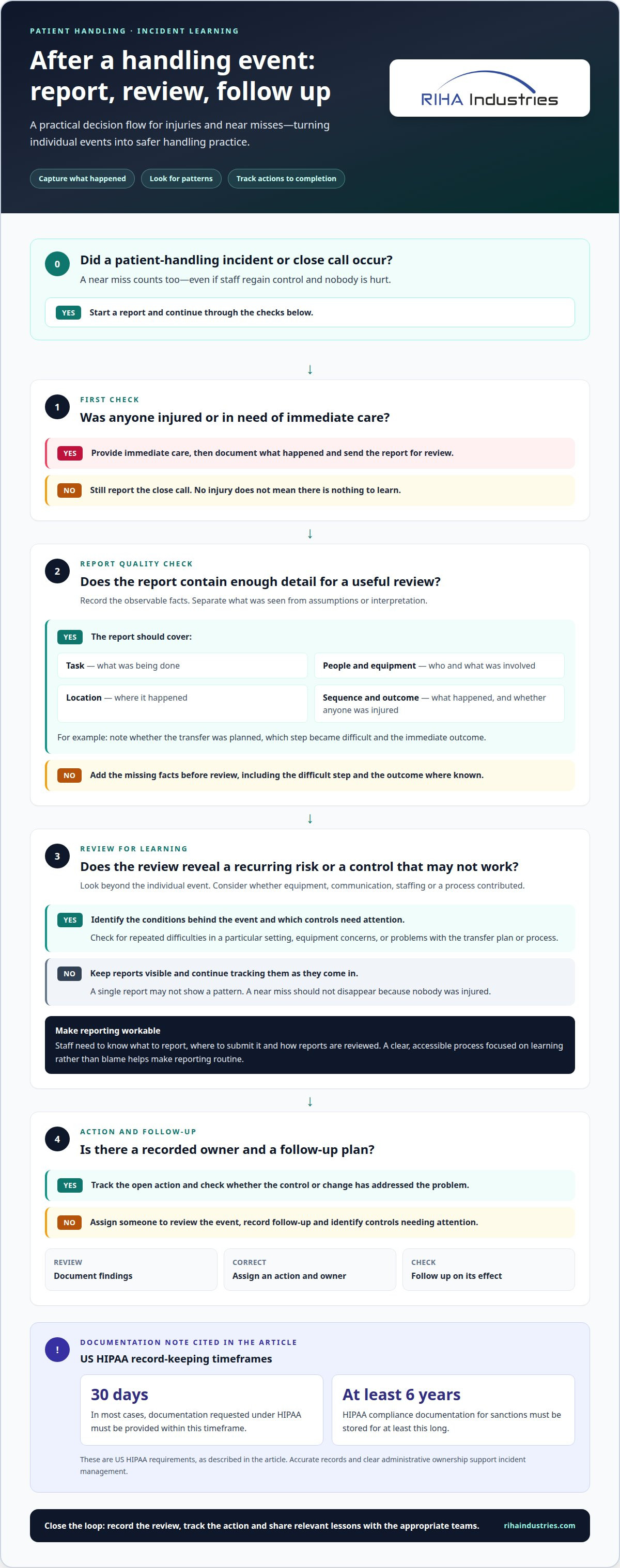
After a patient-handling injury or incident, provide immediate care, document what happened and send the report for review. Record near misses too, such as a transfer that became unstable but ended without injury. Reviewing both helps teams identify hazards before another event occurs. A clear reporting process turns individual experiences into information that can guide safer practice.
The scale of hospital errors reinforces why reporting matters. The National Library of Medicine states that 98,000 people die in any given year from medical errors in hospitals. That figure concerns medical errors broadly, not patient handling alone. Even so, a detailed report about a handling event can help reveal whether equipment, communication, staffing or a process contributed to the incident.
Make reports detailed enough to support a useful review. Record the task, people and equipment involved, location, sequence of events and immediate outcome. For example, note whether the transfer was planned, which step became difficult and whether anyone was injured. Separate observed details from assumptions so reviewers can distinguish evidence from interpretation.
Report close calls as well as injuries. A near miss might involve a patient slipping during repositioning, with staff regaining control before anyone is hurt. Such events can expose weaknesses in a transfer plan or show that a control is difficult to use in practice. A consistent process helps staff report these events, even when the outcome seems minor.
Culture affects whether useful information reaches the people who can act on it. Hospitals can encourage reporting by making the process clear, accessible and focused on learning rather than blame. Staff need to know what to report, where to submit it and how reports are reviewed. Clear arrangements can reduce uncertainty and make reporting part of routine healthcare practice.
After a report is submitted, assign someone to review the event and record follow-up. Reviewers can look for recurring circumstances, such as difficulties during transfers in a particular setting or repeated equipment concerns. Tracking reports as they come in helps teams identify open cases and outstanding actions. A near miss should not disappear from view just because no one was injured.
Documentation also needs disciplined handling. In most cases, documentation requested under HIPAA must be provided within 30 days, according to the U.S. Department of Health and Human Services. The same department states that HIPAA compliance documentation for sanctions must be stored for at least 6 years. These requirements make accurate records and clear administrative ownership important parts of incident management.
Close the loop on each report: document the review, identify controls that need attention and share relevant lessons with the appropriate teams. Staff should see that reports lead to consideration and follow-up. When hospitals consistently record injuries and near misses, patient-handling risk management can move beyond documenting events to learning from them.
2. Reviewing and improving controls
Safe patient-handling procedures should explain how staff assess a transfer, choose suitable equipment, communicate roles and respond when conditions change. Policies should also set out how to report an unsafe process and how managers review it. Clear steps support patient safety and give teams a consistent basis for decisions during routine care.
Hospitals can assess and reduce patient-handling risks by identifying hazards, considering their likelihood and impact, selecting controls, then checking whether those controls work. Assess the task, patient needs, environment, available equipment and staff capability together. This helps teams see where a control may fail in practice.
Start with the handling process. Map each stage, from preparing the space to completing the transfer, and identify where something could go wrong. For example, a control may rely on equipment that is difficult to access in a crowded room. A written procedure can look sound while the actual workflow encourages an unsafe shortcut.
Match controls to the risks they are meant to reduce. Hospitals can clarify responsibilities, make procedures easier to follow, provide relevant training and ensure equipment suits the task. Policies should explain what staff should do if the planned method cannot be followed, including when to pause and escalate the issue. This makes the process workable as conditions change.
Review more than the policy document. Observe how work is done, consider staff feedback and examine incident information for recurring process failures. If a transfer step regularly causes difficulty, assess whether the method, equipment access or communication needs improvement. Focus on the conditions behind the error, rather than treating each event as an isolated lapse.
When a weakness is identified, assign a corrective action and decide how to assess its effect. Corrective and preventive actions, often called CAPA, link a finding to an owner, a change and a follow-up review. For instance, assess a revised workflow through observation and staff feedback to see whether it can be applied reliably.
Review controls when technology, regulations, workflows or threats change. A procedure that suited an earlier layout may no longer fit a redesigned ward or altered transfer process. Regular policy reviews keep written guidance aligned with current practice, while ongoing monitoring shows whether controls remain effective after implementation.
Risk-management workflows can route findings, escalate overdue actions and record follow-up. These processes improve accountability and help teams see whether identified problems have been addressed. They also support audit readiness by keeping decisions and actions traceable.
Effective controls are not static. Hospitals strengthen patient safety by testing whether processes work for patients and staff, then adapting them when evidence reveals a gap. This disciplined approach can reduce errors and help manage the operational and liability risks associated with unsafe handling.
3. Risk indicators and cross-department communication
Risk indicators help hospital teams spot patterns that individual event reviews can miss. For patient handling, useful signals may include repeated transfer difficulties, equipment issues, staff injury reports or recurring delays in a workflow. Define each indicator clearly, identify a reliable information source and agree how it will be reviewed.
Bring risk, quality and patient safety teams into the same discussion. A handling concern might appear in an incident record, staff safety report or quality review. If departments examine only their own documentation, connections between records can remain hidden. Shared reviews help organisations understand how different operational signals relate.
Agree on what each indicator means before comparing information. For example, distinguish an equipment fault from difficulty accessing equipment during a transfer. These issues may need different responses, even if they affect the same task. Consistent definitions make discussions clearer and support more useful analysis across departments.
Connect the people who notice risks with those who can act on them. Clinical teams can describe how a handling process works in practice, while safety and quality staff identify recurring themes. Operational leaders can then consider whether workflow arrangements or access to resources contribute to the pattern. Each group brings a different perspective.
Use analytics to examine patterns over time and across settings. A cluster of similar reports in one ward may point to a local workflow issue. Similar concerns across departments may suggest a broader process weakness. These comparisons help teams focus on recurring risks, not just the latest event.
Prioritise indicators by considering their potential impact, how often they occur and whether existing controls address them. A repeated handling problem with clear consequences may warrant prompt review, even if reports describe different circumstances. Recording the reasons for prioritisation helps teams explain why some risks receive attention first.
Regular communication keeps risk strategies connected to current practice. Teams can share emerging patterns, clarify responsibilities and track agreed responses. A concise summary should identify the issue, supporting evidence, responsible team and next review point. This gives departments a shared reference without replacing detailed records.
Documentation makes cross-department decisions traceable. Record how teams interpreted an indicator, the actions they agreed and what later information changed their view. If staff keep reporting difficulty with the same transfer process, the pattern can prompt a focused review. Shared indicators therefore support coordinated decisions and more targeted risk management.
4. Workforce wellbeing and injury prevention
Safe handling supports staff wellbeing as well as patient safety. Hospitals can train staff to recognise risks during transfers, repositioning and other physically demanding tasks. Training is most useful when it reflects actual clinical workflows, available equipment and the needs of the patients being supported.
For transfers, repositioning and lifting, staff should assess the task, prepare the space, explain the movement and use suitable equipment. They should coordinate roles, communicate throughout and pause if the plan becomes unsafe. These practices help prevent avoidable physical strain and clarify responsibilities.
Training should build practical risk awareness, not just familiarity with written procedures. Staff need to recognise changing conditions, follow the agreed handling process and report equipment or workflow concerns. Scenario-based practice can help teams apply these steps, such as responding when a patient’s movement changes during repositioning.
Responsible training also accounts for different roles. Clinical staff need instruction relevant to their handling tasks, while team leaders need to know how to reinforce procedures and respond to reported barriers. Refresher learning can revisit key steps when workflows or equipment change. Staff feedback can reveal where instructions are difficult to apply.
Safe handling programmes need resources, including staff time, training, suitable equipment and ongoing maintenance. Benefits may include lower physical demands on workers, more consistent transfer practices and fewer handling-related disruptions. The balance depends on hospital needs, the tasks involved and how well the programme fits daily work.
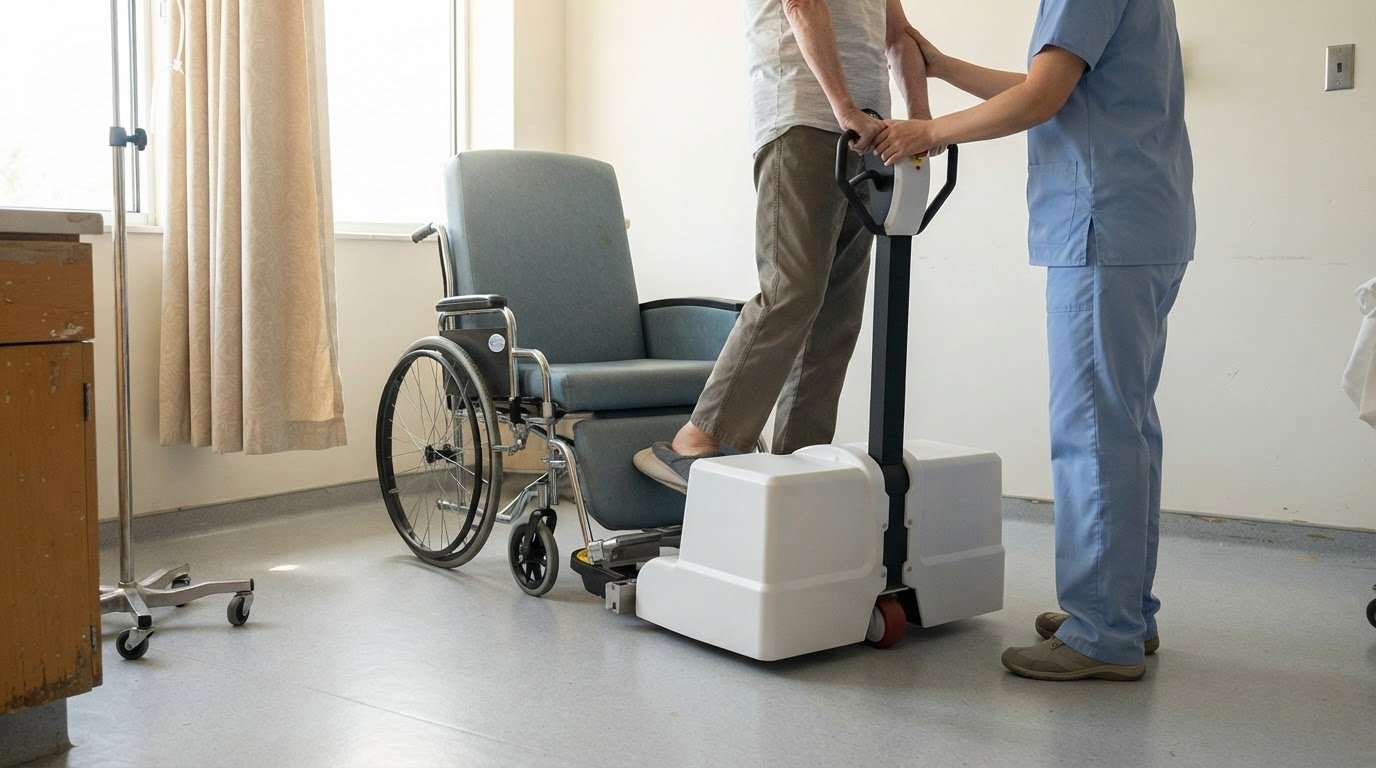
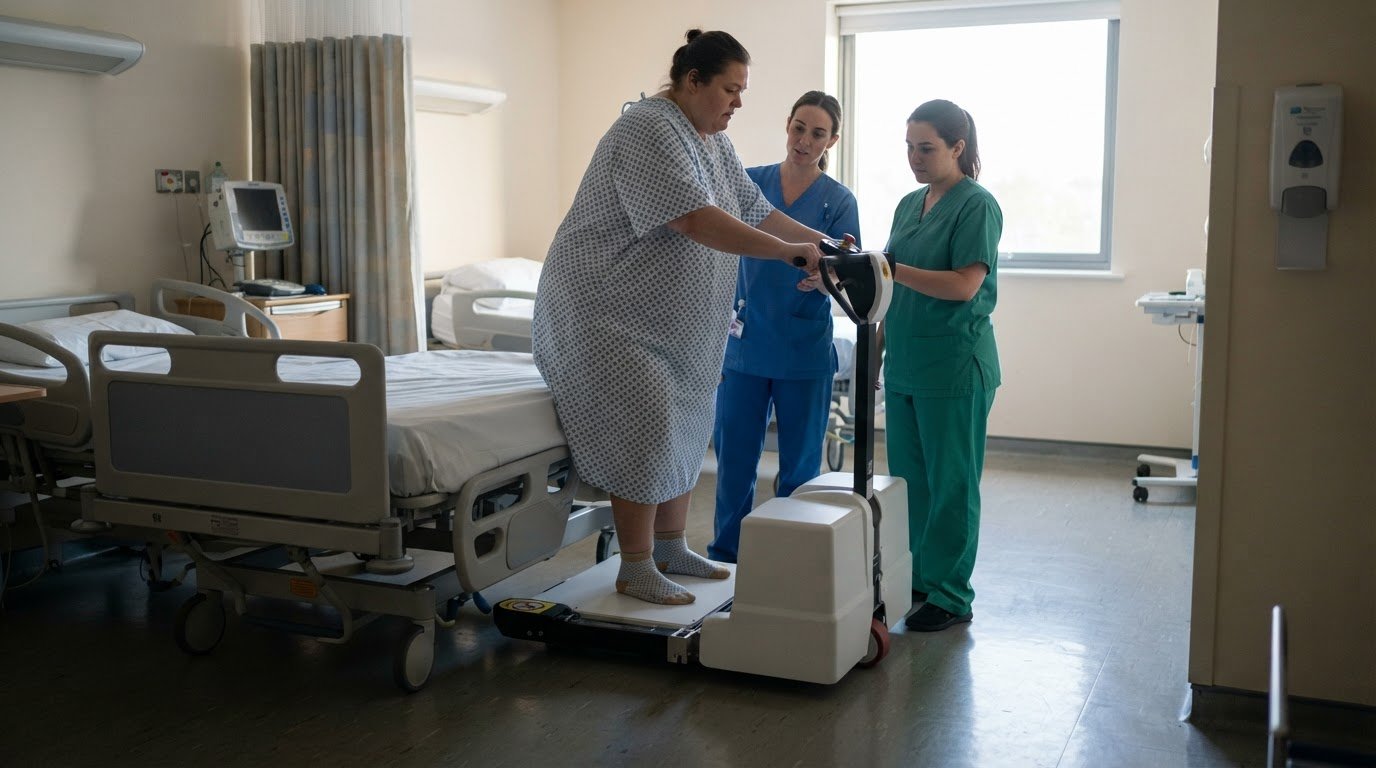
Equipment can form one part of this approach. The StaminaLift Transfer System 5000 and StaminaLift Transfer System 6000 are designed to integrate with existing hospital equipment. Their role in a handling plan should align with the transfer tasks, processes and staff training used in that setting.
Workforce wellbeing also depends on recognising conditions that make safe practice harder. Fatigue, time pressure, restricted space or unclear responsibilities may affect how a transfer is carried out. These factors deserve attention alongside equipment failures, so prevention addresses the work environment rather than placing responsibility on individuals alone.
Hospitals can include staff injury prevention in broader risk reviews. Consider reports of discomfort, near misses and recurring handling difficulties, then identify whether training, workflow or equipment access needs attention. This differs from medication safety, but both rely on clear processes and learning from failures.
To assess whether training is useful, managers can gather staff feedback, observe whether procedures are followed and review handling reports for recurring issues. If workers struggle to apply a step, the response may involve revising the process, improving equipment access or clarifying team roles. This keeps training grounded in real working conditions.
5. Gaps in traditional risk management
Traditional risk management can miss developing healthcare risks when it relies mainly on completed event reports. A report records what someone observed, but may not show how a routine process is changing. For example, repeated workarounds during transfers may increase exposure before an injury appears in formal records.
Risk can also be missed when departments assess information separately. A clinical team may notice transfer delays, facilities staff may track equipment faults, and workforce teams may record physical strain. Viewed alone, each signal can seem limited. Connecting them may reveal a shared handling issue that needs coordinated attention.
Lagging indicators have limits too. Injury counts and incident records describe events after they happen, so they cannot show on their own whether controls work during everyday tasks. Pair them with information about process conditions, such as equipment access or difficulties following a transfer plan. This gives leaders a clearer view of how risk develops.
Risk registers can become outdated when treated as static documents. A ward layout, patient needs or workflow may change while the recorded assessment stays the same. Assigning responsibility for scheduled reviews and changes in practice helps keep documented risks aligned with current conditions.
Another weakness is measuring completion instead of effectiveness. A policy may be distributed and training recorded, yet staff may still face barriers to applying the process. Leaders can address this by checking whether controls work in practice, listening to staff feedback and reviewing recurring problems. Evidence of activity is useful, but it does not prove a control works.
Risk tools can generate information without prompting action. If alerts, reports or follow-up tasks sit in separate systems, staff may not know who owns the next step. Clear responsibilities, escalation routes and recorded outcomes help turn information into decisions. Workflow systems can support this by routing actions and displaying unresolved issues.
Traditional approaches may focus on individual behaviour even when the underlying causes involve the work system. A staff member may depart from a procedure because equipment is hard to access or responsibilities are unclear. Reviewing these conditions helps hospitals address the source of risk, rather than relying only on reminders to follow policy.
Close these gaps by combining event information with ongoing monitoring, staff input and cross-team review. Assign leaders to evaluate controls and adapt risk strategies as practice changes. This broader view makes patient-handling risk management more responsive to emerging patterns, not only events already recorded.
Hospitals reviewing equipment-related handling risks can explore patient transfer systems as one part of their wider controls.
RIHA Industries
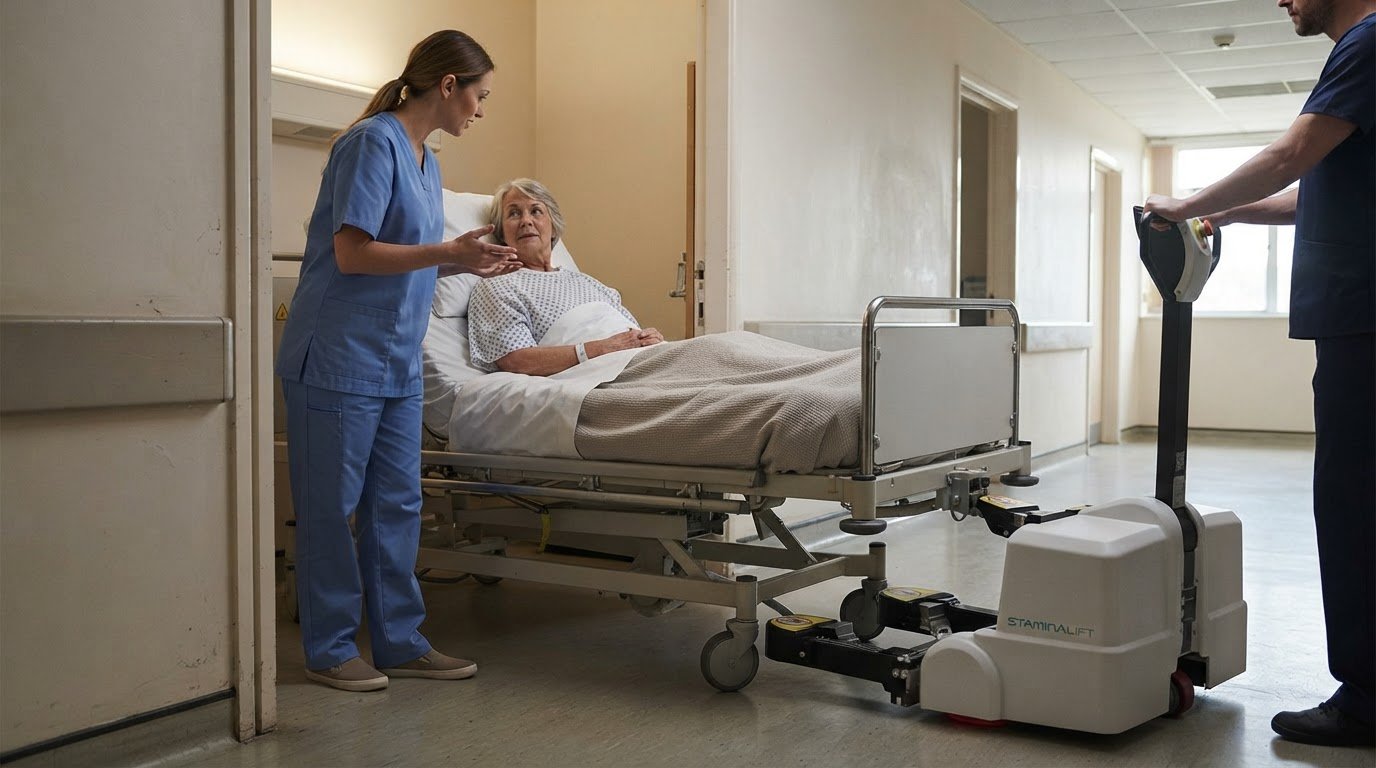
RIHA Industries designs and manufactures patient transfer systems and bed movers for healthcare settings. When a hospital reviews handling controls, these systems can be considered as part of the equipment and workflow assessment. The StaminaLift Transfer System 5000 and StaminaLift Transfer System 6000 are designed to integrate with existing hospital equipment. The StaminaLift 2100 Bed Mover is another option for hospitals reviewing how beds are moved. Selecting equipment should form part of a broader plan that considers transfer tasks, staff procedures and patient needs. Aligning equipment with established processes helps teams evaluate how it fits their approach to safer handling. Contact RIHA Industries to discuss patient transfer systems and bed movers for your hospital’s handling needs.
Build safety into everyday decisions
Safer handling becomes part of hospital practice when leaders treat it as an operational priority, not a separate project. Effective hospital risk management for patient handling depends on keeping responsibilities clear as teams, workflows and clinical environments change. The next step is to connect safety expectations with everyday planning, so staff can apply them during routine care as well as unusual situations.
Make patient handling a regular part of operational discussions. Bring relevant teams together to consider whether current practices remain workable, whether staff can raise concerns and whether follow-up actions are progressing. This connects safety with decisions about resources, processes and workforce support.
Equipment can contribute to that approach when it fits the tasks and workflows a hospital needs to support. RIHA Industries offers patient transfer systems and bed movers for healthcare settings.
Contact RIHA Industries to discuss patient handling and consider how suitable equipment can support your hospital’s approach. Thoughtful planning can help teams build safer handling into the way care is delivered.
Frequently Asked Questions
What Is Risk Management in Healthcare?
Healthcare risk management is the organised process of identifying, assessing and addressing risks that could affect patients, staff or hospital operations. It includes clinical concerns, such as medication errors, and operational issues, such as equipment failures. For example, a hospital might assess a transfer process, identify where a patient could lose balance, then decide how staff should reduce that risk and review the result.
What are the most common risks in healthcare organisations?
Common healthcare risks include medication errors, patient falls, infections, equipment failures, data breaches, staffing issues, communication problems, regulatory violations and system outages. Their effects can overlap: an outage may disrupt communication, while a staffing gap may affect transfer coordination. Grouping risks by clinical, workforce, technology and operational impact can clarify ownership and show which concerns need coordinated attention.
What are the real-world challenges hospitals face today?
Hospitals must manage connected pressures, including changing patient needs, staffing constraints, equipment availability and complex communication between teams. A transfer may require coordination between clinical care and transport, while a busy environment can make equipment difficult to access. Technology or workflow changes can create new points of failure. Leaders need to consider how these practical conditions affect daily work, not just whether written procedures exist.
What does hospital risk management cover for patient handling?
Patient-handling risk management covers the conditions and decisions that shape how patients are moved, from the transfer plan to staff coordination and equipment use. For instance, a patient whose mobility changes may need a different approach from the one planned earlier. A useful programme considers how staff recognise the change, communicate it to colleagues and adapt the process while maintaining continuity of care.
What are the main patient-handling risks in hospitals?
Key risks include a patient losing balance, staff using awkward body positions, equipment malfunctioning, restricted space and unclear team coordination. A crowded room, for example, may make it harder to position transfer equipment correctly. Risk may also increase when a patient’s needs change during a move. Considering the person, task, surroundings, equipment and communication together gives a more complete view of potential hazards.
What equipment reduces patient-handling injuries in hospitals?
Powered patient-transfer systems and bed movers can reduce the physical effort involved in moving patients or beds. The appropriate equipment depends on the task, the patient’s needs, the bed or transfer device, and the hospital’s workflow. Equipment should work alongside staff training and clear procedures, rather than replacing them. Hospitals can assess how a device fits the intended movement and the surrounding clinical environment.
What OSHA rules apply to patient handling and healthcare worker injuries?
Hospitals should align patient-handling procedures with the OSHA workplace-safety requirements that apply to their facility, alongside relevant state regulations, accreditation standards and internal policies. These requirements inform how employers manage workplace hazards and document safety processes. For implementation, connect injury-prevention procedures with staff training, equipment processes and incident records, and ensure responsible teams understand their roles.
How do hospitals measure patient-handling injuries and programme effectiveness?
Hospitals can assess outcomes by reviewing injury reports alongside near misses, staff feedback and observations of handling practices. They can also track whether agreed improvements are complete and whether the same difficulties persist. For example, recurring reports about a transfer task may show that a revised process needs more attention. Reviewing these measures together distinguishes completed actions from controls that work in practice.