Consequences of Poor Manual Handling in Healthcare: Risks and Responses
A routine bed move can create risks that reach far beyond the task itself. The consequences of poor manual handling in healthcare can include ongoing pain and injury for staff, disrupted care for patients and added pressure on already stretched teams. Safe Work Australia’s Key WHS Statistics Australia 2026 report found that body stressing accounted for 35.2% of serious workers’ compensation claims in 2024-25.
Repeated pushing, pulling and repositioning can gradually strain the body. If an injury leads to an absence or modified duties, colleagues may also need to take on extra work. In healthcare, where people and equipment need to be moved safely and reliably, these risks can affect staff wellbeing and service continuity. Training matters, but it may not be enough when a task continues to require significant physical effort.
This article looks at the physical, psychological and operational effects of unsafe handling, and how to assess recurring risks in everyday healthcare tasks. It also explains how changes to work systems and suitable equipment, including powered bed movers, can reduce physical demands as part of a broader risk-management approach.
Table of Contents
Consequences of poor manual handling in healthcare: what is at stake?
How poor manual handling affects healthcare workers’ health and wellbeing
How manual handling injuries affect patients, teams and healthcare services
How Australian healthcare facilities can respond to poor manual handling risks
How powered bed movers can help address manual handling consequences
Consequences of poor manual handling in healthcare: what is at stake?
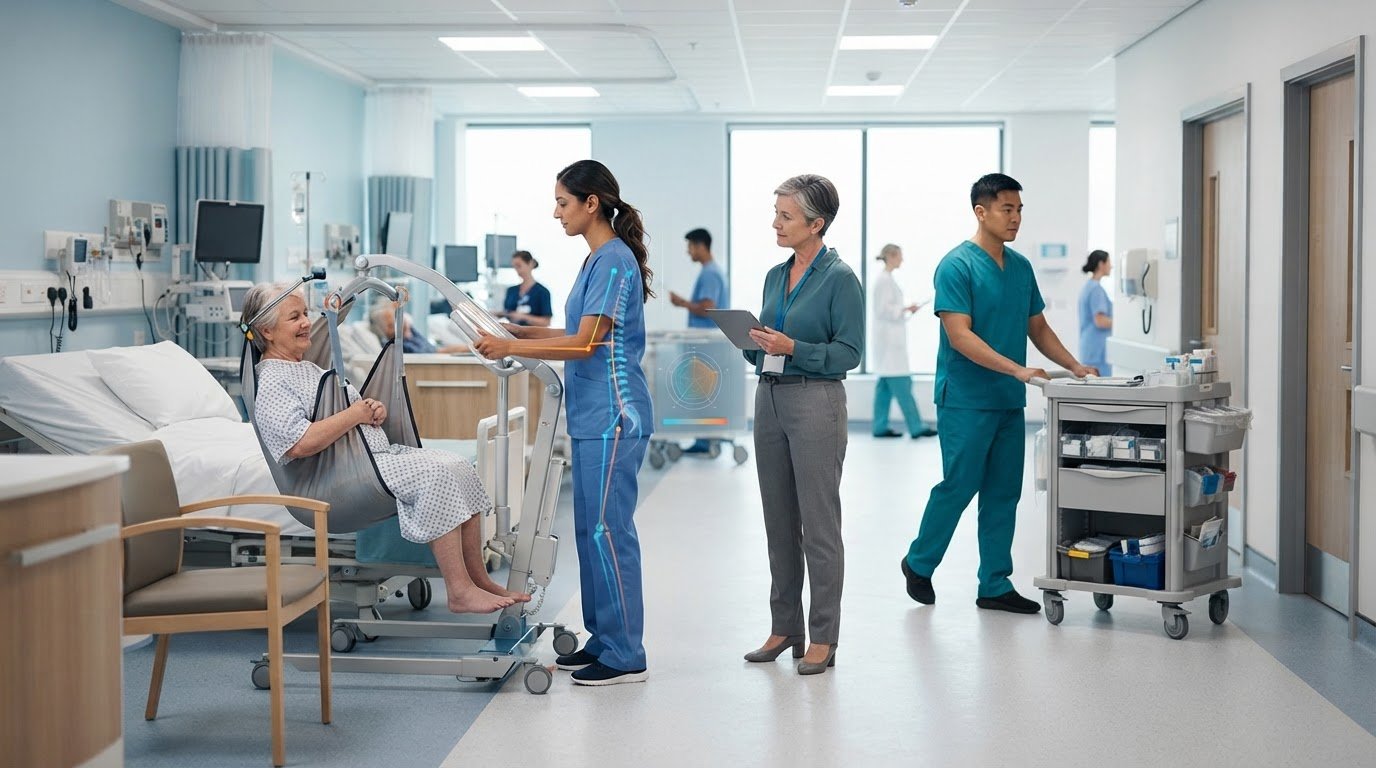
Healthcare work involves moving people and the equipment that supports their care. Poor manual handling occurs when workers face avoidable physical demands while lifting, lowering, pushing, pulling or otherwise moving a load. A person may need extra support because they can’t always assist or move predictably. A bed or trolley, meanwhile, can be difficult to manoeuvre through a crowded ward or tight doorway. The consequences of poor manual handling in healthcare can begin with one demanding movement and build across repeated tasks.
Definition: “Poor manual handling is preventable physical exposure created when the demands of lifting, lowering, pushing, pulling or moving a load aren’t adequately controlled.” The focus is on the exposure and how the task is organised, not on blaming a worker for an injury.
The general principles of Manual material handling (MMH) in healthcare help explain why force, posture and repetition matter. In clinical settings, these factors interact with patient needs, equipment and the layout of care spaces. Risk varies with the task and conditions, so don’t assume a routine movement places every worker under the same physical demands.
Which healthcare tasks create repeated manual handling exposure?
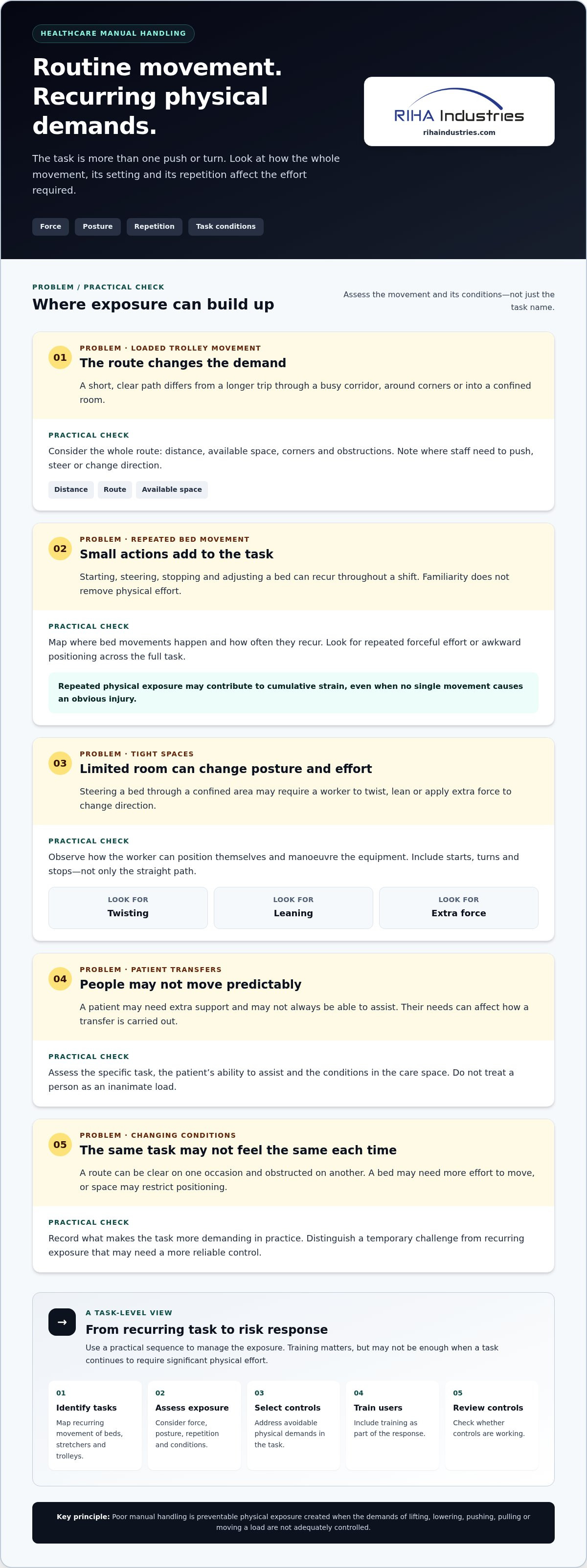
Exposure can arise during bed transfers, equipment repositioning or pushing a loaded trolley between rooms. The effort involved may vary with the load, distance, route and available space. A trolley pushed along a short, clear path presents different demands from one moved further through a busy corridor, around corners or into a confined room. Consider the whole movement, not just how it starts.
Bed and equipment movements can also recur throughout a shift. When staff repeatedly start, steer, stop or adjust a bed in limited space, each action contributes to the task’s overall physical demands. Patients aren’t inanimate loads: their ability to assist and the care they need can affect how a transfer is carried out. Assess the task and environment rather than relying on a broad description such as “moving a bed”.
Why routine movement can become a significant risk
Familiarity doesn’t remove physical effort. A worker may regularly push a trolley, reposition a bed or reach into a tight space, but the movement can still involve forceful exertion or awkward posture. One demanding manoeuvre differs from repeating similar movements across a shift. Repeated exposure can contribute to cumulative strain, even if no single movement causes an obvious injury at the time.
Conditions can change, too. A route may be clear on one occasion and obstructed on another. A bed may need more effort to move, or limited space may restrict how a worker can position themselves. These details help explain why the same task can feel manageable one day and more demanding the next.
For facilities, recognising the pattern is a useful first step. Identify where movement happens, how often it recurs and what makes it physically demanding. This task-level view helps distinguish a temporary challenge from recurring exposure that may need a more reliable control.
How poor manual handling affects healthcare workers’ health and wellbeing
A demanding transfer or forceful push can cause an immediate strain or sprain, while repeated physical effort may contribute to musculoskeletal disorders over time. These conditions affect muscles, joints, tendons and other structures involved in movement. The consequences of poor manual handling in healthcare can go beyond discomfort: pain or restricted movement may make routine tasks harder and affect a worker’s confidence in carrying them out.
“An immediate injury follows a particular event; cumulative strain develops through the combined effects of repeated physical exposure over time.” This distinction matters because discomfort may build gradually rather than appear after one clearly identifiable incident.
Musculoskeletal injuries and persistent physical strain
Forceful pushing or pulling can place demands on the back, shoulders and arms, while bending or reaching in an awkward posture can load muscles and joints unevenly. For example, a worker steering a bed through a tight space may need to twist, lean or apply extra force to change direction. The effect of a single movement varies, depending on the task, the worker and the conditions.
Symptoms can range from temporary soreness to pain that persists or limits movement. Repeated exposure may leave less time for the body to recover between physically demanding tasks. The Risks and prevention of WMSDs in healthcare information from the US National Institute for Occupational Safety and Health discusses work-related musculoskeletal disorders in the context of patient handling. It reinforces why physical demands should be considered as part of safe patient care, not treated as an unavoidable feature of the job.
Effects on confidence, work ability and wellbeing
Pain can affect how freely a person moves, how comfortable they feel during a shift and how readily they take on tasks they previously managed. A worker who has experienced discomfort during a transfer may also worry about aggravating it next time. That concern isn’t inevitable, but it can influence confidence, particularly if the task’s physical demands haven’t changed.
Work ability is shaped by the fit between a person’s health and the demands of their duties. If bending, pushing or repositioning becomes difficult, usual tasks may take more effort or need temporary adjustment. That can affect a worker’s sense of control and wellbeing, as well as their capacity to contribute across a shift. Not every worker with pain will experience the same limitations; symptoms and recovery vary.
Useful workplace responses start by taking discomfort seriously and examining the task, rather than expecting staff to simply push through. Facilities can ask which movements are uncomfortable, when symptoms arise and whether the same physical demand recurs. This information can help direct attention towards practical changes to the work system or equipment.
Where repeated bed movement is part of the physical demand being reviewed, facilities can explore powered bed moving solutions as one possible way to reduce manual effort.
How manual handling injuries affect patients, teams and healthcare services
A handling injury affects the worker first, but its effects can extend into the care environment. If a staff member is absent or working modified duties, a team may need to reorganise tasks, and routine movements may take longer to coordinate. These are possible flow-on effects, not automatic outcomes: an injury doesn’t mean a patient will experience harm or a service will be disrupted.
Consider the consequences of poor manual handling in healthcare across several connected groups. Separating direct impacts from potential flow-on effects helps facilities respond without overstating what any individual incident will cause.
Effects on patients and continuity of care
Patients have individual needs, so the effect on care depends on the circumstances, the task and the available team. If a worker can’t perform a transfer or repositioning task as planned, colleagues may need to coordinate support or adjust the timing. That can create a pause in a workflow, but it doesn’t mean care will be missed or a patient will be injured.
Patient safety and worker injury are distinct considerations. A worker’s strain is a direct health outcome for that worker; any effect on a patient is a separate possibility that depends on how the care task is managed. Clear communication and suitable staffing arrangements can help teams maintain continuity when duties change. The aim is to support safe care while recognising the real limits created by injury or restricted movement.
Operational pressures on teams and facilities
When a staff member is absent or on modified duties, the team may have to share their usual responsibilities. That can add pressure, particularly if other staff are already balancing patient care with repeated movement tasks. Bed transfers, equipment repositioning and trolley movements also take time. If these tasks require extra coordination or physical effort, they may compete with time for other responsibilities.
One absence doesn’t determine how a facility will operate. The effect depends on the role, the shift, available cover and the work that needs to be done. However, recurring injuries or repeated adjustments to duties can prompt managers to examine how tasks are organised, where delays arise and whether staff are carrying additional demands.
Equipment planning can form part of that review. Facilities assessing movement tasks across wards and support areas may find the hospital porter equipment guide useful for broader context. Reviewing equipment use alongside workflow can help identify practical opportunities to support staff and maintain coordinated care.
How Australian healthcare facilities can respond to poor manual handling risks
A practical response starts with the task, not an assumption that staff can manage every movement through technique alone. A facility can identify recurring demands, assess how workers are exposed, choose suitable controls, train users and review whether those controls are working. This sequence helps turn reported discomfort, near misses or difficult movements into useful information for safer work design.
Australian healthcare facilities should consult the WHS guidance that applies in their state or territory when setting their approach. Requirements and guidance can vary by jurisdiction, so avoid assuming that one procedural detail applies uniformly across Australia.
Assess recurring handling tasks before choosing controls
Build a clear picture of the movement before deciding what to change. Note the bed, trolley or other load; the route and distance; how often it moves; the staffing involved; and the physical effort required to start, steer and stop it. Record practical constraints such as tight turns or limited room to manoeuvre. Workers who perform the task can help identify demands that may not be obvious from a written procedure.
Record recurring difficulties and revisit the assessment if equipment, routes, staffing or workflow changes. A control that suits one movement may not address another, so assess the actual exposure rather than relying on a broad label such as “bed moving”.
Combine safe systems, equipment and worker instruction
Once risks are understood, consider controls that reduce the physical demands of suitable tasks. Equipment can reduce reliance on manual force for some movements, while safe work procedures can clarify roles and how a task should be carried out. Training helps workers use the agreed system and equipment appropriately, but it doesn’t remove the force or awkward movement built into a task by itself.
For repeated bed movement, powered assistance may be one engineering control within a broader risk-management approach. It should complement task planning and instruction, not replace assessment or be treated as a universal solution. When evaluating equipment, consider whether its attachment system suits the beds in use, whether it can be manoeuvred along the route and in the available space, and how it fits the workflow. Patient handling equipment selection criteria for nurse back injury prevention can also provide an equipment-focused reference, while the specific task remains central to the decision.
After introducing a control, gather feedback from the people using it. Check whether the movement is easier to manage, whether the equipment fits the workflow and whether any new difficulties have emerged. If the task remains physically demanding, adjust the approach rather than treating training as the final step. Ongoing review helps connect risk controls with day-to-day practice and respond as care environments change.
Facilities assessing repeated bed movements can explore powered StaminaLift bed movers as one possible way to reduce manual effort within a wider safety system.
How powered bed movers can help address manual handling consequences
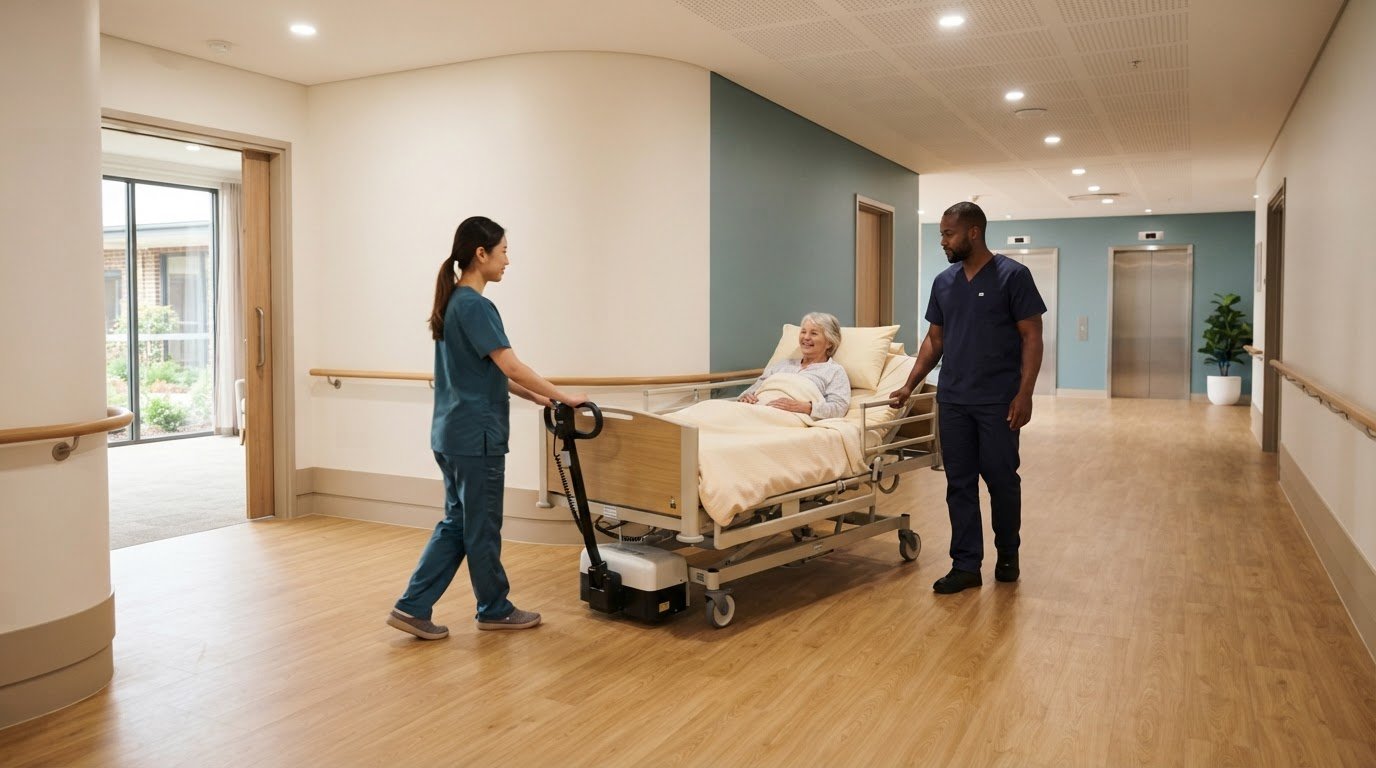
Repeatedly moving beds can demand physical effort that adds up across a shift. Where an assessment identifies this as a recurring risk, powered assistance may help reduce the manual force required for suitable bed movements. It’s one possible engineering control, not a replacement for reviewing the task, organising work safely or training staff to use equipment correctly.
This matters because the consequences of poor manual handling in healthcare can extend from individual discomfort or injury to staffing and workflow pressures. Reducing the physical demands of a repeated movement may support safer work, but the right approach depends on the task, equipment and care environment.
What a powered bed mover changes in the task
StaminaLift is a battery-powered bed mover with joystick controls and patented attachments. It connects to nearly any bed, stretcher or trolley and enables single-person operation. By providing powered assistance for equipment movement, it can reduce reliance on manual force during suitable bed-moving tasks. It doesn’t remove every handling demand or replace the need to assess the movement and train users.
Facilities can identify where repeated bed movement creates physical effort, then assess whether powered assistance suits the route, equipment and workflow. The StaminaLift Transfer System 5000 buying guide provides product-specific detail for teams evaluating this type of equipment.
Evidence, implementation and next steps
RIHA Industries reports that a large South Australian hospital saw injuries from moving beds fall from 20 per year to zero within two years of implementing StaminaLift. This is a reported result from one hospital, not a guarantee that another facility will achieve the same outcome. Local results depend on the tasks involved and how equipment is introduced and used.
Implementation works best as part of a broader risk-control process. Facilities can identify which bed movements recur, how much manual effort they involve and how powered equipment would fit established procedures. They can then train relevant users and review whether the equipment addresses the identified physical demands. Staff feedback can help reveal practical issues that may not be obvious during initial planning.
RIHA Industries was recognised as Top Hospital Bed Movers and Accessories Manufacturer 2025 by MedTech Outlook. This is a company credential, not evidence that a particular facility will achieve a specific injury outcome. Decisions should remain grounded in the facility’s own task assessment and review of controls.
For facilities assessing recurring bed movements, discuss safer equipment movement with RIHA Industries as a practical next step in considering powered assistance within a wider approach to reducing physical demands.
Turn safer handling into a practical next step
Reducing the consequences of poor manual handling in healthcare starts with a clear decision about what to improve next. Choose a recurring movement that staff find physically demanding and make it the focus of a practical review. Observe how the task is carried out, listen to the people doing it and consider whether equipment or workflow changes could reduce unnecessary effort.
Progress doesn’t require every challenge to be solved at once. A focused review can help a facility identify a useful first step, put an appropriate control in place and learn from staff experience as it’s used. That steady approach supports safer work while keeping patient care and everyday operations in view.
RIHA Industries’ healthcare mobility solutions can be part of that assessment when repeated bed movement is a concern. Explore RIHA Industries’ healthcare mobility solutions and take a considered step towards safer equipment movement for your team.
Frequently Asked Questions
What are the most common consequences of poor manual handling in healthcare?
Common consequences include strains, sprains and musculoskeletal disorders, especially where a task involves repeated force or awkward positioning. Pain or restricted movement can affect a worker’s comfort and ability to carry out usual duties. If someone needs time away or modified duties, colleagues may need to adjust task allocation. The consequences of poor manual handling in healthcare vary, so assess the movements and conditions involved rather than assuming every task carries equal risk.
Can poor manual handling affect patient care?
It can affect care indirectly if an injury changes staff availability or interrupts a routine, such as a planned bed transfer. The effect depends on the task, staffing and how the facility adapts its workflow. An incident doesn’t automatically mean a patient is harmed. Teams can support continuity by communicating changes in capacity, coordinating who will carry out affected tasks and reviewing recurring movements that may be contributing to disruption.
Does manual handling include pushing hospital beds and trolleys?
Yes. Manual handling includes pushing and pulling, not just lifting or carrying. Moving a bed from a ward to imaging, steering a trolley around a tight corner or repositioning equipment can all require physical effort. The demands depend on factors such as the load, route, distance and posture. Assess the complete movement, including starting, steering and stopping, rather than focusing only on whether someone lifts an object.
Can manual handling injuries develop over time?
Yes. An injury may occur during a particular movement, while repeated exposure to forceful tasks or awkward positions may contribute to cumulative strain. For example, discomfort might build across recurring repositioning tasks rather than begin with one obvious incident. People respond differently, and exposure doesn’t mean an injury is inevitable. Record recurring discomfort or difficulty, then review the task and whether its controls are working as intended.
Is manual handling training enough to prevent injuries in healthcare?
No. Training can help staff follow task procedures and use equipment correctly, but it doesn’t remove physical effort that remains part of the task. Facilities should also assess the movement itself and consider suitable controls, including equipment where appropriate. For example, if staff repeatedly push beds along a demanding route, review the route and handling process as well as instruction. Refer to the applicable state or territory WHS guidance for jurisdiction-specific requirements.
Can powered bed movers guarantee that manual handling injuries will stop?
No. A powered bed mover may reduce physical effort during suitable bed-moving tasks, but it can’t guarantee that injuries will stop. Outcomes depend on the task, the work environment, implementation and other controls. RIHA reports that a large South Australian hospital reduced injuries from moving beds from 20 per year to zero within two years of implementing StaminaLift. This is a specific case study, not a promise of the same result elsewhere.
What should a healthcare facility do after a manual handling injury?
Follow workplace incident and injury reporting procedures, support the worker and review the task involved. Consider what was being moved, the route, equipment, staffing and work method, and whether existing controls need adjustment. For instance, a difficult turn or an obstructed path may help explain why a movement required extra effort. Reporting and notification requirements can differ between jurisdictions, so consult relevant workplace procedures and applicable state or territory regulator guidance.