
Easi Mover: The Definitive Guide to Powered Hospital Trolley Movers in 2026
- Jul 14
- 11 min read
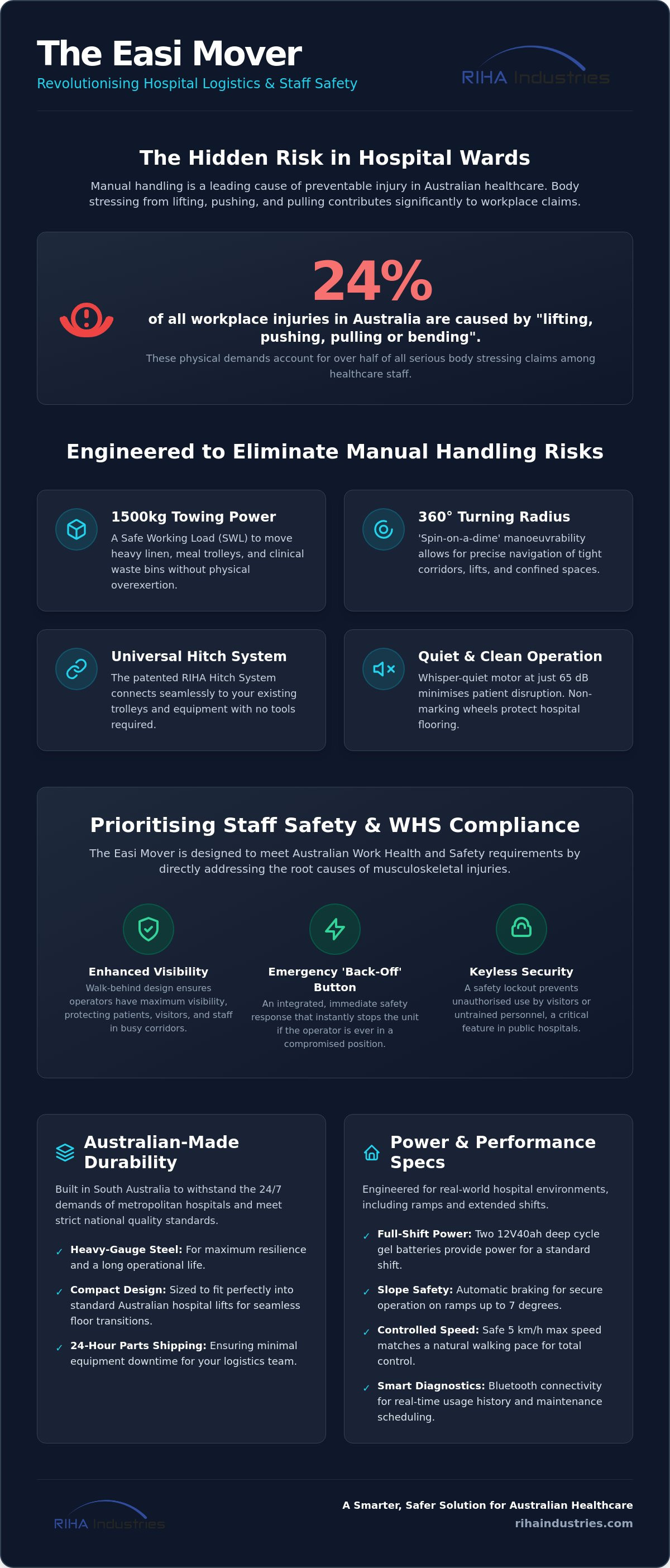
Did you know that "lifting, pushing, pulling or bending" accounts for 24% of all workplace injuries in Australia? In the high-stakes environment of a modern ward, these physical demands contribute to more than half of all serious body stressing claims among healthcare staff. When your porters are tasked with navigating heavy equipment through tight corridors and lifts, a reliable hospital trolley mover becomes more than just a tool; it is a critical safeguard for your team's wellbeing.
We understand that managing heavy loads while protecting staff from musculoskeletal injuries is a constant challenge for facility managers. Discover how the Easi Mover eliminates manual handling risks and transforms hospital logistics with 1500kg of precision-controlled towing power. We will examine how this durable, Australian-made solution helps you meet the latest TGA safety reporting requirements while driving efficiency across every ward transfer.
Table of Contents
What is the Easi Mover? Revolutionising Hospital Logistics
The Easi Mover represents a fundamental shift in how healthcare facilities manage internal logistics. It's a compact, walk-behind motorised hospital trolley mover engineered specifically to handle the heavy, repetitive tasks that often lead to staff fatigue and burnout. By providing a 1500kg Safe Working Load (SWL), this equipment ensures that even the most demanding loads, like bulk linen or clinical waste bins, are moved with precision. RIHA Industries developed this technology with a clear mission. They're dedicated to improving the daily lives of healthcare professionals through smarter mobility that prioritises human wellbeing over manual labour.
Why Walk-Behind Tugs are Essential for Wards
Maintaining safety in a busy clinical environment requires constant spatial awareness. While ride-on platforms might seem faster, they're often too bulky for standard ward doorways and can limit an operator's perspective. A walk-behind design prioritises maximum visibility. It allows porters to navigate crowded corridors without compromising the safety of patients or visitors. This configuration also facilitates better social interaction; porters can maintain eye contact and clear communication with staff while in transit. For added protection, the integrated 'Back Off Button' provides an immediate safety response. It stops the unit instantly if the operator is ever in a compromised position, ensuring that the hospital trolley mover remains a supportive tool rather than a hazard.
Australian-Made Durability for Demanding Facilities
Reliability is non-negotiable in metropolitan hospitals that operate 24 hours a day. Every Easi Mover is constructed from heavy-gauge steel to withstand the constant demands of supply distribution. Because these units are manufactured in South Australia, they're built to meet strict national quality standards. This local engineering ensures the equipment is perfectly sized for the Australian context. The compact dimensions allow the mover to fit effortlessly into standard hospital lifts, ensuring seamless transitions between floors. As a specialised medical device, it integrates into existing workflows while providing the durability that facility managers require. Choosing an Australian-made solution means you're investing in a partner that understands the specific architectural and regulatory rigours of our local healthcare system.
Key Features and Technical Specifications of the Easi Mover
Efficiency in healthcare logistics relies on equipment that combines brute strength with surgical precision. The Easi Mover provides a 1500kg towing capacity, allowing porters to move the heaviest clinical waste and supply bins without physical overexertion. This high Safe Working Load (SWL) ensures that even bulk linen transfers or heavy meal trolley runs don't result in staff fatigue. Its 360-degree turning radius enables 'spin-on-a-dime' manoeuvrability, which is vital in confined lift lobbies where space is at a premium. Unlike larger industrial tugs, this unit can rotate within its own length, making it ideal for the architectural constraints of older hospitals.
Beyond raw power, this hospital trolley mover respects the clinical environment. It features non-marking drive wheels to protect expensive hospital flooring and maintain high hygiene standards, as scuffs and marks can harbour bacteria. At just 65 dB, the motor operates quietly. This ensures minimal disruption to patient rest and recovery, even during night-shift transfers. Ensuring the right equipment is available is a cornerstone of Improving Staff Safety, as it reduces the cumulative strain on a porter's body over a long career.
Power and Performance on Hospital Inclines
Moving heavy loads isn't just about flat surfaces. The Easi Mover is equipped with two 12V40ah deep cycle gel batteries, providing enough charge for a full standard shift. Safety is paramount on ramps, so an automatic braking system ensures secure operation on slopes up to 7 degrees. The drive speed is set to a safe 5 km/h, which matches a natural walking pace and keeps the operator in total control. This speed limit is a deliberate safety feature, preventing the momentum of a 1.5-tonne load from becoming unmanageable in public areas.
Smart Technology and Security Features
Modern facilities require secure and intelligent tools. Keyless control with a safety lockout prevents unauthorised use by visitors or patients, a critical feature in high-traffic public hospitals. Bluetooth connectivity allows for real-time diagnostics and usage history, helping managers identify staff training needs or schedule preventative maintenance. Charging is simplified with an integrated charger and a retractable cable. It's a true 'plug and play' system that fits into any standard power outlet, eliminating the need for bulky external charging stations. You can view the complete hospital trolley mover specifications to determine the best configuration for your specific ward layout.
The RIHA Hitch System: Achieving Universal Compatibility
One of the most significant barriers to implementing a motorised solution is the sheer variety of equipment found in a single facility. From legacy linen carts to modern clinical supply bins, a hospital trolley mover must be adaptable to be truly effective. RIHA Industries addresses this through a patented, tool-free hitch range. This system allows porters to switch between different trolley types in seconds, facilitating rapid ward transfers without the need for manual adjustments or specialised tools. It's about providing a seamless transition between tasks, ensuring that logistics staff can focus on movement rather than mechanical troubleshooting.
The design prioritises the physical health of the operator at every point of contact. Foot-operated adjustable hitches mean staff don't have to bend or crouch to secure a load. Since "lifting, pushing, pulling or bending" caused 24% of work-related injuries in Australia during the 2021-22 period, this small engineering choice has a massive impact on long-term staff wellbeing. For highly specialised equipment like theatre tables, custom modifications can be engineered. This ensures a perfect, secure fit every time, even for high-stakes equipment that requires extra care during transit.
Pin, Adjustable, and Electric Hitches Explained
Understanding which attachment suits your fleet is essential for operational efficiency. Each hitch type is designed to solve a specific workplace challenge:
Pin Hitch: This is the go-to choice for most linen, meal, and store trolleys, featuring a robust 22mm diameter pin for secure towing.
Adjustable Hitch: Designed for versatility, this foot-operated mechanism accommodates round or square frames ranging from 20mm to 40mm.
Electric Adjustable Hitch: For the ultimate reduction in physical burden, this version offers push-button height adjustment. It completely eliminates manual handling strain during the coupling process, making it a favourite for staff who perform hundreds of transfers per week.
Easi Mover vs. Easi Rider: Selecting the Right Tug
Choosing between a walk-behind and a ride-on unit depends on your facility's specific layout and transit requirements. The Easi Mover is the superior choice for shorter distances and tight ward environments. Its walk-behind configuration provides the precision handling needed in crowded areas where visibility is paramount. You can easily navigate around beds, drip stands, and other medical equipment without the bulk of a ride-on platform.
In contrast, the Easi Rider is designed for long-distance porting across expansive metropolitan campuses. If your porters are travelling hundreds of metres between buildings or through long basement tunnels, the ride-on capability significantly reduces operator fatigue and speeds up turnaround times. When deciding, consider your narrowest corridor width, the total transit distance, and the volume of transfers expected per shift. This ensures your hospital trolley mover fleet is perfectly tailored to your hospital's unique architectural constraints and staff requirements.
Improving Staff Safety and WHS Compliance in Australia
Safeguarding the workforce is a primary obligation for any healthcare executive. In Australia, musculoskeletal disorders (MSDs) remain the leading cause of lost time for portering staff. Integrating a motorised hospital trolley mover into daily operations does more than just speed up transfers; it fundamentally changes the risk profile of the facility. Manual handling injuries place a heavy burden on hospital budgets, with costs extending far beyond initial workers' compensation claims. These incidents often lead to high staff turnover and the significant expense of hiring agency replacements to fill gaps in the roster.
Real-world results demonstrate the effectiveness of shifting away from manual labour. In one South Australian hospital, the implementation of specialised motorised assistance saw bed-moving injuries drop to zero. This success story highlights the value of proactive intervention rather than reactive injury management. For a deeper look at protecting your team from long-term strain, read our guide on how to reduce porter back injuries. By removing the physical peak loads associated with starting and stopping 1.5-tonne trolleys, you're investing in the long-term health of your most valuable asset.
Ergonomics in the Modern Clinical Environment
The physical demands on porters are often underestimated by those outside the department. It's common for staff to walk up to 15km per shift while pushing heavy, awkward loads. A hospital trolley mover reduces this physical burden, allowing for efficient single-person operation. Tasks that previously required two porters to manage safely can now be handled by one, increasing operational efficiency without increasing injury risk. There's also a significant psychological benefit. Using 'smiler' equipment that reduces physical exhaustion leads to a more engaged and positive workforce, as staff no longer finish their shifts in physical pain.
Meeting National Manual Handling Standards
Compliance with Australian WHS manual handling guidelines is a legal requirement for every healthcare facility. The Easi Mover is engineered to meet these rigorous standards through specific safety features. Integrated emergency stop buttons and automatic braking systems are critical components in risk mitigation, providing immediate protection in unpredictable ward environments. To ensure long-term success, RIHA Industries provides comprehensive training and certification support for all new equipment. This ensures your team is both confident and competent in using the technology safely. You can consult with our team to discuss a safety audit for your facility's current trolley movements.
Why Choose RIHA Industries for Your Mover Needs?
Selecting the right equipment is only the first step; securing a reliable long-term partnership is what ensures operational continuity. RIHA Industries positions itself as a Visionary Expert in the field, offering FDA-registered technology that meets the highest international standards. When you invest in a hospital trolley mover from RIHA, you're backed by a company that understands the high-stakes nature of healthcare logistics. This global authority is grounded in practical results, ensuring that every unit delivered is capable of meeting the rigorous demands of a modern clinical environment.
Equipment downtime can disrupt an entire ward's supply chain, which is why RIHA offers a 24-hour shipping guarantee for all essential parts. This commitment provides immediate relief to facility managers, knowing that maintenance issues won't lead to prolonged service interruptions. To further support your team, the RIHA website features advanced 3D and AR tools. These allow for remote servicing and spatial visualisation, helping your maintenance department understand the mechanical layout before they even pick up a tool. It's a thoughtful approach to engineering that prioritises ease of use and rapid resolution.
Sustainability is also at the heart of RIHA's manufacturing philosophy. Through 'Engineering Sustainability', the company utilises 3D-printed spare parts where appropriate, reducing waste and ensuring that even legacy equipment can be maintained for years to come. This forward-thinking strategy ensures that your investment remains viable in the long term, reflecting a mission-driven focus on durability and technical excellence.
National Service and Global Support Network
Support is never far away, regardless of your facility's location. RIHA provides comprehensive preventative maintenance and repair services across all Australian states. By dealing directly with the manufacturer, you gain access to superior technical support and a deeper level of product expertise. This direct engagement model is particularly beneficial for rural health facilities. These teams can use the online 3D viewer tool to collaborate with RIHA's engineers, ensuring that even remote hospitals receive world-class support for their hospital trolley mover fleet.
Next Steps: Trials and ROI Calculations
Proving the value of new technology requires clear data. We encourage facilities to use our online ROI calculator to see the tangible labour savings and reduction in injury-related costs that motorised tugs provide. It's a simple way to build a business case based on proven financial outcomes. If you're ready to see the equipment in action, you can book a hands-on demonstration within your own hospital environment. This allows your porters to experience the precision and power of the Easi Mover first-hand. For a broader look at modernising your logistics, explore our ultimate guide to hospital porter equipment to see how integrated solutions can transform your facility's safety culture.
Transforming Healthcare Logistics for a Safer Future
Implementing the Easi Mover is a strategic commitment to both operational efficiency and the long-term health of your portering team. By providing 1500kg of precision-controlled power and universal compatibility through patented hitch systems, this equipment removes the physical peak loads that lead to chronic musculoskeletal injuries. It's about empowering your staff to navigate complex environments with confidence and ease, ensuring that heavy transfers no longer dictate the physical limits of your workforce.
As a certified Australian-made and FDA-registered manufacturer, RIHA Industries has already delivered zero-injury results in Australian hospital trials. We're dedicated to helping you meet modern WHS standards while streamlining ward transfers across your entire campus. If you're ready to see how a high-performance hospital trolley mover can protect your team and improve logistics, we're here to support that transition. Relief and empowerment are within reach through thoughtful engineering designed specifically for the clinical front line.
Book an obligation-free Easi Mover demonstration at your facility today to experience this world-class technology first-hand. We look forward to partnering with you to create a safer, more efficient clinical environment for everyone.
Frequently Asked Questions
What is the maximum weight the Easi Mover can tow?
The Easi Mover is engineered with a Safe Working Load (SWL) of 1500kg, which allows it to transport the heaviest clinical waste bins and linen trolleys effortlessly. This high capacity ensures that your facility can manage bulk supply transfers without the risk of manual handling injuries to staff. By providing this level of towing power, the unit eliminates the physical peak loads that often lead to long-term musculoskeletal issues.
Does the Easi Mover require a special licence to operate in Australia?
No specialised heavy vehicle or machinery licence is required to operate this walk-behind tug in Australian healthcare facilities. While it's a powerful tool, it's designed for ease of use by any portering or logistics staff member. We provide comprehensive training and certification support for all personnel to ensure they're confident in using the hospital trolley mover safely within crowded ward environments.
Can the Easi Mover handle ramps and inclines in older hospital wings?
Yes, the unit is designed to safely navigate inclines and ramps up to 7 degrees. An integrated automatic braking system provides immediate security, preventing the load from rolling back and ensuring the operator remains in total control even on the uneven surfaces common in legacy hospital buildings. This feature is essential for maintaining safety when moving 1.5-tonne loads through varied architectural layouts.
How long does the battery last on a single charge for a standard shift?
Equipped with two 12V40ah deep cycle gel batteries, the unit typically provides enough power for a full 8-hour shift under normal operating conditions. The integrated battery charger features a retractable cable, making it easy to plug into any standard power outlet for "top-up" charging during staff breaks. This ensures the equipment is always ready for the next ward transfer without requiring bulky external charging stations.
Is the Easi Mover compatible with different brands of linen and meal trolleys?
Universal compatibility is achieved through our patented RIHA hitch system, which connects to almost any globally available trolley brand. Whether you use pin-style linen carts or square-frame meal trolleys, our adjustable and electric hitches ensure a secure, tool-free connection every time. This flexibility allows your facility to modernise its logistics without needing to replace your entire existing fleet of trolleys.
How does the 'Back Off Button' safety feature work for operator protection?
The 'Back Off Button' is a critical safety mechanism located on the handle that instantly stops and reverses the unit if it comes into contact with the operator. This provides immediate protection in tight spaces or lift lobbies, ensuring the hospital trolley mover remains a supportive tool that prioritises staff wellbeing. It's a key component of our commitment to zero-injury results in the workplace.
What kind of preventative maintenance does an electric tug require?
To ensure 24/7 reliability, we recommend regular inspections of the non-marking wheels, battery health checks, and testing the emergency stop functions. RIHA Industries offers specialised Preventative Maintenance and Repairs to keep your fleet in peak condition and identify potential issues before they cause downtime. Our Bluetooth diagnostics also allow for real-time tracking of usage patterns to help schedule these services effectively.
Where is the Easi Mover manufactured and serviced?
Every unit is certified Australian-made, manufactured at our facility in Edinburgh North, South Australia, to meet strict national quality standards. We maintain a comprehensive national support network that provides repair services across all states. This local presence is backed by a 24-hour shipping guarantee for essential spare parts, ensuring that your facility faces minimal equipment downtime and receives rapid technical support.


