Electric Bed Movers for Aged Care Facilities
The most powerful option is not automatically the right one. Choose an electric bed mover for aged care facilities by matching its bed compatibility and manoeuvrability to the beds, corridors, doorways and lifts it must navigate. The right fit should also support residents’ mobility needs and staff handling practices during routine and urgent moves.
Moving beds efficiently matters, but safe movement depends on more than motor performance. Turning space, doorway clearance and lift dimensions can determine whether a mover works smoothly across your facility.
This guide explains how to assess bed and mover compatibility, facility access, fall-risk considerations and caregiver safety. It also covers urgent moves, how to compare options with daily requirements, and when specialist bed-moving equipment may help your team move beds with greater control.
Table of Contents
Fall risks and caregiver injury prevention
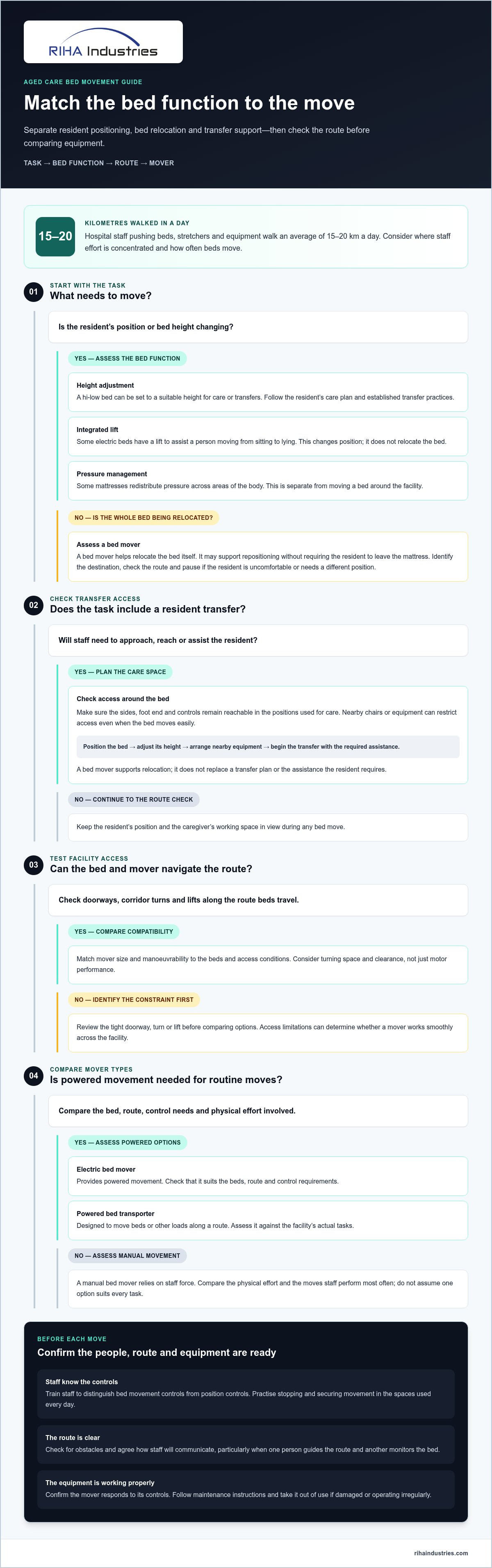
Bed movement affects residents’ access to care and the physical demands on caregivers. Assess bed height, transfer access and route conditions together, rather than treating the mover as a standalone purchase.
Caregiver support and nursing height
Electric hospital beds can be raised to help caregivers transfer and lift patients. Adjusting the bed to a suitable working height can reduce awkward reaching during tasks such as repositioning a patient or changing bedding. A bed mover does not perform these care tasks; it helps move the bed itself.
Before choosing equipment, identify when staff need to move beds and when they need access to residents. A bed may need to be positioned for care, then moved clear of a doorway. Keep the resident’s position and the caregiver’s working space in view at every step.
Access for patient transfers
Clear space around the bed helps caregivers approach a patient and manage a transfer. Check whether the bed’s sides, foot end and controls remain reachable in the positions used for care. A tight space beside a chair, for example, can limit access even when the bed moves easily.
Plan the sequence: position the bed, make the required height adjustment, then arrange nearby equipment before beginning the transfer. A bed mover supports relocation, but it does not replace a transfer plan or the assistance a patient requires. This distinction helps staff avoid treating bed movement as a substitute for safe transfer practices.
Caregiver bed mobility controls
Caregivers need to know which controls move the bed and which adjust its position. Keep these functions distinct during staff instruction: demonstrate the bed’s movement controls, then practise stopping and securing movement in the spaces staff use every day.
Safe operation requires training suited to the equipment and route. Assign trained staff to operate the mover, explain the controls and practise a routine move before using it around residents. Include how staff communicate during a move, particularly when one caregiver guides the route and another monitors the bed.
Mover type comparisons
A manual bed mover relies on staff force, while an electric bed mover provides powered movement. A powered bed transporter is designed to move beds or other loads along a route. Compare options based on the bed, route, control needs and physical effort involved in routine moves.
Hospital staff pushing beds, stretchers and equipment walk an average of 15-20 km a day. That workload makes it practical to examine how often beds move and where staff effort is concentrated. Ask whether the equipment supports the facility’s actual bed movements, rather than assuming every powered option suits every task.
Include risks, maintenance and inspections in safe-use procedures. Before each move, check the route for obstacles and confirm the mover responds to its controls. Follow the equipment’s maintenance instructions, and take it out of use if you notice damage or irregular operation. Record concerns and arrange preventative maintenance and repairs as needed.
Benefits for people with limited mobility
For a resident with limited mobility, bed movement is only one part of maintaining access to care. Consider the resident’s usual position, transfer method and the space staff need to work. Moving a bed to create space beside a chair, for instance, may improve access for a planned transfer while the resident remains supported on the mattress.
Some electric hospital beds have integrated lifts to assist users moving from a sitting to a lying position. This function supports a change in position; it is separate from a bed mover, which relocates the bed. When comparing equipment, define each task clearly: does the resident need help changing position, does staff need to move the bed, or are both needed?
Hi-low bed adjustment can help caregivers set the bed at a suitable height for care or transfers. Consider the sequence staff follow, such as lowering the bed to help a resident get into position, then raising it for care tasks. The right setting depends on the task and the person’s mobility, so staff should follow the resident’s care plan and established transfer practices.
A bed mover can support facility routines by helping staff reposition a bed without requiring the resident to leave it. Before moving, identify the destination and check that the route is clear of chairs, walking aids and other equipment. If a resident is uncomfortable or needs a different position, pause and address that need before continuing.
Keep residents’ mobility needs separate from mattress functions. Some electric beds have pressure management systems that redistribute pressure across different areas of the body. This function does not move the bed around the facility. For example, a resident may use a pressure management mattress while staff use separate equipment to relocate the bed and improve room access.
To assess suitability, walk through a typical care scenario with staff: note the resident’s position, the bed adjustments required, the transfer space and the route to the next location. This practical review can reveal whether integrated lift functions, hi-low adjustment or powered bed movement addresses the real task. Explore bed movement equipment considerations as part of that assessment.
Match the equipment to the resident and the task, not just the bed. A resident who can sit but cannot reposition independently may have different needs from someone who needs help with every transfer. Document these differences in the facility’s equipment assessment, then consider how each bed function supports daily care without replacing individual assistance.
Emergency controls and power-failure options
For powered bed movers in US healthcare facilities, applicable requirements depend on the equipment’s intended use and classification. Assess relevant federal, state and local rules alongside the manufacturer’s instructions and facility procedures.
Emergency control options
Emergency controls should allow trained staff to stop movement promptly if a route becomes blocked or a resident needs attention. During an equipment assessment, locate the stop control and confirm staff can identify it quickly from the operating position.
Practise a realistic scenario, such as a doorway becoming blocked during a move. Staff should know who operates the control, who attends to the resident and how the bed remains secure. Record these steps in the facility’s moving procedure and include them in staff training.
Power-failure options
A power interruption can affect powered movement or motorised bed adjustment, depending on the equipment. Identify what stops working, whether the bed remains stable and what the manufacturer instructs staff to do. Do not assume a mover has a battery or manual override; these functions depend on the specific equipment.
Include a power-loss scenario in the facility’s emergency procedure. Staff should stop the task, keep the resident supported and follow the equipment instructions before attempting further movement. If the bed is blocking an exit, follow the site’s emergency plan rather than improvising a manual move.
Keep bed movement distinct from bed adjustment. A mover relocates the bed; the bed’s motorised functions may change its height or position. A caregiver may use a remote to adjust the bed while a separate control operates the mover. Label the controls clearly during staff orientation, especially when both systems are used in one room.
Remote controls can make routine adjustments easier, but usability depends on clear buttons, understandable functions and convenient storage. Ask staff to demonstrate a familiar task, such as raising the bed before care and returning it to the required position. Check that the remote is not confused with the bed-mover controls.
Resident independence matters too. A resident who can operate an adjustment control may benefit from changing position without waiting for assistance. Set access according to the resident’s abilities and care plan, and show caregivers how to support that choice without taking over the controls unnecessarily.
Before routine use, include three checks in staff practice: identify the correct control, confirm the intended movement, and agree who watches the resident and the route. These steps help prevent accidental operation and clarify responsibilities. Review the procedure whenever equipment changes or staff notice recurring confusion.
For ongoing readiness, assign responsibility for reporting faults and following the manufacturer’s maintenance instructions. A damaged control, unexpected movement or failed adjustment should prompt staff to stop using the affected function and follow facility procedures. Clear reporting helps maintenance teams address issues before the next planned move.
Fall-risk and low-height features
Assess bed height and rails alongside each resident’s mobility and care routine. Neither feature replaces an individual care plan. Review how the resident gets into and out of bed, where staff provide assistance, and what position the bed needs for rest and care.
A typical ideal bed height for an older person is 20 to 23 inches from the floor to the top of the mattress. Use that range as a comparison point when assessing beds, not as a universal setting for every resident. Mattress thickness affects the measured height, so measure from the floor to the mattress surface rather than the bed frame.
Low-height settings change the distance between the mattress and floor. Consider the resident’s feet, transfer method and ability to move independently before choosing a resting position. A resident who stands from the bed, for example, may need a different setup from someone who transfers with staff assistance. Record the preferred position in the care plan and communicate it across shifts.
Bed rails also need an individual assessment. Consider why a rail is being used, how the resident moves and whether it affects access for transfers or care. A rail may provide a handhold for one resident, while another may need clear access beside the mattress. Match rail use to the resident’s needs and care plan instead of treating rails as a standard fall-prevention measure.
Check the complete bed arrangement, not just one feature. Review rail position, mattress fit, bed height and access to the call system. If the mattress changes, reassess its height and relationship to the rails. A change to one component can affect how the resident interacts with the whole bed, so record the review and share updated instructions with caregivers.
Before moving a bed, confirm its intended position. Staff may need access to one side for care, followed by a lower resting position. Keep the mover’s role separate from bed adjustment: the mover moves the bed across the room, while the bed’s own controls change its height. This distinction helps staff follow the planned setup.
Use a practical review process: observe the resident’s usual bed entry or transfer, measure mattress height, assess rail use and document the preferred setup. Repeat the assessment when mobility or equipment changes. A clear record gives caregivers a consistent reference and keeps the bed configuration aligned with the resident’s current routine.
Bed mover size and hospital lift access
The right mover must fit both the bed and the route, including the lift. Measure the complete journey before selecting equipment, because turning space can matter as much as corridor width.
Electric bed movers used in aged care include powered units that couple to a bed and powered transporters designed to move beds or other loads. Their mechanisms, bed connections and steering methods differ. Choose according to the facility’s actual task, not the equipment label alone.
Compatibility depends on the hospital bed’s frame, base and connection points. A mover designed for one bed interface may not attach to another without an adaptor. Compare the specific bed models in use, then assess whether the connection stays secure during turns and travel. Do not assume a mover suits every hospital or long-term care bed.
Build a route checklist before assessing mover dimensions:
Measure doorway clearances and note door swings.
Record corridor widths and the tightest turn.
Measure lift door openings, internal dimensions and thresholds.
Consider the bed, mattress and attached equipment as one moving load.
A hospital lift needs more than enough floor space for the bed. Staff must also manoeuvre the mover through the entrance, clear the lift doors and position the bed without blocking access. A bed that enters straight ahead, for example, may still be difficult to turn inside the lift. Trial the route with the intended equipment and a representative bed.
Turning capability matters in corridors and doorways. A 360-degree turning radius is listed for the StaminaLift TS5000, supporting manoeuvring in hospital corridors and doorways. Compatibility also matters: the TS5000 is incompatible with two beds without an adaptor. These examples show why facilities should compare the mover’s dimensions and bed interface against their own equipment and routes.
In the United States, electric bed mover prices depend on the case and are given after a quote request; key factors include mover type, bed compatibility, adaptors and facility access requirements.
For a practical selection, document each bed model and route constraint, then match them to the mover’s connection and turning requirements. Review the StaminaLift 2100 Bed Mover and Easi Mover against those operational needs, and discuss bed mover options for your facility.
Compatibility is model-specific: choose a mover whose connection suits the bed’s frame, base and connection points, and use an adaptor if required. Powered units that couple to a bed and transporters designed to move beds are options, but do not assume any mover will fit every hospital or long-term care bed.
RIHA Industries: StaminaLift Transfer System 5000
RIHA Industries’ StaminaLift Transfer System 5000 helps facilities assess powered bed movement against their existing equipment and access needs. Its 360-degree turning radius supports manoeuvring in hospital corridors and doorways, making route layout a practical part of selection.
Compatibility still matters: the TS5000 is incompatible with two beds without an adaptor. Compare your bed models and connection requirements before choosing a system. For other bed-moving needs, RIHA Industries also offers the StaminaLift 2100 Bed Mover and StaminaLift Transfer System 6000. The right option depends on the beds in use and the movements staff need to complete.
Contact RIHA Industries to discuss bed-moving equipment for your facility.
Make your next equipment decision part of a lasting plan
Turn your assessment into a practical equipment brief to guide purchasing and future facility planning. Record the tasks the mover must support, who will operate it and how staff will learn its controls. A shared brief gives decision-makers a consistent reference instead of leaving each team to interpret requirements differently.
An electric bed mover for aged care facilities should suit daily operations as well as the current equipment plan. Consider how room changes, new care routines or replacement beds could affect its role over time. A clear brief helps your team compare options against its priorities and explain the reasoning behind its decision.
RIHA Industries offers bed-moving systems for healthcare settings. If you’re ready to discuss which option may suit your facility’s needs, contact RIHA Industries about bed movers.
A considered next step helps your team plan with greater clarity and confidence.
Frequently Asked Questions
Which bed mover should you choose?
Choose a mover that suits the bed fleet, routine workload and facility layout, rather than selecting by power alone. For an electric bed mover for aged care facilities, start by identifying the beds staff move most often and the tasks that create the greatest handling burden. Then compare connection compatibility, manoeuvrability and operator controls. Trialling a representative bed on the intended route can reveal practical issues before the facility adopts the equipment.
What are the weight capacity, speed, and battery runtime of leading bed movers?
Capacity varies by model and task: the StaminaLift Transfer System 5000 is rated for a 300 kg lift and 600 kg push or pull, while the StaminaLift Transfer System 6000 is rated for a 450 kg lift and 900 kg push or pull. Speed and runtime are model-specific operating details. Compare them against the loaded bed, route length, gradients and stop-start use your facility expects.
How can an aged care facility assess its corridors, elevators, and bed fleet before choosing a mover?
Run a route audit with facilities staff and a representative bed. Record the narrowest doorway, tightest turn, lift entrance and any thresholds, then note where doors or parked equipment reduce clearance. Create a bed-fleet register listing each bed model, frame type and connection points. A trial route can reveal pinch points, awkward alignment or access conflicts that a floor plan alone may miss.
Which electric bed movers are compatible with hospital and long-term care beds?
Compatibility depends on the specific bed and mover. The StaminaLift TS5000 is incompatible with two beds without an adaptor.