Evidence Based Practice for Safer Patient Handling and Lift Choices
Manual patient handling is a leading risk for overexertion injuries. Safer lift decisions depend on the person’s abilities, the task and the care environment, not a therapist’s strength alone. Evidence-based practice for safe patient handling brings these factors together with suitable assistive equipment, staff training and clear policies to reduce avoidable strain while supporting patient care.
Physical therapists and assistants already weigh risk and function when planning movement. The challenge is applying that clinical judgement in real working conditions, where space, equipment access and changing patient needs can affect what is safe. A no-manual-lift policy can set expectations, but it works best within a broader programme that makes suitable equipment accessible and supports staff to use it.
This article explains how evidence informs lift choices, what to consider when matching assistive equipment to a task, and how policies and training contribute to injury prevention. It also explores how physical therapists and assistants can help shape safer handling practices in their workplaces.
Table of Contents
Manual-lifting injury risks for physical therapists and assistants
Manual lifting exposes physical therapists, assistants and other healthcare workers to injury during routine patient movement. Evidence-based practice safe patient handling uses the task, the person’s abilities and the work environment to guide safer decisions.
Musculoskeletal risks from manual handling
Manual patient handling means supporting or moving a person by hand or bodily force, including pushing, pulling, carrying, holding or supporting a body part. These actions can repeatedly strain muscles and joints, particularly during transfers and repositioning.
Physical therapists and assistants face this risk while helping patients move, even when movement is part of treatment. Government statistics across the U.S. highlight significant injury rates in the sector. Those figures show why clinical skill must be paired with safer handling methods.
Manual lifting is the single greatest risk factor for overexertion injuries in patient handling. A patient who can take part in a transfer may still need substantial support, so staff must consider the force required and whether the person’s abilities could change during movement.
Preventing strain during patient movement
Preventing strain means planning movement around the patient’s abilities, the task and the limits of the care space. A transfer that looks straightforward can become difficult if the patient cannot bear weight, the route is restricted or staff must reach across equipment.
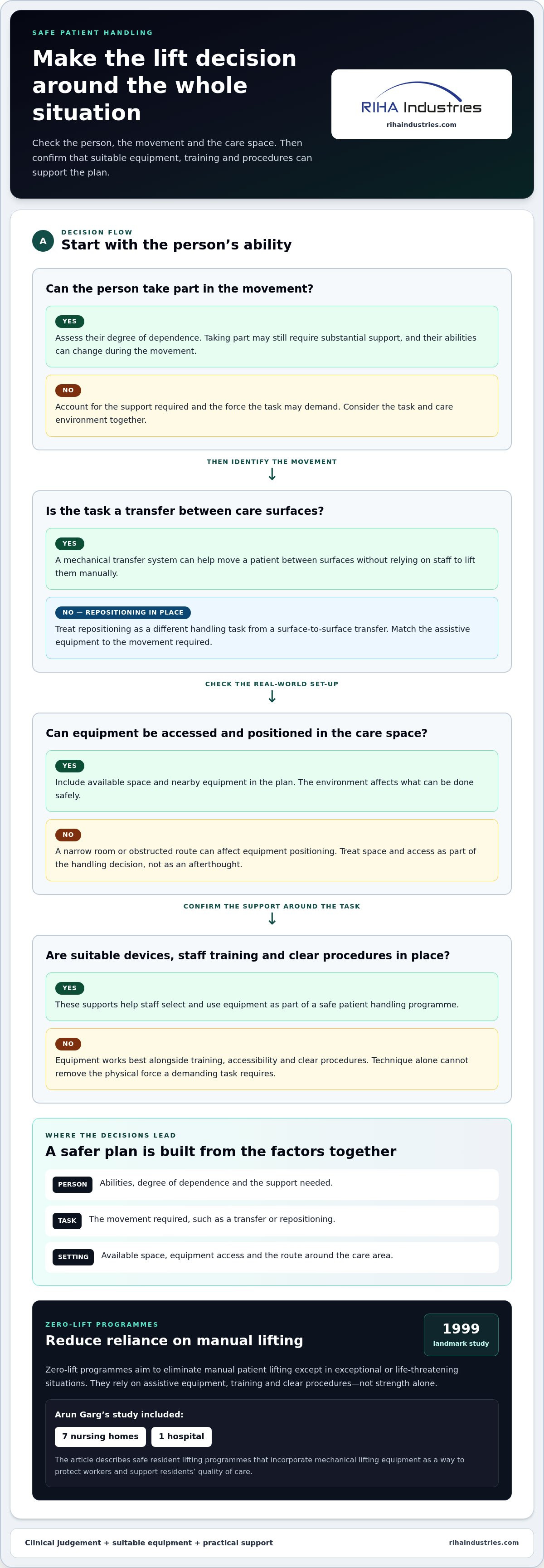
Assess the patient’s degree of dependence before choosing how to support movement. Someone who can assist with repositioning presents a different handling task from someone who needs full support. The care environment matters too: available space and nearby equipment affect what can be done safely.
Legislation such as Washington House Bill 1672 demonstrates how injury prevention can be treated as an organisational responsibility, not only an individual worker’s technique, supporting initiatives advocated by organisations like RIHA Industries.
Zero-lift programmes and staff protection
Zero-lift programmes aim to eliminate manual patient lifting except in exceptional or life-threatening situations. Reducing reliance on bodily force can limit workers’ exposure to high-strain tasks and support more consistent handling practices.
A landmark zero-lift programme study by Arun Garg was conducted in 1999 and included seven nursing homes and one hospital. Safe resident lifting programmes that incorporate mechanical lifting equipment can protect workers from injury, reduce workers’ compensation costs and improve residents’ quality of care.
Zero-lift does not mean ignoring movement or patient needs. It means making assistive equipment, training and clear procedures part of the response, rather than expecting staff to manage a demanding lift through strength alone.
Training and mechanical lifting equipment
Training helps staff recognise risk and follow handling procedures, while mechanical lifting equipment can reduce the physical force a task requires. They work best together: training helps workers select and operate suitable equipment, while equipment addresses physical demands that technique alone cannot remove.
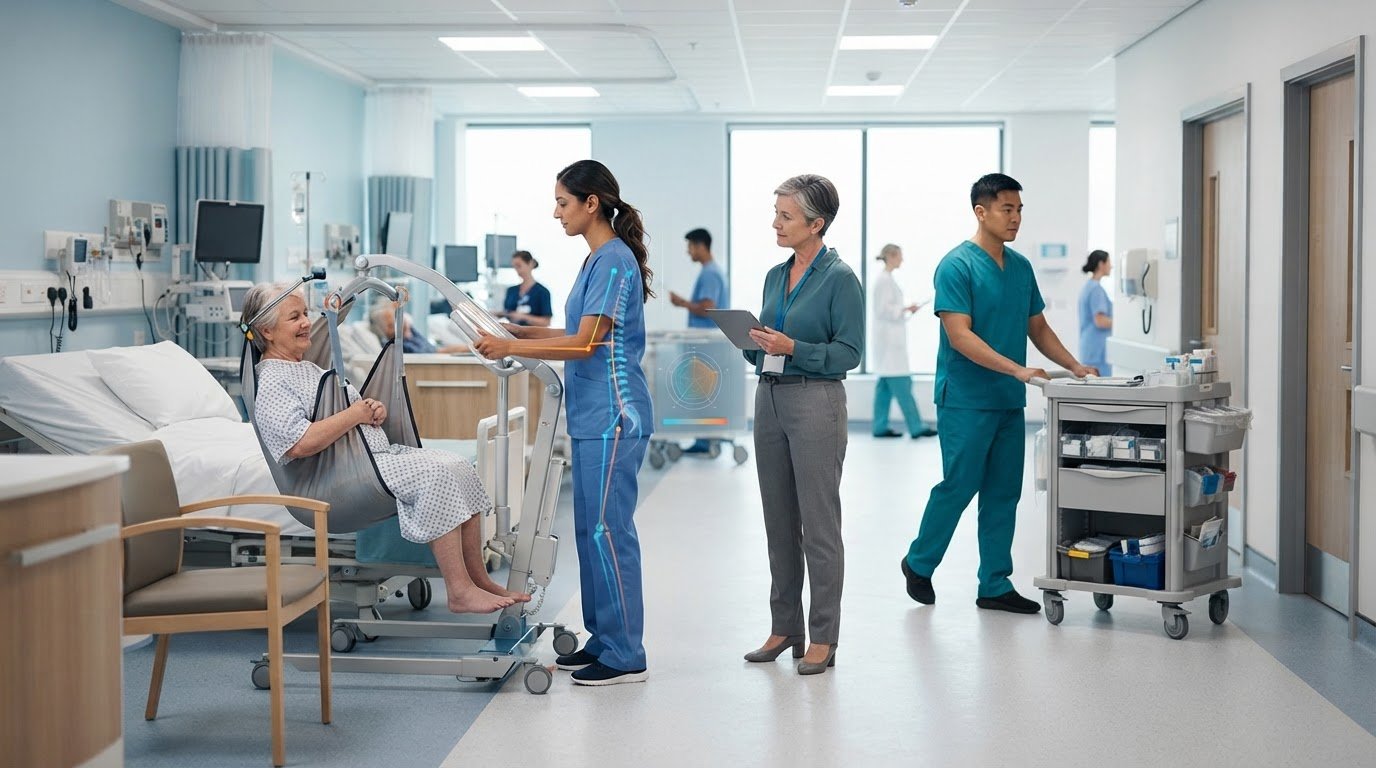
Assistive lifting devices can help healthcare workers handle patients while reducing injury risks to themselves and their patients. Employers can support safer practice by making devices accessible, training workers to use them and encouraging their use within a safe patient handling programme.
The cost of patient lifts and safe handling programmes depends on equipment needs, the care environment, training and ongoing maintenance; the price depends on the case and is given after a quote request. Assess return on investment by weighing programme costs against potential reductions in injuries, compensation costs and time away from work, rather than assuming a fixed saving.
Safe patient handling equipment and assistive devices
Assistive equipment can reduce the physical force staff use during patient movement. The right choice depends on the task, the patient’s needs and the hospital environment.
Engineering controls for patient handling
Engineering controls are equipment and workplace arrangements that reduce physical demands at their source. They matter because training alone cannot remove the force required to support a dependent person.
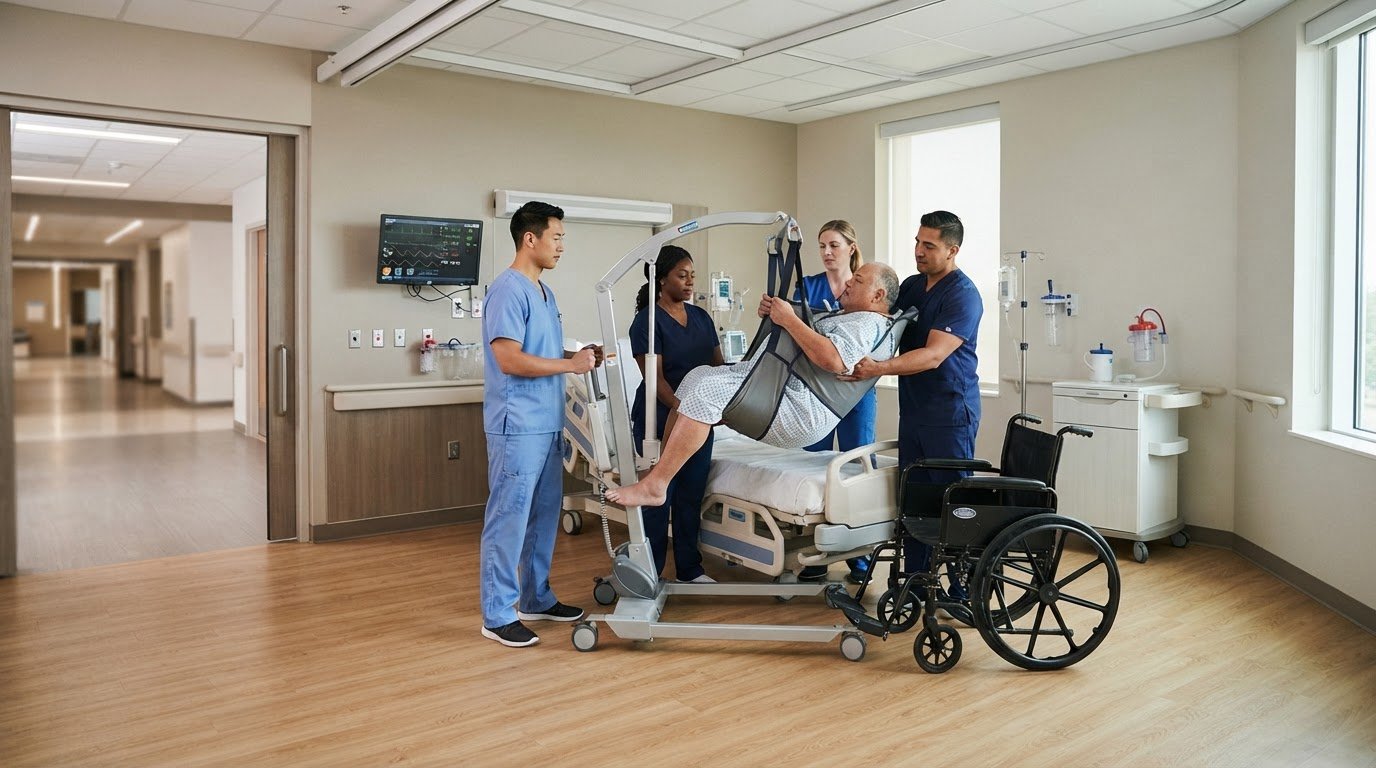
For example, a mechanical transfer system can help move a patient between care surfaces without relying on staff to lift them manually. The equipment supports the movement; staff still need appropriate procedures, training and access to devices when required.
In US workplaces, safe handling programmes can combine accessible assistive devices, staff training, active encouragement to use equipment and clear procedures. The Association of Rehabilitation Nurses describes 11 U.S. states as having passed laws or regulations requiring safe patient handling policies. This state-level context is relevant when organisations implement guidelines and equipment programmes.
Equipment for patient transfers
Assistive transfer equipment supports a patient’s movement while reducing the physical load on workers. Matching the device to the transfer matters: moving between a bed and another surface differs from repositioning someone in place.
Before a transfer, consider the person’s degree of dependence, the movement required and the available space. A narrow room or obstructed route can affect equipment positioning, while the patient’s ability to participate can shape the support needed. These practical factors help staff incorporate equipment into the transfer plan.
Barriers can prevent equipment use even when a device is available. It may be difficult to access, unsuitable for the space or unfamiliar to staff. Training should cover the actual equipment and transfer tasks workers encounter, not just general lifting advice.
Implementation also depends on workplace procedures. Staff need to know where equipment is stored, how to access it and which process applies to a particular movement. Regular training helps workers apply procedures consistently, while management support makes equipment use a normal part of care, not an optional extra.
Safe patient handling equipment includes more than a single type of lift. RIHA Industries’ StaminaLift Transfer System 5000 and StaminaLift Transfer System 6000 are designed to integrate with existing hospital equipment. Consider patient transfer systems when assessing how equipment can fit into a facility’s handling approach.
Mechanical devices and staff training address different parts of the risk. Equipment reduces the force involved in lifting and transfers; training helps staff use it appropriately in the care environment. Together, they support a practical programme rather than treating manual technique as the only safeguard.
Safe lift decisions and no-manual-lift policies
Safe lift decisions weigh the patient’s ability, the movement required and the handling risks. In the United States, 11 states have passed laws or regulations requiring safe patient handling policies, according to the Association of Rehabilitation Nurses; national no-lift policies aim to eliminate manual patient lifting except in exceptional or life-threatening situations.
Risks of manual lifting and repositioning
Manual lifting and repositioning use workers’ bodily force to support or move a patient, creating injury risks for both parties. For healthcare workers, patient handling is a leading risk factor for overexertion injuries. For patients, a transfer that relies on staff strength can be harder to control if their ability to assist changes during movement.
The risk isn’t limited to a full lift. Pushing, pulling, holding or supporting a body part can also place physical demands on staff. A patient who can partly assist may still need substantial support during repositioning, so the planned technique should reflect their current abilities and the task, not assumptions based on an earlier transfer.
Patient harms from manual handling
Patient harm can occur when manual handling makes a transfer difficult to control or places avoidable strain on the person being moved. Safe handling must protect the patient as well as the worker.
For example, a patient who cannot bear weight may need more support than a manual technique can safely provide. Assistive lifting devices can help workers perform handling tasks while reducing injury risks to themselves and patients. The patient’s degree of dependence and the available space should inform the movement plan.
Manual techniques can persist despite known risks. One cited evaluation found that 98% of nurses used the “Hook and Toss” or “Drag Lift” technique, while a cited survey found that 83% of nurse educators in the United States taught it. The technique had been deemed unsafe since 1981, underscoring why established habits need review.
State approaches are not identical. The Association of Rehabilitation Nurses describes 11 U.S. states as having laws or regulations requiring safe patient handling policies. Washington approved legislation through House Bill 1672 on March 22, 2006, according to the Washington State Legislature. These examples show why health administration teams need to understand the policy that applies in their state.
A no-manual-lift policy needs workable procedures, not just a written rule. Staff need to know which movements require equipment and how exceptional situations are handled. National policies allow exceptions for life-threatening circumstances, while routine transfers should minimise manual lifting and eliminate it when feasible.
For a therapist or assistant, a sound decision starts with assessing the patient’s abilities and degree of dependence, then considering the movement and care environment. If a patient’s capacity changes, the original plan may no longer suit the task. Using an appropriate assistive method supports more controlled movement and reduces reliance on manual force.
Work-related musculoskeletal disorders among healthcare workers
Musculoskeletal disorders can affect workers’ ability to provide care and remain at work. U.S. figures show why occupational safety programmes need to address patient handling across care environments.
In 2017, U.S. nursing assistants had 18,090 days-away-from-work cases involving musculoskeletal disorders, with an incidence rate of 166.3 cases per 10,000 workers. These disorders accounted for 52% of nursing assistants’ days-away-from-work cases that year. The figures highlight the scale of the safety and health challenge in nursing roles.
The 2018-2019 Healthy Nurses Healthy Nation survey found that 58% of nurses experienced pain at work during the past year. In the same survey, 80% agreed or strongly agreed that they had access to safe patient handling and mobility devices. Access is one factor; facilities also need training, consistent procedures and a culture that supports equipment use.
The Veterans Health Administration conducted an 18-month observational study of caregiver injury incidence and severity before and after a safe patient handling programme was introduced. That kind of evaluation tracks more than equipment installation. It considers injury patterns and severity over time, helping organisations assess how a programme functions in practice.
To implement a safe patient handling programme, healthcare facilities should combine accessible lifting devices, staff training, clear procedures and active encouragement to use equipment. Assess the care environment, identify risky handling tasks, then determine whether staff can access and use suitable devices during those tasks.
Assess the setting: Review patient movement tasks, available space and equipment access in each care area.
Train staff: Include practical instruction in the devices and procedures workers use.
Evaluate practice: Review injury incidence and severity, and identify barriers to equipment use.
Home healthcare and emergency response involve different conditions from hospital care. A worker may provide care in a private home with limited space, while emergency response can involve urgent movement and changing surroundings. Evaluate each setting separately, including what can be done safely in its work area. This helps adapt handling procedures instead of assuming one hospital-based approach fits every setting.
Research and programme evaluation should reflect where care occurs. Findings from a hospital or the Veterans Health Administration may inform practice, but home healthcare and emergency response have distinct environments that need consideration. A useful evaluation connects the task, available equipment, staff training and injury outcomes, then uses the findings to improve the programme.
Physical therapists' and assistants' role in safe patient handling
Physical therapists and assistants bring movement expertise to workplace safety decisions. Their clinical perspective can connect a patient’s mobility goals with handling risks during assessment, treatment and repositioning.
Start with the patient’s abilities and degree of dependence. Someone who can bear weight and follow movement cues needs a different handling plan from someone requiring full support. Reassess if pain, fatigue or function changes during a session, because the earlier plan may no longer suit the task.
Physical therapists and physical therapist assistants should be involved in safety strategies wherever injury risk factors are present. Their role goes beyond using a lift correctly: they can identify tasks that cause strain, explain movement demands and give practical feedback about equipment access and care-space constraints.
A study of acute care physical therapists aimed to describe their patient-handling practices and perceptions of safe patient handling. This matters because professional beliefs and routine practice can influence whether safer methods are adopted. Therapists can help identify gaps between written procedures and what happens during a bed transfer, repositioning task or mobility assessment.
In 2004, a taskforce of the Association of Rehabilitation Nurses, the American Physical Therapy Association and the Veterans Health Administration was convened to address patient-handling equipment for safety and therapeutic purposes. That combined perspective reflects an important distinction: equipment should support worker safety while still serving the patient’s therapeutic movement needs.
In practice, therapists and assistants can contribute to a safer programme by:
Identifying treatment or transfer tasks where patient dependence increases physical demands.
Describing how the care environment affects equipment positioning and movement.
Sharing whether available devices support the intended therapeutic activity.
Taking part in training and applying agreed procedures during patient handling.
For example, a therapist planning a sit-to-stand activity can consider the patient’s ability to participate, the support required and the space around the chair. If the movement becomes a transfer requiring more assistance, staff can adapt their approach instead of continuing with an unsuitable plan.
This clinical input also helps health and safety teams understand how patient mobility goals interact with occupational risks. Nurses, therapists and assistants may face different handling demands, so shared discussion can reveal gaps in procedures or equipment access. Feedback about a specific repositioning task is more useful than a general instruction to “lift safely”.
To strengthen safe patient handling in your workplace, explore patient transfer solutions as part of a wider approach that aligns equipment, staff practice and patient movement needs.
RIHA Industries: StaminaLift Transfer System 5000
RIHA Industries’ StaminaLift Transfer System 5000 supports patient transfer planning where equipment integration is a consideration. Its range also includes the StaminaLift Transfer System 6000, designed to integrate with existing hospital equipment, and the StaminaLift 2100 Bed Mover.
Consider these systems when reviewing how patient transfers fit a facility’s safe handling approach. The appropriate choice depends on the movement task, care environment and how equipment will work alongside existing hospital equipment. A transfer system is one part of a wider programme that includes suitable procedures and staff training.
For facilities assessing patient transfer equipment, contact RIHA Industries to discuss the StaminaLift Transfer System 5000 and its role in your handling needs.
Build safer handling into everyday practice
The next step is to make safe movement part of routine clinical decision-making, not an isolated policy or equipment purchase. An evidence-based practice for safe patient handling can continue to develop as teams review how procedures work in real care settings and adapt them to changing patient needs.
Equipment selection should support that process. RIHA Industries offers the StaminaLift Transfer System 5000, StaminaLift Transfer System 6000 and StaminaLift 2100 Bed Mover for healthcare environments. Consider how these options align with your transfer tasks, existing equipment and workplace handling approach.
Start a practical conversation about the movement challenges your team is working to address. Contact RIHA Industries to discuss safe handling and explore suitable equipment options for your setting. Thoughtful decisions can help your team build a safer, more consistent approach to patient movement.
Frequently Asked Questions
What is evidence-based practice for safe patient handling?
Evidence-based practice combines research findings, clinical judgement and the needs of the person being moved to guide handling decisions. Teams consider the movement goal, the patient’s ability to participate and the care setting before selecting a method. This connects clinical care with occupational safety, rather than relying on habit or one manual technique for every transfer.
What research shows that safe patient handling programs reduce healthcare worker injuries?
Research includes Arun Garg’s 1999 evaluation of a zero-lift programme across seven nursing homes and one hospital, and an 18-month Veterans Health Administration observational study comparing caregiver injuries before and after a programme began. Findings on safe resident lifting programmes indicate that mechanical equipment can protect workers from injury. Comprehensive handling programmes can reduce care-worker injuries, with beneficial effects persisting and improving over time.
Which patient handling tasks have the highest risk of musculoskeletal injury?
Tasks that require workers to lift, reposition, push, pull, hold or support a patient using bodily force pose musculoskeletal risks. The demands depend on the person’s need for assistance and the movement involved, so no single task ranking fits every care setting. Supporting a dependent patient during repositioning, for example, differs from assisting someone who can contribute to the movement.
What patient assessment criteria guide the choice of a lift or transfer device?
Base the choice on the patient’s ability to participate, degree of dependence and the movement required by the care plan. Then consider the route, available space and how the device can be positioned in the room. A transfer between care surfaces may require different support from repositioning in place. Reassess if the patient’s abilities or the task changes before movement begins.
What types of safe patient handling equipment are recommended for different transfers?
Mechanical lifting devices are used to assist patient handling when bodily support alone creates excessive physical demand. Transfer systems suit tasks involving movement between care surfaces, while equipment designed to move beds addresses transport of the bed itself, not the patient’s transfer. RIHA Industries’ StaminaLift systems are designed to integrate with existing hospital equipment, so consider them when planning compatible patient transfer arrangements.