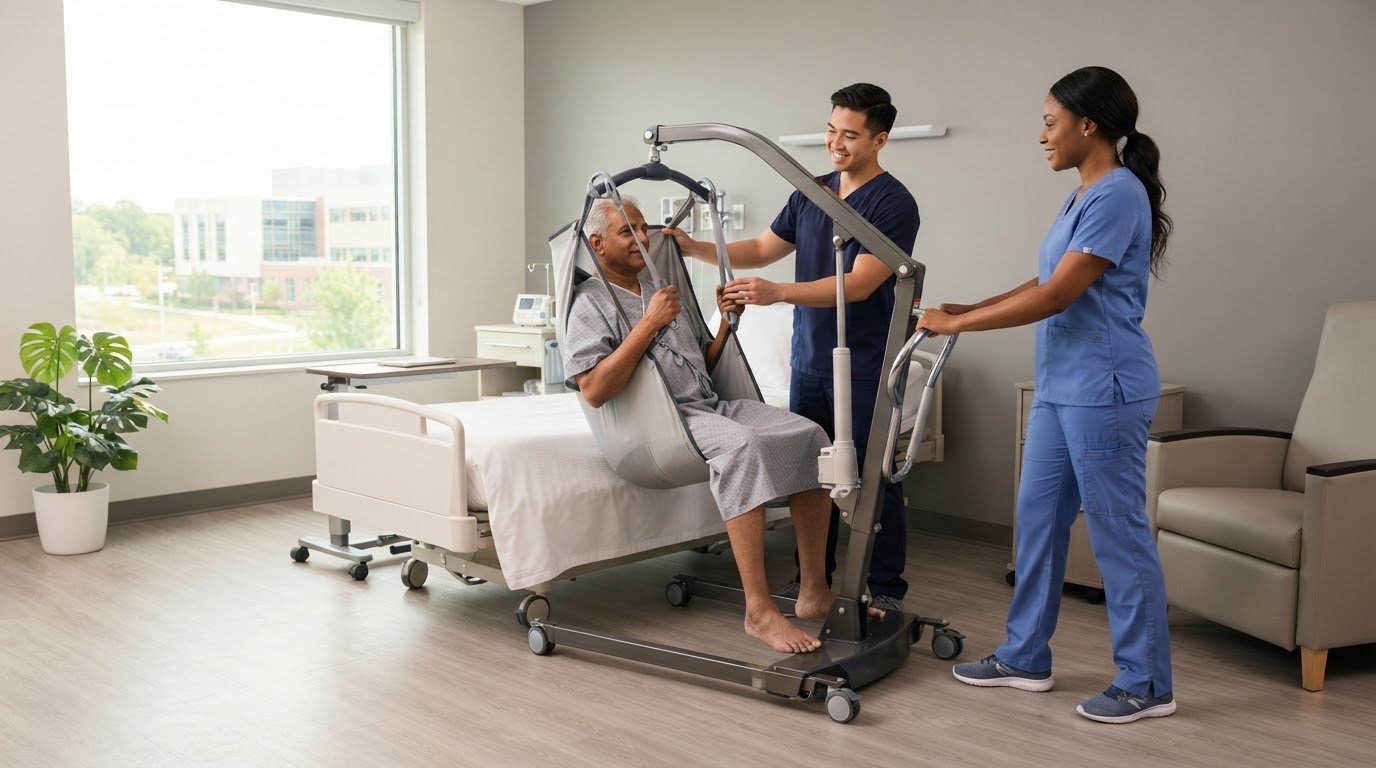
Heavy duty bed movers for bariatric hospital beds
A heavy duty bed mover for bariatric beds should be selected to suit the bed’s total load, castor and frame design, and the routes it must travel. Bariatric hospital beds are rated from 600 to 1,000 lb, and the bed’s capacity needs to account for the mattress, rails and accessories as well as the user. The right choice is the mover whose working capacity and connection method match the bed, with enough clearance for the ward’s doors, corridors and lifts.
It’s understandable to focus first on weight capacity: moving a wider, heavier bed requires equipment designed to handle the load in a controlled way. But a high rating alone doesn’t guarantee a practical fit. Wheelbase, castor dimensions, bed construction and available manoeuvring space all affect whether a mover can connect securely and travel where it’s needed.
This guide explains how to compare load ratings, assess castor compatibility, plan for lifts and corridors, and understand the role of a bed mover. You’ll get practical criteria for matching a mover to your bariatric bed and hospital environment, helping staff move equipment more safely and efficiently.
Table of Contents
Choosing a bed weight capacity with a safety margin
Choose a mover by comparing its rated capacity with the bed’s complete moving load, not just the patient’s weight. Include the mattress, rails, accessories and any equipment travelling with the bed.
Matching capacity to bed weight
Bariatric hospital beds are rated from 600 to 1,000 lb, while a standard home care bed has a capacity of about 450 lb. Treat the bed’s rating as the permitted total, not as the patient’s available weight allowance. Check that the mattress suits the bed and patient, then account for its weight and fitted accessories when assessing the load.
Keep the mover’s ratings distinct. A bed’s safe working load, a mover’s maximum lift capacity and its push-or-pull capacity describe different limits. Match each rating to the task, including whether the mover lifts or draws the bed. A high push-or-pull rating does not mean the mover can lift the same load.
For example, a bed rated at 750 lb is a safer choice than one rated at 600 lb for a patient weighing 500 lb. The difference leaves capacity for the mattress, rails and accessories. This comparison concerns the bed rating, not the mover’s rating; assess both before moving the bed.
To establish the working load, account for the patient, mattress, rails and attached accessories, then compare their combined weight with the bed and mover ratings. Reassess the total if equipment or accessories change. Check a loaded cart’s capacity against everything it carries too. Don’t assume the bed mover’s rating also applies to a cart.
Mattress fit matters as well as weight. Match the mattress to the bed’s width and the patient’s needs, and make sure it sits securely on the bed platform. A mattress that is too wide or poorly supported can affect the setup and load distribution during movement. For residential care or home environments, specialist retailers like Bennetts Bedrooms can provide useful guidance on selecting supportive frames and mattresses tailored to individual dimensions and requirements.
Understanding undersized mover risks
An undersized mover may exceed its rated capacity, making controlled movement harder and increasing strain on the equipment. An incompatible connection can also leave the bed insecure. Consider the patient and staff: an unstable bed can disrupt a transfer and demand extra physical effort from staff.
In the US, workplace safety requirements apply to how staff handle equipment. Use the mover within its rated capacity and follow facility procedures. Do OSHA or other US safety standards apply to moving bariatric beds? Yes. Workplace safety requirements govern safe handling, while equipment ratings define the mover’s operating limits.
Before use, compare the bed’s total load with the mover’s stated capacity and confirm that the connection is secure. Stop if the load exceeds a rating or the mover cannot engage properly. An undersized or incompatible mover can lead to loss of control, equipment strain and more manual handling, so both capacity and fit matter.
Wheelbase and castor compatibility
Matching a mover to the bed’s wheelbase and castors helps ensure a secure connection and smooth movement. Measure the bed, then compare its dimensions with the mover’s jaw range and mattress fit.
Checking bed and castor fit
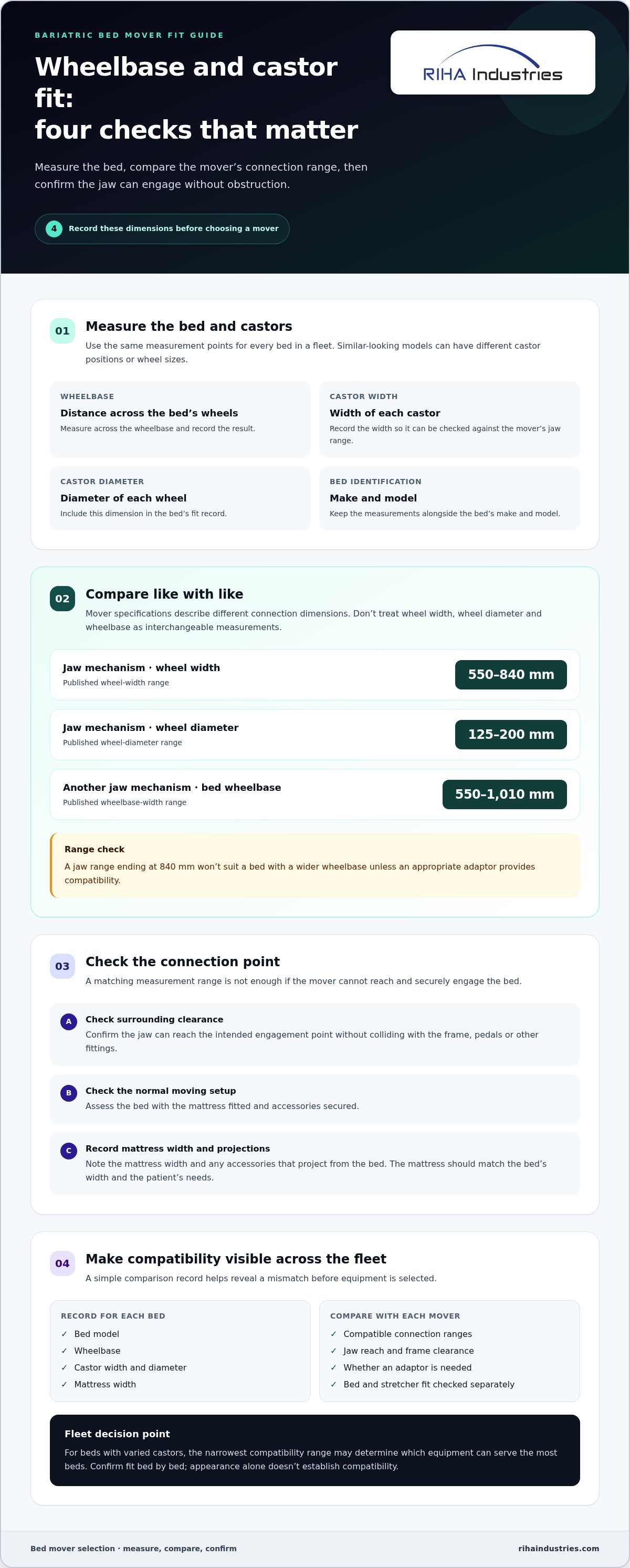
Measure between the bed’s wheels across the wheelbase, then record castor width and diameter. Published mover specifications include jaw mechanisms that capture wheel widths from 550 mm to 840 mm, and wheel diameters from 125 mm to 200 mm. Another jaw mechanism accommodates bed wheelbase widths from 550 mm to 1,010 mm. These ranges show why checking the exact dimensions matters.
Use the same measurement points for every bed in a fleet. Models can look similar yet have different castor positions or wheel sizes. Record the measurements alongside each bed’s make and model, then compare them with the mover’s operating range before selecting equipment.
Check more than the wheels. Confirm the jaw can reach the correct engagement point without colliding with the frame, pedals or other fittings. Include the bed in its normal moving configuration, with the mattress fitted and accessories secured. A mattress should match the bed’s width and the patient’s weight; a mismatch can affect how the bed is configured and moved.
For a practical fit assessment, record:
The distance across the bed’s wheelbase.
Each castor’s width and diameter.
The frame clearance around the intended connection point.
The mattress width and any projecting accessories.
These measurements provide a consistent basis for comparing bariatric bed compatibility across wards and bed models.
Comparing bed mover compatibility
Compare movers by their stated connection ranges, not by appearance or capacity alone. For example, a jaw range ending at 840 mm won’t suit a bed with a wider wheelbase unless an appropriate adaptor provides compatibility. Two beds are reported incompatible with a mover without an adaptor, illustrating why bed-by-bed fit matters.
Bed and stretcher compatibility require separate checks. Frames, castor positions and connection points can differ, so a fit with one type of equipment doesn’t establish a fit with another. Compare the equipment’s dimensions with the mover’s intended connection before choosing a shared moving solution.
When comparing bariatric bed products, make a table with the bed model, wheelbase, castor width, castor diameter and mattress width. Add each mover’s compatible ranges beside those measurements. This makes mismatches clear and helps distinguish a suitable connection from a superficial similarity.
For a bed fleet with varied castors, the narrowest compatibility range may determine which equipment can serve the most beds. If a particular bed falls outside that range, treat it as a separate compatibility case rather than assuming the mover will engage safely. You can compare bed-moving equipment options against the measurements gathered for your ward.
Construction materials and finish
Construction affects how a bed mover stands up to repeated movement, cleaning and contact with hospital equipment. Assess the frame, joints, protective finish and accessible components separately. A sturdy-looking exterior alone won’t show how the frame is assembled or how its finish will hold up to ward cleaning. Compare the design with the work it must handle, including frequent turns, tight approaches and contact near bed frames.
Start with the load-bearing frame. Identify its material and inspect how sections join at corners, pivots and lifting points. Welds, fasteners and brackets should suit the forces applied in those areas. During routine inspections, look for cracks, loose fixings or distortion. For example, a bent bracket near a connection point may affect component alignment and needs attention.
Material choice involves practical trade-offs. Steel can provide a substantial frame, while aluminium can reduce equipment weight. Neither description alone shows whether a particular mover suits a hospital’s needs. Review the complete construction, including the frame profile, joints and moving components. Assess the material against the intended load and operating method, not just its label or appearance.
Check the finish against the facility’s cleaning process. Smooth, accessible surfaces are easier to wipe than exposed crevices around brackets or fasteners. Inspect corners, seams and component joins where residue could collect. Check the cleaning and maintenance instructions against the products and routines used in the ward. Don’t assume a particular colour or coating proves resistance to chemicals or wear.
Protective coverings and guards can help limit scuffs during close manoeuvring, but they shouldn’t conceal damage. Check that guards are secure and don’t block controls, connectors or inspection points. Look for chipped paint, corrosion, exposed metal and worn surfaces. Assess damage near a joint or attachment point before continued use, especially if it affects alignment or the frame.
Use a repeatable inspection sequence for each mover:
Review the frame, joins and visible fasteners.
Inspect the finish, corners and areas exposed to cleaning.
Check guards and covers for movement or damage.
Record defects and arrange maintenance according to facility procedures.
Consider maintainability as part of construction quality. Components that can be inspected without dismantling unrelated parts make routine checks more practical. Note how easily staff can access joints, controls and wear points. Compare these details across candidate movers and with the facility’s maintenance capability and cleaning processes. This helps teams assess the complete working system, not just a metal frame with a durable-looking finish.
Bariatric bed moving
Plan each move around the bed, patient, route and mover’s operating limits. A bariatric bed mover can reduce the physical effort of repositioning, but staff still need a clear procedure, a secure connection and a controlled route. Aim to move the bed without abrupt starts, turns that risk contact or unnecessary manual force.
Before moving, check the bed’s total load against the mover’s rated capacity and confirm the connection is engaged correctly. For example, one mover specification gives a maximum push-or-pull capacity of 600 kg. That rating applies to push-or-pull work, not necessarily lifting, so compare the correct capacity with the task. Keep the patient’s comfort in view and ensure the bed remains in its intended configuration.
Route planning matters just as much as equipment selection. Clear obstacles, check the floor for thresholds or uneven surfaces, and consider corners where the bed’s width affects turning. A mover with a 360-degree turning radius can help manoeuvre in confined areas, while a stated ability to operate on inclines up to 7 degrees can inform route assessment. These specifications don’t replace checking the actual path and operating instructions.
What staffing and operating procedures are recommended for moving bariatric beds? Assign a trained lead to direct the move and agree on clear verbal cues with the team. Before starting, secure the patient and loose equipment, check the mover’s connection, clear the route and decide who will guide each turn. Stop if the route, connection or bed movement becomes unsafe.
Use a consistent sequence so everyone knows when movement begins and stops:
Explain the move to the patient and agree on communication cues.
Check the bed, mover, connection and route before movement.
Position staff to guide the bed without placing themselves in pinch points.
Move at a controlled pace, pausing for turns, thresholds or obstacles.
Park the bed securely and check the patient and equipment afterwards.
During movement, the lead should monitor the route and the bed’s response, while another staff member checks clearance at corners and doorways. Use the mover’s controls smoothly instead of trying to correct a poor approach with force. If a castor catches, the bed drifts or the connection shifts, stop and reassess before continuing. A brief pause can prevent a small alignment issue from becoming a difficult manoeuvre.
Record recurring access problems, such as a tight corridor turn or an incline on the usual route. This helps teams plan a safer pathway and identify when equipment selection or procedures need review. Keep the mover’s operating instructions available, and follow its stated limits for load, incline and handling. Consistent checks make each transfer more predictable for patients and staff.
Bed mover size and hospital lift access
A mover that fits the bed must also suit the hospital’s route, lift and destination. Measure the complete path before selecting equipment, including doorway openings, corridor turns and lift entrances. A bariatric bed may fit through a doorway but leave too little room to manoeuvre once the mover is attached.
Start with the mover’s in-use dimensions, not only its stored or transport size. The StaminaLift TS6000 measures 820 mm × 900 mm × 1225 mm in use. Compare those dimensions with the hospital lift’s clear doorway and cabin space, allowing for the bed, mover and staff positions during entry and exit.
Measure each access point at its narrowest usable opening. Record doorway width and height, corridor width, turning space and lift cabin dimensions. Note handles, wall protection, door mechanisms and other fittings that reduce clearance. Measuring the widest part of a door frame can overstate the space available to a moving bed.
Lift access involves more than fitting through the doors. Consider the occupied cabin space and the combined load of the mover, bed, patient and equipment. The lift’s stated load limit applies to everything inside, so include every item travelling together. Plan how staff will guide the bed into the lift and position it for a controlled exit.
Use a route survey before ordering or allocating a mover:
Measure every doorway and corridor pinch point along the route.
Record the lift’s clear opening and internal dimensions.
Compare the mover’s in-use dimensions with the narrowest access points.
Account for the bed, patient, mover and accompanying equipment in the lift.
Map turns at entrances, lift lobbies and ward corridors.
For example, a 900 mm-wide mover needs a route that accommodates its full in-use width, plus practical space to steer. A lift cabin may be wider internally than its doorway, so assess both measurements. Check the approach angle too: a direct entry may fit, while turning the bed inside the cabin may not.
Assess the actual route rather than relying on building plans alone. Renovations, stored equipment and temporary barriers can change available clearance. Walk the route with the measurements and note tight turns or thresholds. If the bed travels between wards, survey each destination rather than assuming every lift and corridor is identical.
Keep the measurements with the equipment selection record. This gives facilities and clinical teams a shared reference for lift access, route planning and future changes. Reassess the route if the mover, bed configuration or destination changes, so the measurements continue to reflect actual hospital access.
RIHA Industries: StaminaLift Transfer System 5000
The StaminaLift Transfer System 5000 gives healthcare teams a bed-moving option to assess against bariatric bed loads and handling needs. Its safe working load is 600 kg, with a maximum push-or-pull capacity of 600 kg and maximum lift capacity of 300 kg. These ratings describe different functions, so match the relevant limit to the task and the bed’s configuration.
Compare the TS5000’s capacity and connection requirements with your bed measurements and hospital route. If another setup is more suitable, RIHA Industries also offers the StaminaLift 2100 Bed Mover, StaminaLift Transfer System 6000, Easi Rider and Easi Mover. The right comparison starts with your equipment, operating needs and access constraints.
For help matching a bed mover to your requirements, contact RIHA Industries.
Make the next move a considered one
Choosing a heavy duty bed mover for bariatric beds is also an opportunity to make equipment planning part of a consistent ward process. Set out who leads each move, how staff communicate and how changes to beds or routes are reflected in local procedures. This helps teams take the same considered approach to routine transfers.
RIHA Industries offers the StaminaLift Transfer System 5000, StaminaLift 2100 Bed Mover and StaminaLift Transfer System 6000. Consider which option best aligns with the equipment and operating needs identified for your facility. A clear discussion of your bed-moving requirements can help focus that next step.
Contact RIHA Industries about bed movers to continue exploring suitable options for your setting. With a practical plan and equipment matched to the task, your team can move forward with greater clarity and confidence.
Frequently Asked Questions
Which bed mover should you choose?
Choose a mover that suits the bed’s handling requirements, connection points and operating environment. For a hospital bed fleet, compare the StaminaLift Transfer System 5000 and 6000 against the beds staff move most often. Consider whether the equipment will serve one bed model or varied configurations, and how staff will use it during routine transfers. A solution designed for one setup may not suit every bed in a mixed fleet.
What is a heavy-duty bed mover for bariatric beds?
A heavy-duty bed mover for bariatric beds is powered equipment that connects to a bed and assists staff with moving it. It provides a controlled way to push or pull the bed instead of relying solely on manual force. The mover is not a hospital bed or patient lift. Its suitability depends on the bed’s load, connection design and the task it needs to perform.
Which bed movers support bariatric beds and what are their weight capacities?
The StaminaLift Transfer System 5000 and 6000 have distinct capacity ratings. The TS5000 has a safe working load of 600 kg, maximum lift capacity of 300 kg, and maximum push-or-pull capacity of 600 kg. The TS6000 has a safe working load of 900 kg, maximum lift capacity of 450 kg, and maximum push-or-pull capacity of 900 kg. Match the rating to the specific operation.
What bed mover works with bariatric bed frames, castors, and widths?
Compatibility depends on how the mover connects with the particular frame and castors, not the bed’s width alone. The StaminaLift Transfer System 5000 and 6000 use jaw mechanisms with different adjustment ranges. Compare the bed’s attachment points and castor arrangement with the mover’s design. Also consider whether mattress edges, frame covers or accessories restrict access to the connection area.
Which bariatric bed movers are best for hospitals, nursing homes, or home use?
The best choice depends on the beds used and the routes they travel. Hospitals and nursing homes can assess the StaminaLift Transfer System 5000 or 6000 against their bed fleet, workflow and access conditions. Home environments may have different doorways, floor transitions and operating needs, so don’t assume a hospital setup transfers directly. Choose equipment only after considering its intended use and the actual environment.
How do you safely move a bariatric bed with a bed mover?
Use trained staff and follow the mover’s operating instructions and facility procedures. Before moving, explain the plan to the patient, secure loose items and make sure staff know who is directing the manoeuvre. Familiarise the operator with the controls before approaching the bed. Move smoothly, communicate clearly and stop if the bed behaves unexpectedly or the connection appears insecure. Resume only after addressing the cause.