Hospital Bed Transport Efficiency: Comparing Bed Movers and Stretchers
A powered bed mover helps caregivers transport a patient on a hospital bed with less manual effort, while a stretcher serves a different transfer task. A hospital bed transport efficiency study can show how these options affect staff effort, transfer times and patient movement through a facility. The key is to match the equipment to the task, rather than assume one solution suits every journey.
Transfer speed matters, but it is only part of the picture. Staff need to control heavy equipment safely, and delays can disrupt the flow of care. This comparison explains how bed movers assist transport, how powered movement changes the physical task, and where stretchers differ from beds. It also shows how equipment choice can affect routine transfers and hospital operations.
Table of Contents
What technologies are used to aid caregivers in transporting patients on hospital beds?
Powered drives and bed movers assist caregivers by providing propulsion, helping staff guide a loaded bed without relying solely on manual pushing. Other technologies include sensor-based navigation, tracking systems and equipment designed to attach to different beds. Their operational value depends on the route, the patient’s needs and how well equipment fits existing clinical workflows.
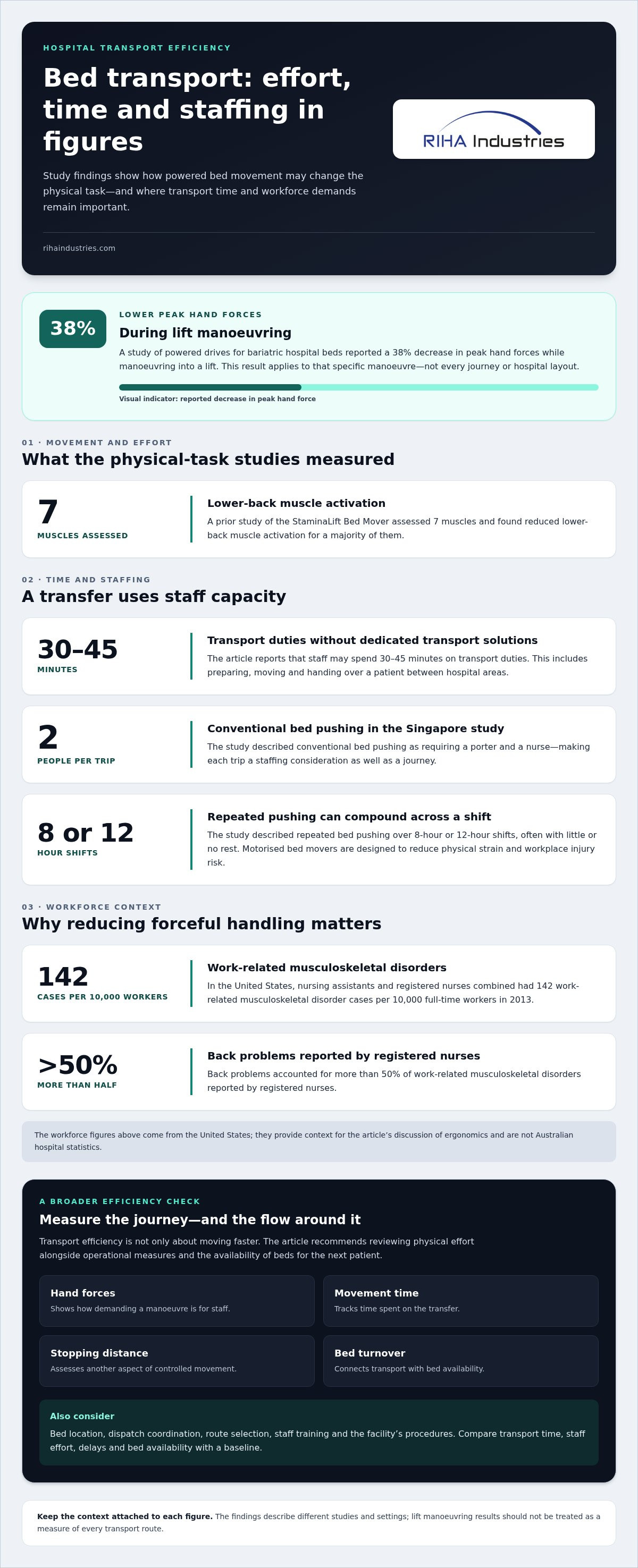
Powered movement can make demanding manoeuvres easier to manage. In a study of powered drives for bariatric hospital beds, peak hand forces decreased by 38% while manoeuvring into a lift. This finding relates specifically to lift manoeuvring; it should not be treated as a measure of every journey or hospital layout.
Transport technology affects more than ward activity. A patient’s journey to imaging, another department or a discharge area also affects bed availability and staff coordination. Real-Time Location Systems (RTLS) can help teams locate beds, while dispatch processes coordinate requests with available transport staff. These tools work best when they support clear operational procedures.
Route planning helps teams account for narrow corridors, busy junctions and lift access. Hospitals can use route information to assign suitable equipment and staff, then coordinate dispatch around the destination and clinical requirements. For example, an imaging transfer may need a route that accommodates both the bed and equipment travelling with the patient. This helps teams plan a controlled journey through the facility.
Staff training and standard operating procedures help turn equipment capability into consistent practice. Training should cover controls, manoeuvring, entering and exiting lifts, communication during movement and responding to an obstructed route. Procedures can specify who confirms the destination, prepares the route and updates the bed’s status. This helps clinical and transport teams follow the same process.
In Australian hospitals, bed transport should follow the facility’s applicable infection-control procedures and equipment-handling policies. Teams should use the hospital’s specified cleaning process for beds and contact surfaces, especially when equipment moves between patient-care areas. Routes and handling procedures should also preserve access to required patient-support equipment.
Studies can assess transport efficiency by measuring hand forces, movement time, stopping distance and bed turnover. For example, a controlled study of powered drives measured force during manoeuvres, including entering a lift. These measures show how equipment affects the physical task. Operational measures can also reveal whether dispatch, route selection and bed availability improve together.
Hospitals can improve bed transport by mapping common routes, matching equipment to transfer needs, training staff and coordinating dispatch. Compare transport time, staff effort, delays and bed availability with a baseline. Reviewing these measures together helps distinguish a quicker journey from a genuine improvement in hospital operations.
Clinical staff time spent on transport
Patient transport takes clinical staff away from other duties, and manual bed movement adds physical demands. Identifying where time and effort accumulate helps care facilities plan staffing and equipment use more effectively.
Time Spent on Patient Transport
Time spent on patient transport includes preparing, moving and handing over a patient between hospital areas. It matters because each transfer uses staff capacity that could otherwise support clinical care. Without dedicated transport solutions, staff may spend 30-45 minutes on transport duties. In the Singapore hospital context described by a study, conventional bed pushing required two people: a porter and a nurse. This makes each trip a staffing consideration, not just a journey.
Repeated effort can compound across a shift. The study described bed pushing as repeated work over 8-hour or 12-hour shifts, often with little or no rest. Motorised bed movers are designed to reduce staff physical strain and workplace injury risk. A prior study of the StaminaLift Bed Mover assessed 7 muscles and found reduced lower-back muscle activation for a majority of them. Reduced exertion can help staff maintain capacity across repeated transfers.
Equipment and Staff Utilisation
Equipment and staff utilisation describes how transport resources are assigned to patient movement and other duties. Matching a suitable mover to a bed transfer can reduce reliance on manual pushing and help staff remain available for clinical responsibilities. Clear dispatch processes also reduce the chance of multiple teams searching for equipment or responding to the same request. Review task allocation alongside transfer demand.
Workplace injury figures underline why ergonomics belongs in those reviews. In the United States, nursing assistants and registered nurses combined had 142 work-related musculoskeletal disorder cases per 10,000 full-time workers in 2013. Back problems accounted for more than 50% of work-related musculoskeletal disorders reported by registered nurses. These figures make reducing repeated forceful handling relevant to both staff safety and workforce capacity.
Training supports safe adoption. Manufacturers provide onboard tutorials, visual guides and simulation modules to help clinical staff learn to use bed movers and accessories. Training should include practical control use, steering, stopping and communication during a transfer. Standard procedures can clarify who prepares equipment, accompanies the patient and hands over at the destination. Familiarity helps staff use equipment smoothly rather than reverting to manual handling.
Operational outcomes also depend on how teams coordinate work. A major health system reduced patient transport time by 9% within four months of implementing a strategic partnership. Although the result reflects that implementation, it illustrates why facilities can track transport time alongside staffing, physical demands and delays. Smoother movement and clear communication may also support patient satisfaction. Facilities assessing powered transfer equipment can explore powered patient-transfer solutions as part of their equipment planning.
Inpatient transport delays and departmental throughput
Bed transport delays affect more than the journey: they can influence when departments receive patients and equipment is ready for reuse. The process of moving, cleaning, preparing and allocating a bed determines when it is ready for the next patient.
Hospital size, layout and patient volume shape transport efficiency through distance, route complexity and competing requests. A high-volume imaging department, for example, needs predictable bed movement, while tight corridors and turns can slow manoeuvring. One mid-size hospital case study served approximately 40,000 imaging patients per year; its corridors ranged from 48 to 60 inches, and its MRI suite had a 1.5T scanner with multiple 90-degree turns.
An unused bed is not necessarily ready for another patient. It may still need cleaning, repair, or movement to a department where demand exists. Poor inventory management can leave departments short of beds, while difficulty locating available beds delays transport teams. Discharge delays can also keep beds occupied 4-6 hours longer than necessary, reducing capacity for incoming patients.
The operational effect can extend beyond one ward. Hospital transport delays can reduce daily departmental throughput by 15-20%, while discharge delays may contribute to emergency department boarding, late discharges and workflow disruption. When a medically ready patient remains in a bed, the next admission may wait, even if another bed exists elsewhere in the facility.
Case results illustrate how coordinated changes can influence these measures. Within four months of implementation, a major health system reduced bed turnover time by 23%, or 26 minutes per bed, and reduced patient transport delays by 28%. These are outcomes from that implementation, not a universal forecast. Hospitals can use them to identify relevant measures for their own operational review.
Bed turnover: time between one patient leaving and the bed becoming ready for the next.
Transport delay: time between a transport request and movement beginning.
Department throughput: patients moved through a department over a defined reporting period.
Bed availability: whether a suitable, prepared bed can be located when needed.
Tracking these measures together helps teams locate the cause of a delay. If requests wait before dispatch, staffing or coordination may be the constraint; if movement takes longer, route design or congestion may matter more. Advanced transport management solutions can reduce response times by 20-30%, while hospitals implementing sophisticated transport systems report 12-15% improvements in department throughput. The operational goal is better utilisation across the whole patient pathway, not simply faster movement in one corridor.
Reliable discharge coordination can improve predictability by aligning transport requests, staff availability and bed preparation. Hospitals can review delay patterns by department, destination and time of day, then adjust dispatch and bed allocation accordingly. Optimising inpatient transport services has been associated with a 20% reduction in patient wait times. That outcome reflects service optimisation, so local reviews should also consider patient needs, facility layout and the steps required before a bed can be reused.
Comparison with manual and powered stretchers
Hospital beds and stretchers serve different transport needs. A bed can travel with a patient between departments, while a stretcher may suit transfers where a bed is impractical. Compare them based on the patient, destination, route and staff effort, rather than treating them as interchangeable.
Manual bed movement depends on staff applying force and controlling direction, especially around turns, ramps and lift thresholds. Powered drives add propulsion to the bed, helping caregivers manoeuvre it with less physical effort. According to Study authors (not identified in research facts), a 2017 study measured hand forces on 10 caregivers as they moved a bariatric bed manually and with a powered drive.
The same study found that using a powered drive reduced stopping distance by 55% during bariatric hospital-bed transport, according to Study authors (not identified in research facts). Stopping distance matters when staff must control a loaded bed near other people, equipment or a confined turning point. The result concerns the tested bed transport and should be read in that context.
A separate reported finding offers another comparison: the robotic bed mover could halve the manpower required to push hospital beds compared with conventional bed pushing, according to Study authors (not identified in research facts). Fewer staff assigned to propulsion may support workforce allocation, but a patient transfer still requires appropriate clinical support and coordination.
Stretchers address a different practical need. For an emergency department transfer or movement through a space that cannot accommodate a hospital bed, a stretcher may be more suitable. A bed mover assists with moving the bed itself. Choose equipment based on the patient’s required position and destination, then consider corridor width, lift access and the staff needed to accompany the patient.
Facilities comparing manual and powered options can assess the same journey using consistent measures. Observe staff effort during turns, stopping control and whether the route requires repositioning. Record staffing and handover delays. Comparing manual and powered journeys on the same route helps separate equipment effects from differences in layout.
Patient flow also depends on matching equipment to the transport request. A stretcher may suit a transfer that does not require the hospital bed to travel; a powered bed mover is relevant when the bed must move with the patient. In both cases, staff should follow clinical requirements and facility procedures, particularly on busy routes.
Improving transport is not simply a choice between manual and powered equipment. The right approach depends on patient needs, the route and the task. Facilities can review these factors alongside staff strain, stopping control and patient flow to make a sound operational comparison.
What does hospital bed transport efficiency mean, and how is it measured?
Hospital bed transport efficiency describes how reliably a facility moves patients and beds while using staff time and equipment effectively. A useful assessment looks beyond journey speed: it considers physical effort, movement control, delays and whether the bed reaches its destination ready for the next operational step.
Start by defining the journey you are measuring. Record when a transport request arrives, when movement begins and when the bed reaches its destination. Use the same start and end points for comparable transfers. A ward-to-imaging transfer and a bed return after discharge involve different tasks, so measuring them together can obscure where delays occur.
Compare like with like. Record the route, destination, bed type, transport method and staffing for each transfer. Lift journeys, corridor turns and ramps place different demands on caregivers. Tracking these details helps distinguish changes in equipment performance from changes in route or workload.
Staff effort can be assessed through hand-force measurements or muscle activity. One controlled laboratory study recruited 14 participants: 7 hospital porters and 7 students. It analysed mean electromyography data for 4 muscles across 4 movements. These measures help describe the physical demands of specific tasks, but they do not represent every worker or hospital route.
Operational measures add context. Facilities can monitor:
Request-to-dispatch time and journey duration, using consistent start and finish points.
Staff numbers and equipment used for each comparable transfer.
Stopping distance or manoeuvring performance during defined route sections.
Bed turnover time, transport delays and availability after the transfer.
Review several measures to avoid misleading conclusions. A faster journey might involve greater staff effort, while lower hand force alone does not show that departmental flow improved. Compare results before and after a change, using the same route definitions and transfer categories. Then assess whether improvements appear in both staff demands and operational outcomes.
A hospital bed transport efficiency study is most useful when its measures address the facility’s decision. If manual effort is the concern, assess force or muscle activity. If delays are the issue, examine dispatch and journey stages. If bed availability matters, include turnover and readiness after movement. Clear definitions make the findings easier to interpret and apply.
Use the results to identify where equipment or process changes may help, then repeat the same measurements. This creates a practical basis for comparing transport methods without relying on a single headline figure. To explore equipment designed to assist bed movement, discuss bed transport solutions with RIHA Industries.
A controlled laboratory study assessed physical demands using hand-force measurements and mean electromyography data across four movements. Participants included hospital porters and students. Operational assessments can also track dispatch and journey times, staffing and equipment, manoeuvring performance, bed turnover, delays and readiness after transport.
RIHA Industries: StaminaLift Transfer System 5000
The StaminaLift Transfer System 5000 supports hospitals seeking a powered approach to patient and bed movement. Its role is relevant when teams are reviewing manual effort, transfer workflows and compatibility with existing hospital equipment.
RIHA Industries also offers the StaminaLift Transfer System 6000 and StaminaLift 2100 Bed Mover. These options connect the operational questions explored in this article with equipment designed for hospital bed transport. The right fit depends on the facility’s equipment and the transfers staff need to manage.
For a transport review, consider the bed types in use, typical routes and manoeuvres that challenge staff. These details help establish how a bed mover could support your workflow without treating it as a replacement for stretchers or other transfer methods.
Contact RIHA Industries to discuss hospital bed transport equipment for your facility.
Turn transport findings into practical change
Turn transport observations into a focused improvement plan. A hospital bed transport efficiency study can help teams identify where movement creates unnecessary effort or interrupts wider workflows. Use the findings to set an operational priority, such as improving manoeuvring on a challenging route or fitting equipment into existing procedures.
Bring clinical, transport and facilities teams into the discussion. Their perspectives can help distinguish equipment needs from process issues and shape an approach that works with the hospital’s daily operations. Then assess which bed-movement solution suits the transfer tasks and equipment already in use.
RIHA Industries offers patient-transfer systems and bed movers for healthcare settings. To discuss your facility’s bed transport requirements and available solutions, contact RIHA Industries. A considered next step can help your team build a more purposeful approach to patient movement and staff support.
Frequently Asked Questions
What are the average time and labour costs for transporting a hospital bed?
Transport time and labour cost depend on the journey, staffing and work involved. Record time spent waiting for dispatch, preparing the bed, moving it, handing over and returning equipment. Estimate labour cost using staff time, the number of staff involved and applicable employment costs. Compare similar journeys, such as ward transfers to the same destination, to see where time is spent.
How do manual and powered hospital bed transport systems compare?
Manual transport relies on staff to push, steer and control the bed; a powered system supplies propulsion to assist movement. Compare both options on the same route and bed type, noting staff effort, manoeuvrability and control during starts and stops. A powered bed mover assists with moving a bed, while a stretcher is a separate patient-transfer option. Base the comparison on the task and clinical needs, not on treating the equipment as interchangeable.
What factors cause delays or bottlenecks in hospital bed transport?
Delays can stem from unassigned transport requests, unavailable staff, unclear bed status, cleaning or repair needs, lift queues and congested routes. Handover can also stall if the destination department is not ready to receive the patient. To investigate, follow a delayed request from dispatch to arrival and note where it pauses. Separating delays into request, preparation, travel and handover stages helps teams identify whether coordination, equipment readiness or route access needs attention.
What are the safety risks and injury rates associated with hospital bed transport?
Risks include physical strain from pushing, awkward positioning while steering, and difficulty controlling a heavy bed during turns or stops. In the United States, the 2013 national average incidence rate for work-related musculoskeletal disorders was 38 cases per 10,000 workers. Facilities can reduce exposure by reviewing demanding manoeuvres, maintaining safe handling procedures and training staff on equipment controls. Injury data should be considered alongside local reports of strain and transport-related incidents.
What studies measure bed transport efficiency in U.S. hospitals?
Bed-transport studies assess staff hand forces, movement time, stopping distance, and bed turnover. A 2017 study measured hand forces on 10 caregivers moving a bariatric bed manually and with a powered drive.