Manual Handling Audit Tool: A Healthcare Task Screening Reference
A manual handling audit tool for healthcare screens tasks to distinguish those that appear low risk from those requiring a more detailed risk assessment. It organises information about each task and its demands, helping teams focus attention where closer review is needed. Screening is a starting point, not a substitute for a fuller assessment when risk factors are identified.
That distinction matters because lifting, carrying, pushing and pulling place different demands on workers, even when tasks seem routine. A useful tool helps teams examine those demands systematically rather than relying on guesswork or treating every task alike.
This guide explains how assessment software screens handling tasks, applies ergonomic tools and classifies risk across healthcare and other workplaces. You’ll also see how task-based screening and lifting assessments fit into the process, and what teams can consider next based on the results.
Table of Contents
What Is Manual Handling Assessment Software?
A manual handling audit tool for healthcare records task information, screens hazards and helps teams decide what needs closer assessment. The Manual Handling Operations Regulations were introduced in 1992, according to the UK legislation register.
Deciding When to Complete a Detailed Assessment
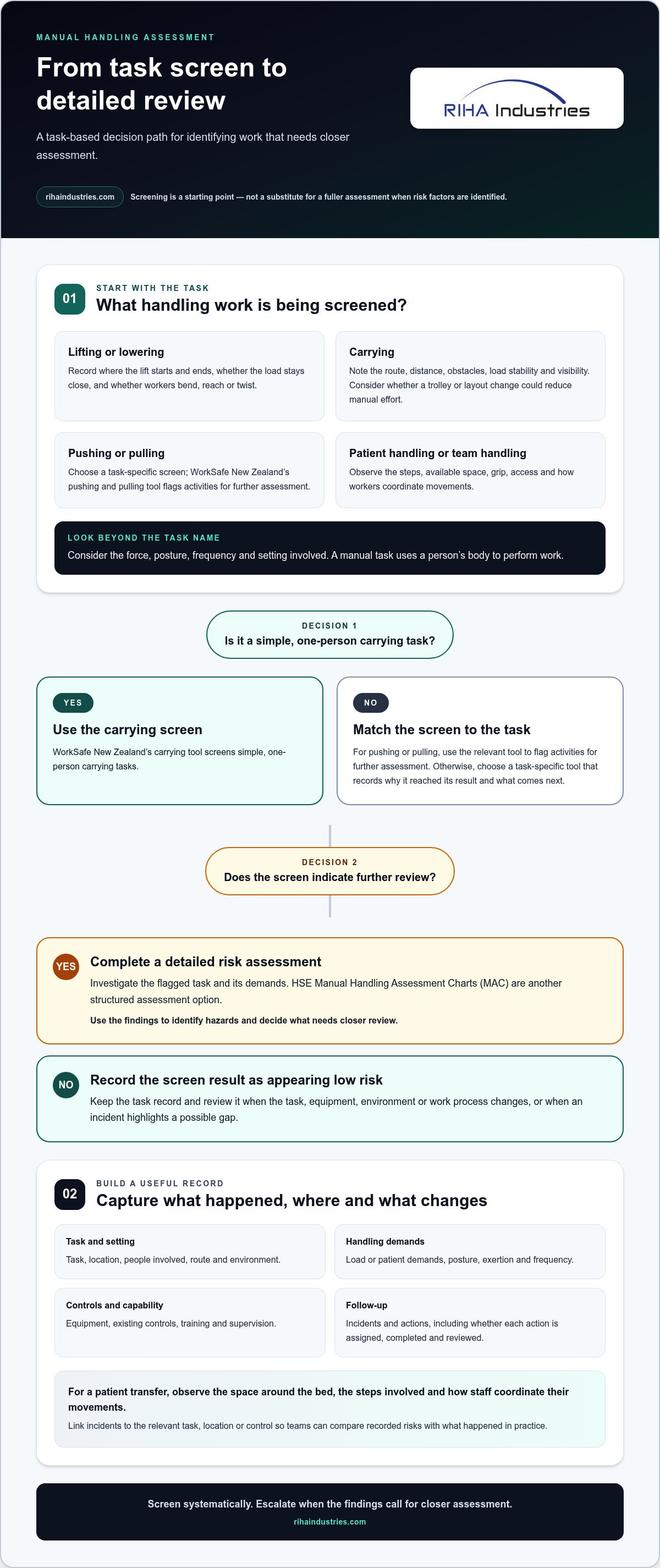
A screening tool separates tasks that appear low risk from those needing a detailed risk assessment. WorkSafe New Zealand’s carrying tool screens simple, one-person carrying tasks, while its pushing and pulling tool flags activities for further assessment. Choose a task-specific tool that records the reasons for its result and indicates the next assessment step.
What are the best manual handling audit tools for healthcare facilities? Choose a tool that matches the task, such as a carrying or pushing and pulling screen, then carry out a detailed assessment when its findings indicate further review. HSE Manual Handling Assessment Charts, known as MAC, offer another structured assessment option.
Links Between Assessments and Incidents
Linking an assessment to incident records connects task hazards with events and follow-up actions. Software can associate an incident with the relevant task, location or control, helping teams compare the recorded risk with what happened in practice. For example, a patient-handling incident can prompt a review of the task assessment and its existing controls.
What data and metrics should a patient handling audit collect? Record the task, location, people involved, load or patient-handling demands, hazards, controls, training, incidents and actions. Track whether each action is assigned, completed and reviewed, so the audit shows what changed.
Are there free manual handling audit checklists for hospitals and clinics? Yes, free checklist formats can provide a starting structure for recording tasks and hazards. Use a checklist as a screening aid, not as a substitute for a detailed assessment when the task warrants one.
How often should healthcare facilities audit manual handling practices? Review assessments whenever a task, equipment, environment or work process changes, and after an incident highlights a possible gap. Include regular reviews in your process for keeping assessments current.
How can healthcare facilities implement audit findings and reduce patient handling injuries? Assign actions to address identified hazards, consider mechanisation where appropriate, and confirm training and supervision. Then check whether the controls work and update the assessment when conditions change.
Manual handling risk assessment software stores task details, findings and actions in a consistent record. Mobile assessments can include photographs or video showing the workstation, equipment position or movement sequence. Use this evidence to clarify the task description, then record the assessment outcome and required controls.
A digital record also helps teams compare findings across departments. Organise risk assessments by task or location to identify recurring concerns and follow up on actions. Keep images relevant to the assessment and record enough context to interpret them later.
Healthcare and workplace lifting, pushing, pulling, and carrying tasks
A manual task uses a person’s body to perform work. In healthcare, that might mean repositioning a patient; in a warehouse, moving cartons. A workplace audit should examine the force, posture, frequency and setting involved, not just the task name.
The 2021 NHS Staff Survey found over 30% of staff reported work-related musculoskeletal problems. The reported proportion increased by 1.4 percentage points from 2020 to 2021. These figures show why audits need to consider routine handling demands as well as isolated incidents.
What OSHA rules apply to patient handling and manual lifting in healthcare? For a US facility, assess handling tasks against the workplace requirements that apply to the site and record which requirements you used. Include patient transfers, load movement, available equipment, staff training and the controls used for each task.
What state-specific safe patient handling laws apply to healthcare facilities? The relevant provisions depend on the state where the facility operates. Identify applicable state requirements in the audit record, then assess whether transfer procedures, equipment and staff practices meet them.
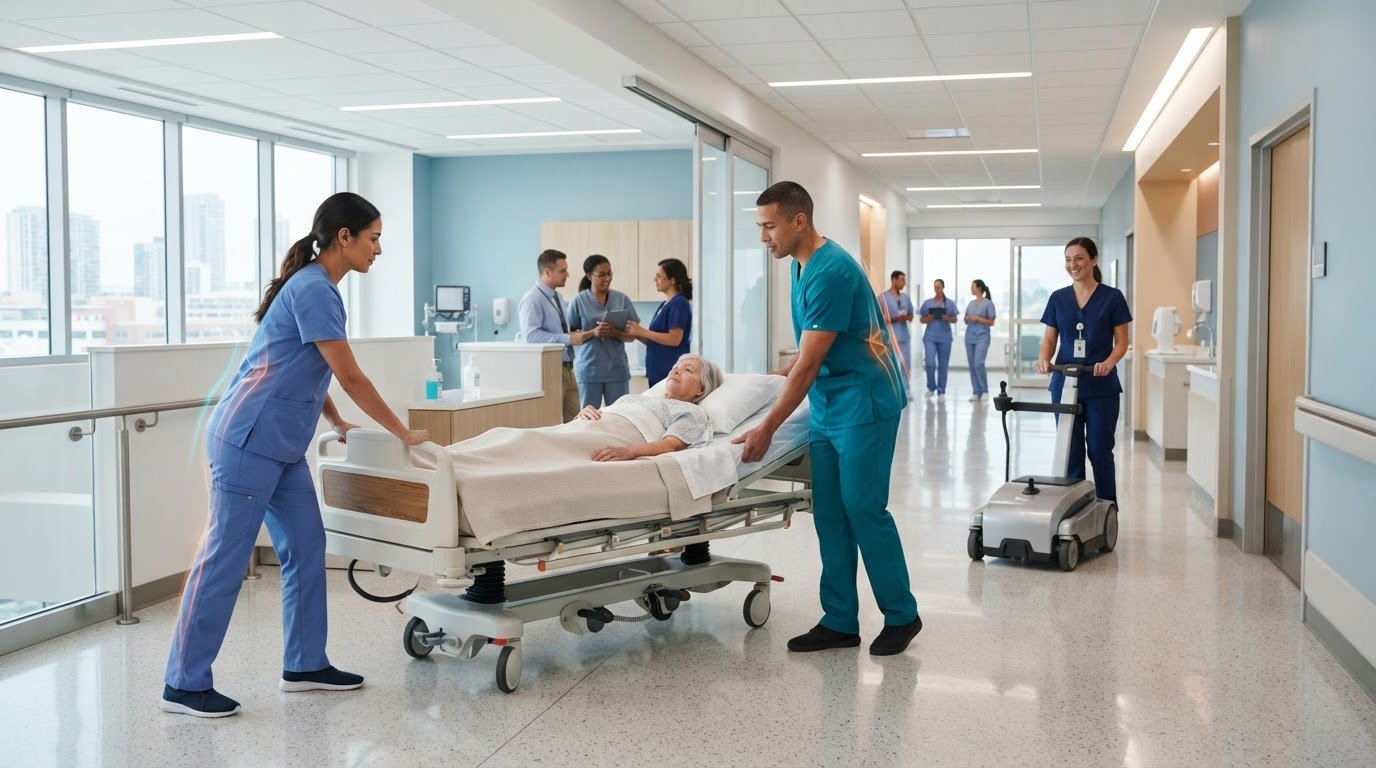
What should a healthcare manual handling audit assess? Record the task, load or patient, worker posture and exertion, frequency, route, environment, equipment and existing controls. For a patient transfer, observe the space around the bed, the steps involved and how staff coordinate their movements.
Lifting means raising or lowering an object or person using physical effort. Assess where the lift starts and ends, whether the load stays close, and whether workers need to bend, reach or twist. Lifting from floor level, for example, differs from moving an item between waist-height surfaces.
Team handling involves more than one worker managing a task. It can distribute effort, but the audit should also examine communication, timing, grip and access. During a patient repositioning task, record how workers coordinate each movement and whether the available space supports their approach.
Carrying means moving a load while supporting it by hand or body. Snook tables set acceptable limits for carrying, pushing and pulling. Record the route, distance, obstacles, load stability and visibility, then consider whether a trolley or layout change could reduce manual effort.
For each observed task, record who performs it, what makes it demanding and which controls are used. Compare written procedures with actual practice, including equipment access and staff coordination. This gives health and safety teams specific findings to prioritise and actions to review.
Manual tasks include using force to lift, lower, push, pull, carry, move, hold or restrain anything. An audit can therefore capture activities that may not look like conventional lifting, such as maintaining a hold or restraining movement, and describe the force and body position involved.
For each observation, connect the action to its setting and controls. Note what is being handled, how the worker applies effort, and whether the task involves repeated movement, a sustained hold or coordination with another person. This broader record keeps the assessment focused on the work actually performed, not just the labels in procedures. If practice differs from written instructions, record the difference and consider whether the controls address the observed demands.
NIOSH Lifting Equation, Snook tables, and HSE MAC tool
The NIOSH Lifting Equation, Snook tables and HSE Manual Handling Assessment Charts (MAC) support different parts of a manual handling assessment. Match the tool to the movement, record the task conditions and use the findings to inform controls. These methods structure observation and analysis, but don’t replace examining how work happens in practice.
The NIOSH Lifting Equation calculates a recommended weight limit for a lifting task. It considers load position, lift height, twisting and frequency. For example, assess whether a carton is lifted from floor level or a higher surface, whether the worker twists, and how often the lift occurs. Record these details consistently, because changes in position or frequency alter the conditions being assessed.
Use the equation to examine the lift itself, rather than treating the load’s weight as the only consideration. Follow the task from its starting position to its destination, noting where the load is held and how the worker turns. Then review the result alongside workplace conditions and existing controls. A recommended weight limit is one assessment input, not a complete account of every handling hazard.
Snook tables set acceptable limits for pushing, pulling and carrying. They help compare the demands of these tasks with relevant limits, rather than focusing only on lifting. For a trolley task, document the push or pull, route and conditions affecting movement. For carrying, record the load and path. Use the table that matches the movement, and connect its findings to practical controls.
These tables are useful in workplaces with repeated transport tasks, such as moving supplies between storage and care areas. They can guide closer examination, but the assessment still needs a clear description of the actual route and work method. If the route changes or workers carry items differently, update the task record before comparing findings.
The HSE MAC tool is the Health and Safety Executive’s Manual Handling Assessment Charts, which structure the assessment of manual handling tasks. Apply it to an observed task, record relevant findings and consider which controls could address them. For example, assess the actual movement of a load rather than relying only on a written procedure.
MAC, Snook tables and the NIOSH equation aren’t interchangeable. The equation addresses lifting, Snook tables address pushing, pulling and carrying, while MAC provides a chart-based assessment approach. Select the method that fits the task, then note its scope and limitations in the risk assessment. If a job includes lifting and carrying, assess each movement with an appropriate method.
For all three methods, keep the assessment traceable: describe the task, record the method, capture findings and link each finding to a control. Revisit the assessment when load position, route, frequency or work method changes. This helps teams compare like with like and decide whether existing controls still address the observed conditions.
Risk categories and configurable matrices
A risk category groups assessment findings according to the level of attention or action they need. A configurable matrix applies an organisation’s chosen criteria consistently, helping teams compare tasks and prioritise controls. Keep the scoring rules visible so staff can understand how each finding led to its category.
A task risk matrix commonly considers the likelihood of harm and its possible consequence. For example, a task involving awkward posture and repeated effort may need closer review than one with stable loads and effective controls. Record the factors behind each rating, not just the final colour or label. A category is useful only if it leads to a clear next step.
Set the matrix criteria before assessing tasks. Define low, moderate and high risk using the organisation’s assessment method, then apply those definitions across departments. If a patient transfer receives a high rating because of restricted space, the record should identify that condition and the control action. Avoid changing thresholds between teams without documenting why.
Compliance scoring measures how fully an organisation meets specified audit criteria. The Scottish Manual Handling Passport audit exemplar uses a separate points-based method: Yes or N/A receives 2 points, Partial receives 1 point, and No receives 0 points. Its total possible audit score is 56 points. This score reflects criterion responses, not a task’s likelihood of causing injury.
The Scottish Manual Handling Passport audit guidelines classify nil compliance as 0%, low partial compliance as 1-29%, moderate partial compliance as 30-69%, and high partial compliance as 70-99%. Full compliance is 100% only when the whole organisation meets all requirements in the criterion. Keep these compliance bands distinct from a task-risk matrix, because they measure different things.
In software, configurable fields can help teams record the reason for a category, the evidence reviewed and the control assigned. For example, a finding might include the task, observed hazard, selected category and action owner. Use consistent terms in reports and local guidance so managers can interpret results across wards or work areas.
Review patterns across categories as well as individual scores. A cluster of similar findings may point to a recurring issue, such as inaccessible equipment or a difficult route. Compare the evidence and actions before deciding whether the same control applies to each task. A matrix supports prioritisation, but doesn’t replace task-level judgement.
After introducing controls, reassess the task using the same criteria. Record whether the hazard remains, whether the category changes and what evidence supports the change. Keep earlier results in the audit trail so teams can see how actions affected later assessments. This makes risk categories useful for follow-up rather than static labels in a report.
Screening manual handling tasks
Task screening is an initial check to identify handling activities that need closer risk assessment. It helps teams decide where to investigate further rather than treating every task as equally demanding. Include routine work and less frequent activities, such as repositioning a patient or moving supplies during a room change.
How do you conduct a manual handling risk assessment for healthcare workers? Observe the task, apply the HSE TILE framework, record hazards and existing controls, then decide whether detailed assessment is needed. Review the findings with workers who perform the task, so the record reflects actual practice.
TILE stands for task, individual, load and environment, the four factors used to organise a manual-task screen. For a bedside transfer, describe the movement and its frequency under task; consider the worker’s capabilities under individual; note the patient or equipment under load; and record bed access, floor space and obstacles under environment. This structure makes findings easier to compare across tasks.
A screen should also capture exposures beyond a single lift. Manual tasks include repetitive actions, sustained postures and concurrent exposure to vibration. For example, assess repeated upper-limb movements during equipment handling, or a posture held while providing care. WorkSafe New Zealand’s upper-limb screening tool is intended for repetitive upper-limb use for about 2 hours per day and helps identify whether detailed assessment is needed.
Choose a screening tool suited to the activity. WorkSafe New Zealand’s carrying tool is designed for a simple carrying task performed by one person. Its pushing and pulling tool helps identify activities that may need further assessment. The seated manual-handling screening tool applies when workers are seated and handle loads with two hands. Match the tool to its intended task: don’t use a carrying screen for a patient transfer.
Use the screen to determine a clear next step. Record the activity, who performs it, where it occurs, what makes it demanding and which controls are already in place. Note whether the task appears low risk or needs a more detailed assessment, and explain the decision using observed conditions. If the screen identifies concerns, assess them in depth rather than relying on the screening result alone.
For example, a seated worker handling a load with two hands falls within the seated screening tool’s scope. If the task also involves repeated upper-limb movement, record that exposure separately. Make the reason for escalation visible so a reviewer can see which task features need closer examination.
Finish by recording actions and review points. Consider mechanisation where appropriate, confirm training and supervision, and check whether controls work. Schedule regular reviews to keep assessments current, especially when the task or its conditions change.
RIHA Industries: StaminaLift Transfer System 5000
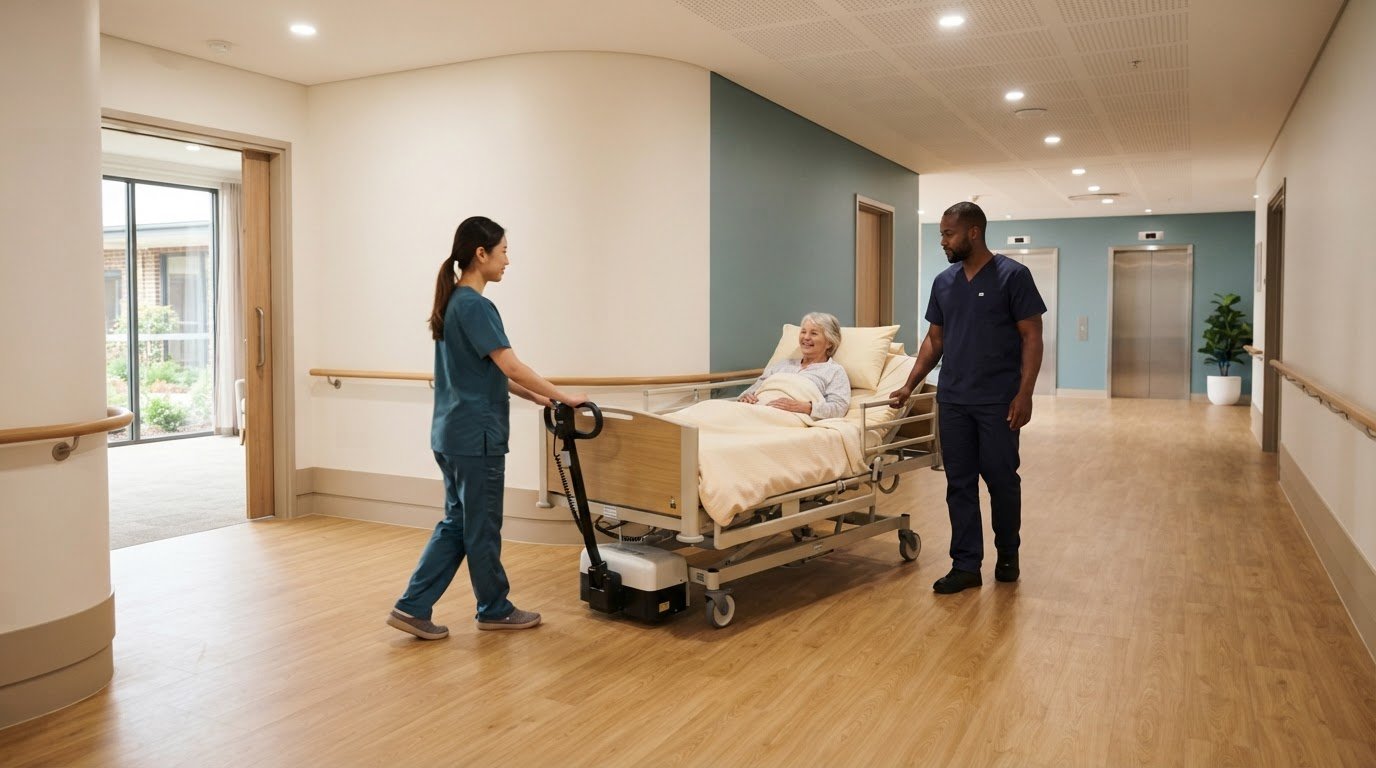
RIHA Industries’ StaminaLift Transfer System 5000 is a next step when audit findings highlight repeated patient-transfer tasks. RIHA’s transfer systems are designed to integrate with existing hospital equipment, making them relevant when facilities review how transfers are carried out. The StaminaLift Transfer System 6000 is another transfer-system option, while the StaminaLift 2100 Bed Mover addresses bed-moving tasks. For moving heavy loads, the Easi Rider and Easi Mover tugs can assist staff.
Use your assessment findings to identify the tasks needing equipment support, then consider which type of movement the equipment must assist. This connects audit actions to practical handling needs without treating one solution as suitable for every task. To discuss equipment for your handling requirements, contact RIHA Industries.
Turn audit findings into practical next steps
A manual handling audit tool for healthcare is most useful when its findings inform everyday decisions, not just the next report. Give each action a clear owner, link it to the task it addresses and set a review point. This helps teams see whether a change has been put into practice and whether working conditions have shifted.
Use this process to build a feedback loop between staff observations and equipment decisions. A recurring handling challenge can prompt closer examination of how people, loads and spaces interact, then inform the next improvement. Keep discussions grounded in the tasks staff perform and the controls available in their workplace.
Where equipment may support the next step, discuss your requirements with RIHA Industries. Discuss your handling requirements and take a considered step towards practical workplace improvements.
Frequently Asked Questions
What is a manual handling audit tool for healthcare?
A manual handling audit tool for healthcare provides a structured way to document handling tasks, identify concerns and assign follow-up. For example, an auditor can record a ward’s transfer procedure, note where equipment is stored and compare written steps with staff practice. Give each finding an action owner and review status. This makes the record useful to managers and clinical teams planning practical changes.
What are common manual handling hazards and injury risks in healthcare?
Common hazards include a patient moving unexpectedly, reaching across a bed or an interrupted transfer that leaves a worker supporting an awkward position. These conditions can contribute to back, shoulder or other musculoskeletal injuries. For example, an audit can examine how staff respond when a patient cannot follow the planned movement, and whether the procedure gives workers a clear, safer way to pause and reset.