Motorised tugs for hospital waste bin handling
What if moving hospital waste bins didn’t depend on staff pushing and pulling them by hand? A motorised tug for hospital waste bins uses electric power to move heavy containers through healthcare sites, helping reduce the physical effort involved in routine transport.
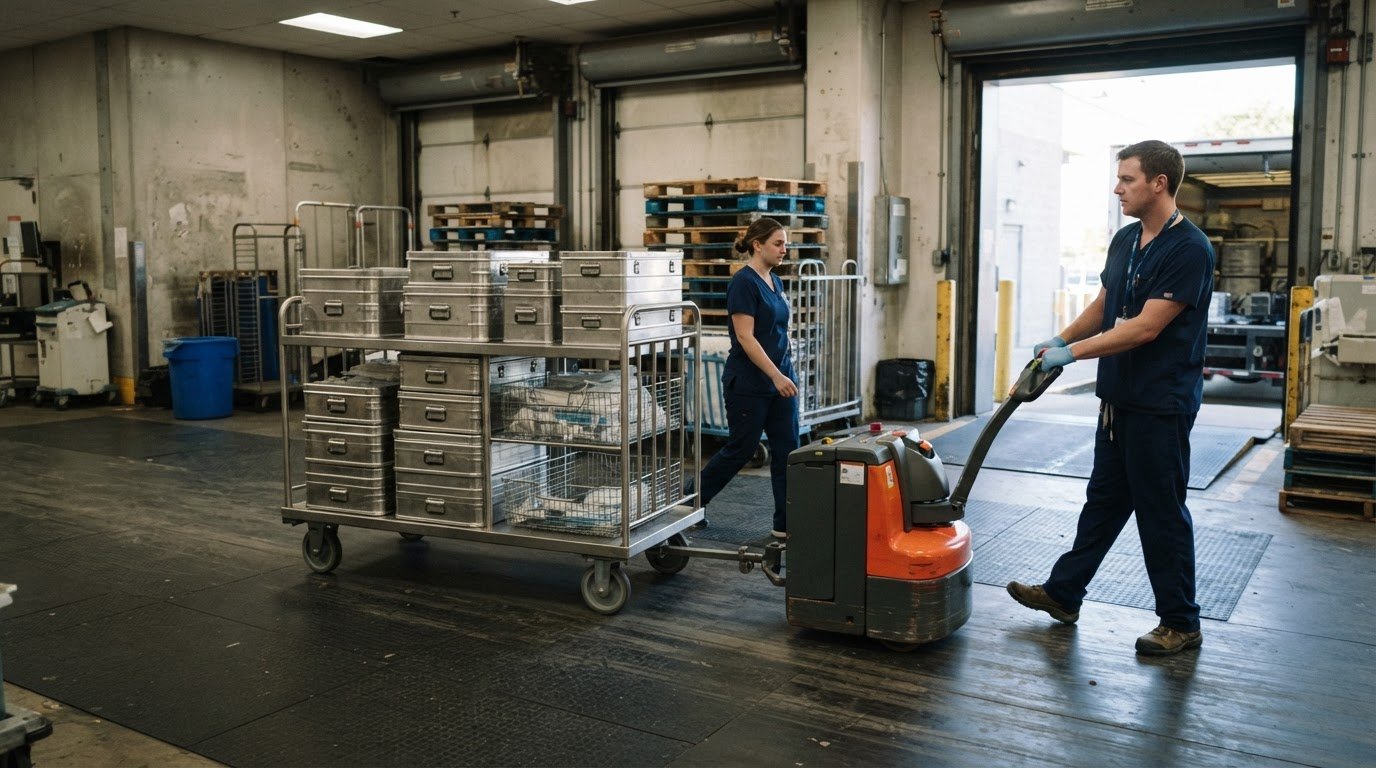
Waste still needs to move safely and efficiently through busy corridors, service areas and shared spaces. A motorised tug for hospital waste bins can tow loaded containers without staff pushing the full load manually. Electric tugs also operate more quietly than traditional transport methods and produce no exhaust emissions.
This article explains what smart electric tugs do and how they can support waste movement across healthcare sites. You’ll learn how they work, where they may fit into hospital operations, and what to consider when planning bin handling routes and equipment. It also looks at the practical factors that shape a suitable tug solution, so you can assess how powered movement could support staff and day-to-day site logistics.
Table of Contents
What are smart electric tugs?
An electric tug is a powered unit that moves carts and heavy loads, including hospital waste containers. Its motor supplies the force needed to move a connected load, while an operator guides it along the route.
Battery-powered bin movement
A battery-powered tug connects to a compatible bin or cart and supplies the force needed to move it. A tug may transport waste containers between collection points, while other configurations can move hospital beds, linen carts or other equipment. Choose a motorised tug for hospital waste bins based on the container’s connection and the site’s daily movement patterns. Battery capacity and charging arrangements matter when planning repeated trips.
Handling inclines and uneven surfaces
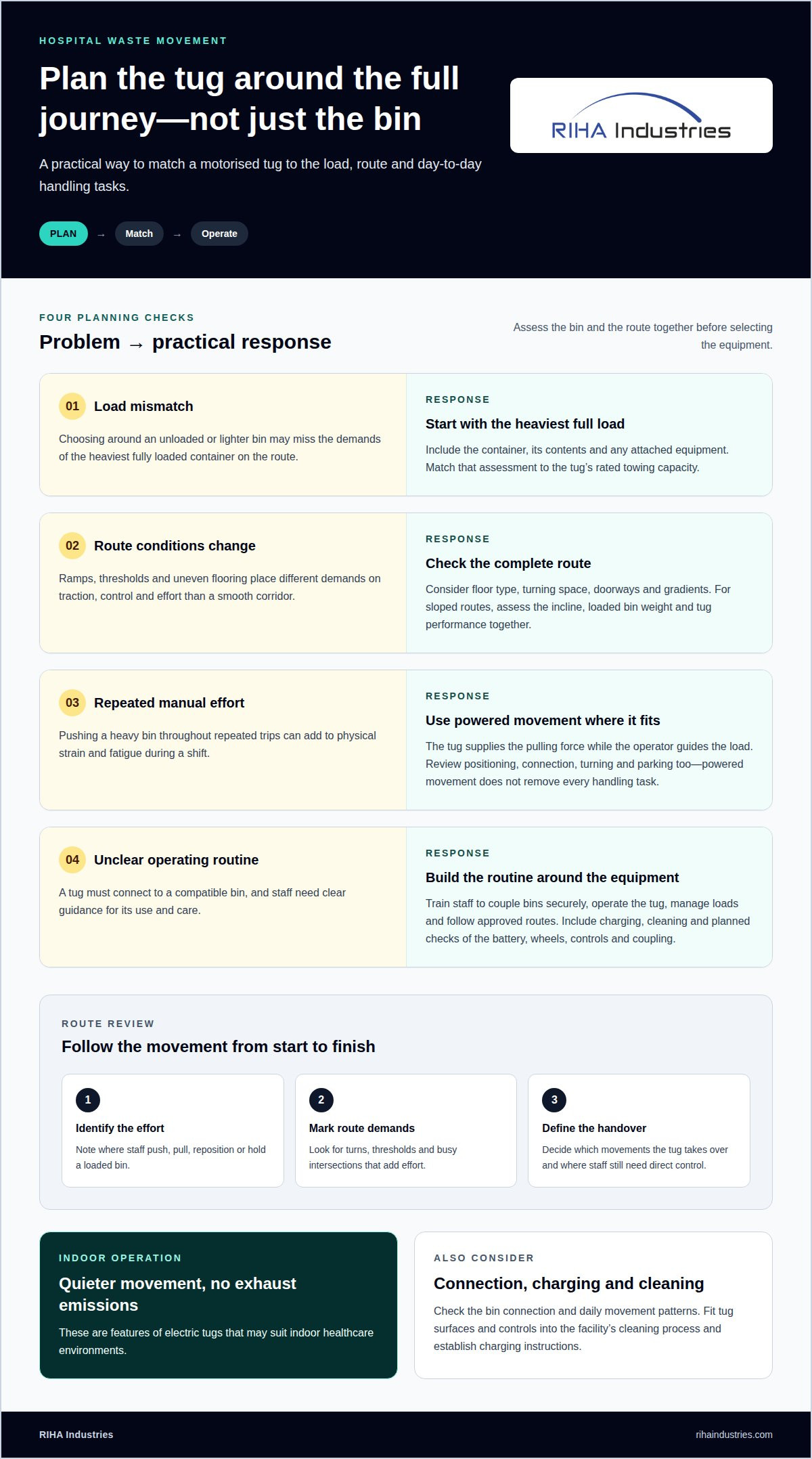
Floor conditions affect traction, control and the effort needed to move a loaded container. Ramps, thresholds and uneven flooring place different demands on a tug than a smooth corridor. For sloped routes, assess the incline, loaded bin weight and the tug’s rated performance together. A tug suited to level floors may not be suitable for a steep grade.
Choosing tug capacity and route suitability
Start with the heaviest fully loaded bin on the route, then match it to the tug’s rated towing capacity. Include the container, its contents and any attached equipment in the load assessment. Floor type, turning space, doorways and gradients also influence the choice. Assess the complete route, not just a clear, level section.
In the United States, tug cost depends on the required capacity, battery arrangement and route conditions, and is provided after a quote request. The bin connection, expected use and site layout also affect the specification.
For infection control, consider how the tug’s surfaces and controls fit the healthcare facility’s cleaning process. Include the equipment in established cleaning routines for the areas where it operates, alongside the handling procedures for each waste container.
Train staff to couple bins securely, operate the tug, manage loads and follow approved site routes. Operators also need clear instructions for charging and cleaning. Planned maintenance can include checking the battery, wheels, controls and coupling; repairs address faults that affect operation.
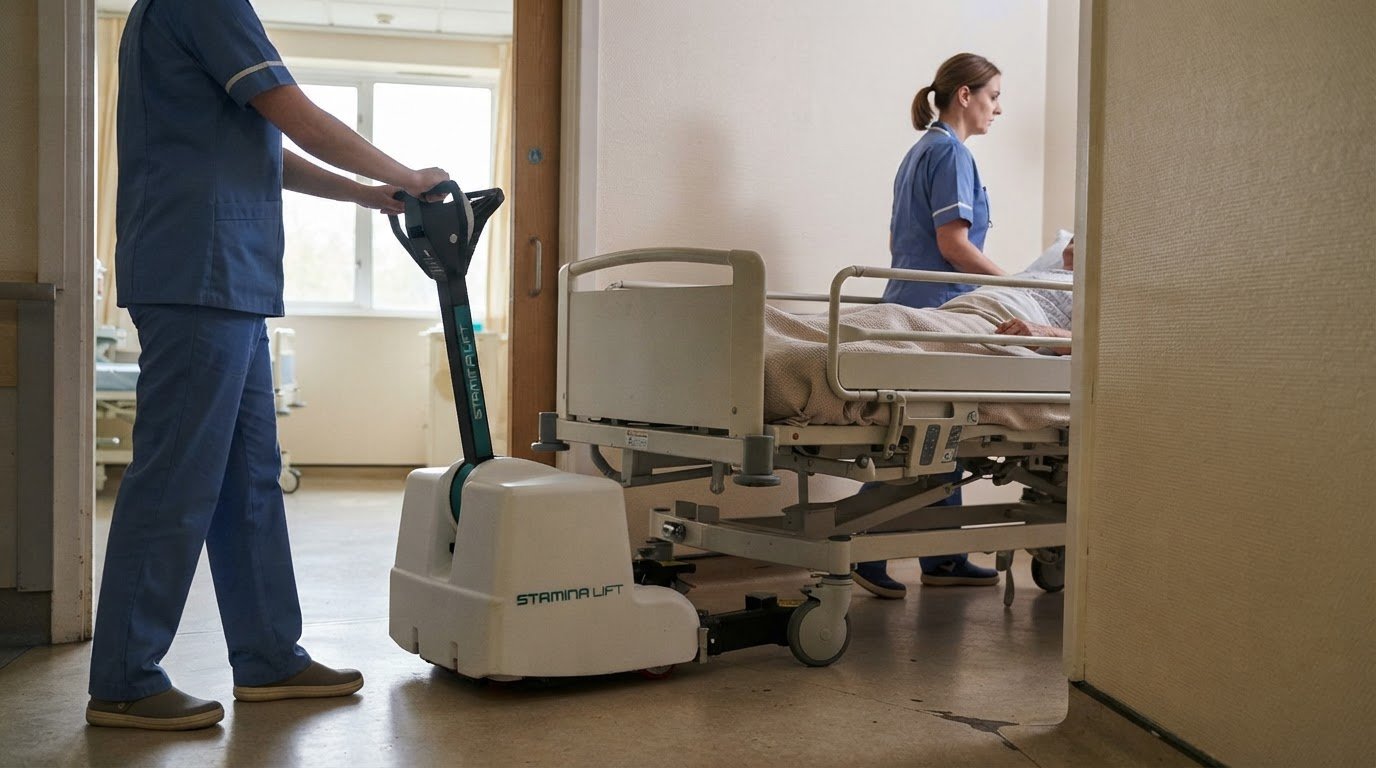
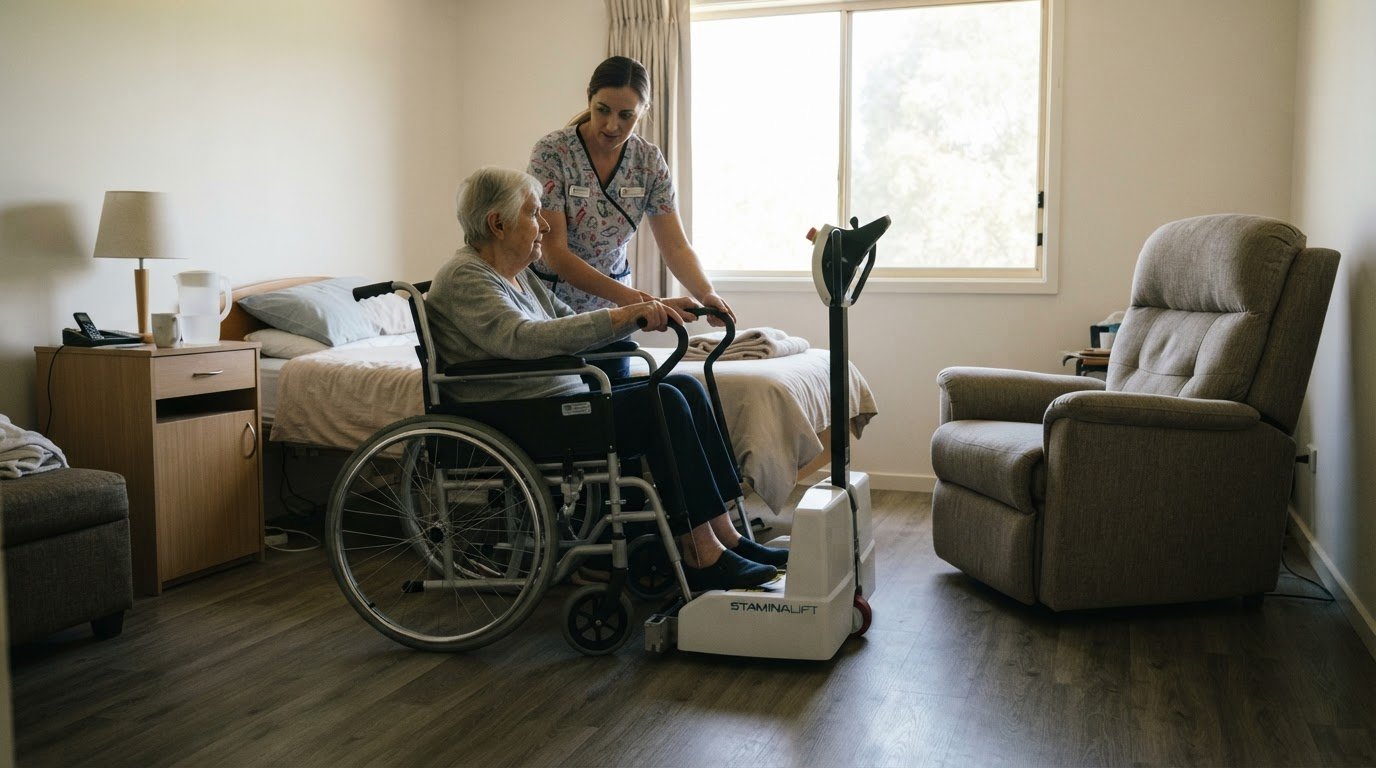
Healthcare facilities use electric tugs to transport linen carts containing clean or soiled laundry, and to move hospital beds, including beds carrying patients. These applications involve different equipment, so the connection, loaded weight and route all matter when choosing a tug. Site procedures should cover secure coupling and approved routes for each movement.
Healthcare facilities use smart electric tugs to transport carts of meals and mail packages. These examples show that tugs can support movement beyond waste containers, while the demands of each trip still depend on the load and path. A facility can consider the intended cart, available turning space and floor conditions when planning where a tug will operate. Cleaning routines, charging instructions and maintenance checks can also be included in the operating plan.
Reducing manual handling by healthcare staff
Powered movement can reduce the force staff need to apply when transporting waste, especially on repeated routes between collection points.
Reducing strain and fatigue
When staff move a heavy bin manually, they apply force through the handle and control it throughout the journey. Repeating this task can add to physical strain and fatigue during a shift. An electric tug supplies the pulling force while the operator guides the load. Staff can connect a waste container at a collection point and guide it towards a designated holding area instead of pushing it for the entire journey.
Powered assistance changes how physical effort is distributed, but it does not remove every handling task. Staff may still need to position the bin, connect it and manage its contents. Review each step, including turning and parking, to identify where powered movement reduces effort and where careful manual handling remains necessary.
Operator safety and powered tug use
Manual pushing and powered towing place different demands on the operator. With manual movement, staff provide the force; with a tug, they guide the powered load and manage its connection and direction. A compact tug may help in a constrained work area, but safe operation still depends on visibility, route conditions and control of the moving bin. Procedures should cover coupling, travel and stopping.
In US hospitals, operate the tug according to its instructions and the facility’s applicable safety procedures. Requirements depend on the equipment and task, so procedures should address the specific tug and route rather than assume every model works the same way.
A practical manual-handling review can follow the movement from start to finish:
Identify where staff push, pull, reposition or hold a loaded bin.
Note route features that add effort, such as turns, thresholds or busy intersections.
Decide which movements a powered tug can take over, and which require staff control.
These steps help distinguish tasks suited to a tug from those that still require direct handling. For example, a tug can tow the container along a service corridor while staff position it at the collection point. Clear handovers also help prevent one worker from pushing while another controls the tug.
Training should use the actual equipment and familiar routes. Staff need to practise coupling and uncoupling, steering, stopping, and responding when a route becomes obstructed. Planned upkeep supports reliable operation; preventative maintenance and repairs can address equipment condition as part of that approach.
Clinical, hazardous and general waste transport
Electric tugs can move waste containers through healthcare facilities, including containers used for hazardous or biological waste. The tug moves the container; the facility’s waste management procedures determine how each waste stream is contained, identified and handled.
Separate transport tasks by container type to keep the process clear. A general waste bin might travel from a ward service area to a collection point, while a clinical waste container follows the facility’s designated route and handling procedures. A powered tug can reduce the need to push or pull either load manually, but it does not replace required controls for the container.
For hazardous or biological waste, plan the transfer around the container and designated route. Staff connect the container to the tug, move it without pushing the full load manually, then disconnect it at the authorised destination. The route, transfer point and operator actions should follow established facility procedures. A tug supports movement; it does not make an unsuitable container or route appropriate.
Before assigning a tug to a waste stream, consider these practical points:
Container compatibility: confirm the tug can connect securely to the bin or trolley used for that stream.
Load and route: account for the filled container and the whole journey, including turns and changes in floor level.
Transfer points: identify where the container is collected, moved and handed over.
Operator procedure: specify who couples, guides and releases the load under site instructions.
These steps help distinguish a transport problem from a waste-handling problem. If staff struggle to push a bin along a long service route, a tug can provide powered assistance. If the issue concerns the container, its contents or its destination, waste management procedures remain central.
General waste transport may involve repeated trips with standard bins from clinical areas to a central collection point. Clinical, hazardous or biological waste may use different containers and designated handling steps. Keeping these tasks distinct helps staff follow the correct process while using powered movement where it suits the load and route.
During implementation, map one representative journey for each container type. Record the collection point, destination, connection method and any route restrictions. Then train operators on the actual sequence, including what to do if a container cannot be connected or the route is blocked. This practical review supports consistent transport without confusing tug operation with waste classification or treatment.
Operating in tight corridors and busy service routes
Hospital waste routes may pass through doorways, shared corridors and active service areas. Assessing these spaces before introducing a powered tug helps identify where turning, passing and stopping need careful planning.
Walk the route with the bin or a representative container. Note narrow points, door swings, corners, changes in floor level and places where staff or equipment commonly cross. A corridor outside a treatment area, for example, may be clear at some times but busy during meal or linen movements. Plan for changing conditions, not just an empty passage.
Assess the tug and attached bin as one moving combination. Check whether the combination can follow the route, negotiate turns and reach the destination without obstructing access. A compact tug may suit restricted spaces, but suitability depends on the complete load and turning path. Allow space to couple and uncouple the container at both ends.
Floor surfaces also affect movement. Smooth flooring, thresholds and uneven transitions can each change how a loaded bin travels. Identify surface changes along the route and consider how the operator will maintain control at each point. A turn beside a doorway, for example, may require a slower approach and clear sightlines.
Busy routes need simple operating practices. Facility teams can set passing points, preferred travel directions and places where a tug should wait for pedestrians or other equipment. A waste transfer should not block access, unexpectedly cross another task or force staff to manoeuvre a bin through a congested space.
Use a practical route review to guide decisions:
Map the collection point, destination and all connecting corridors.
Mark tight turns, doorways, thresholds and changes in floor surfaces.
Identify areas shared with beds, linen carts or meal carts.
Choose safe stopping and waiting points that keep access clear.
Trial the planned movement with the intended container and operating procedure.
This review shows where powered movement can reduce manual handling and where the route itself needs adjustment. Relocating a temporary holding point may remove a difficult turn, while scheduling a transfer outside a busy service period can reduce conflicts with other movements.
Staff should know how to pause if a corridor becomes obstructed or visibility changes. Clear instructions for stopping, waiting and resuming help operators respond consistently. These controls support careful movement but cannot eliminate every possibility of collision or injury. Review routes regularly to account for layout changes, stored equipment and new traffic patterns.
Bin movement in hospitals and healthcare sites
Waste-bin transport is part of the wider movement of equipment through a healthcare facility. An electric tug can move a waste container along a planned route while staff guide it, reducing the need for manual pulling during the journey. Suitability depends on the bin, its connection to the tug and the spaces along the route.
Start with the movement task, not just the equipment. Identify where staff collect the bin, where it needs to go and which corridors connect those points. A route from a ward service area to a collection point may cross shared spaces used by linen carts, meal carts or hospital beds. Mapping these movements highlights where timing, access and turning room matter.
Next, consider how the tug fits into the bin’s usual handling sequence. Staff may need to position the container, connect it, guide it along the route and release it at the destination. Give each step a clear place in the facility’s workflow. A transfer point, for example, can provide room to attach the tug without obstructing a doorway or nearby activity.
Waste bins are not the only loads moved around healthcare facilities. Electric tugs can transport carts carrying clean or soiled laundry, meals, mail and sterilised materials. They can also move hospital beds, including beds carrying patients. Coordinate these movements so a bin transfer fits alongside other tasks rather than disrupting them.
To assess whether powered movement suits a particular task, review:
Load: the bin or cart being moved, including its contents.
Connection: how the container attaches and releases.
Route: corridors, turns, doors and changes in floor surface.
Workflow: collection, travel, arrival and handover responsibilities.
Traffic: other people and equipment using the same spaces.
This review can reveal small process changes with practical value. A different collection point may simplify a turn, while a clearer handover area may prevent bins from waiting in a corridor. These changes can improve workflow without assuming the tug alone will resolve every access or scheduling issue.
Electric tugs operate more quietly than traditional transport methods and produce no exhaust emissions, characteristics that may suit indoor routes. A motorised tug for hospital waste bins works best within a defined movement process, with staff clear on the route, connection and destination before each transfer.
Healthcare facilities also use electric tugs to move hospital beds, including beds carrying patients. Coordinate these movements carefully, including the people guiding the load and the destination’s ability to receive it. Review the route for clear passage, turning space and a suitable transfer point. Staff can agree who guides the movement, who manages the handover and how the route stays clear. A defined process helps coordinate bin transport with other equipment movements while allowing facility teams to assess each route and workflow on its own terms.
RIHA Industries
RIHA Industries supplies the Easi Rider tug to help healthcare staff move heavy loads. For hospital waste handling, assess how powered movement fits the container, route and existing workflow. Bin weight, connection method and corridor conditions all affect whether a tug suits the task.
RIHA Industries also supplies patient transfer systems and a bed mover designed to integrate with existing hospital equipment. These products address different movement needs, so the right option depends on the load and application. Understanding the waste route gives your team a practical basis for deciding whether a tug suits the bin and facility.
Contact RIHA Industries to discuss your healthcare site’s equipment needs.
Plan the next move for your site
Choosing a motorised tug for hospital waste bins starts with a practical review of the task: the container, its route and staff movements around it. This gives your team a clear basis for deciding how powered movement could fit into site operations.
RIHA Industries offers the StaminaLift Transfer System 5000, StaminaLift Transfer System 6000 and StaminaLift 2100 Bed Mover for healthcare movement needs. These offerings address patient transfer and bed movement, while the Easi Rider supports movement of heavy loads. Matching equipment to its intended application helps keep the decision grounded in your facility’s requirements.
Consider the routes and handling tasks your team wants to improve, then discuss how suitable equipment may support them. Contact RIHA Industries about tugs to take the next step towards a considered approach for your healthcare site.
Frequently Asked Questions
What are the risks of using motorised tugs around hospital staff and patients?
Key risks include collisions, trapping or pinching, and loss of control over a moving load. In a busy ward corridor, a patient, visitor or staff member may enter the tug’s path unexpectedly. Poor visibility or an unsecured connection can also make movement harder to control. Reduce these risks with trained operators, clear pedestrian access, suitable travel speeds and procedures for stopping when the route is obstructed.
What bin weight and load capacity should a hospital waste tug support?
Choose a tug rated for at least the heaviest fully loaded bin on the route, including its contents and attached equipment. Assess the full route’s floor conditions, turns, doorways and gradients as well.
What tug features help with infection control and cleaning in hospitals?
Check that the tug’s surfaces and controls fit the hospital’s cleaning process, and include the equipment in established cleaning routines for the areas where it operates.