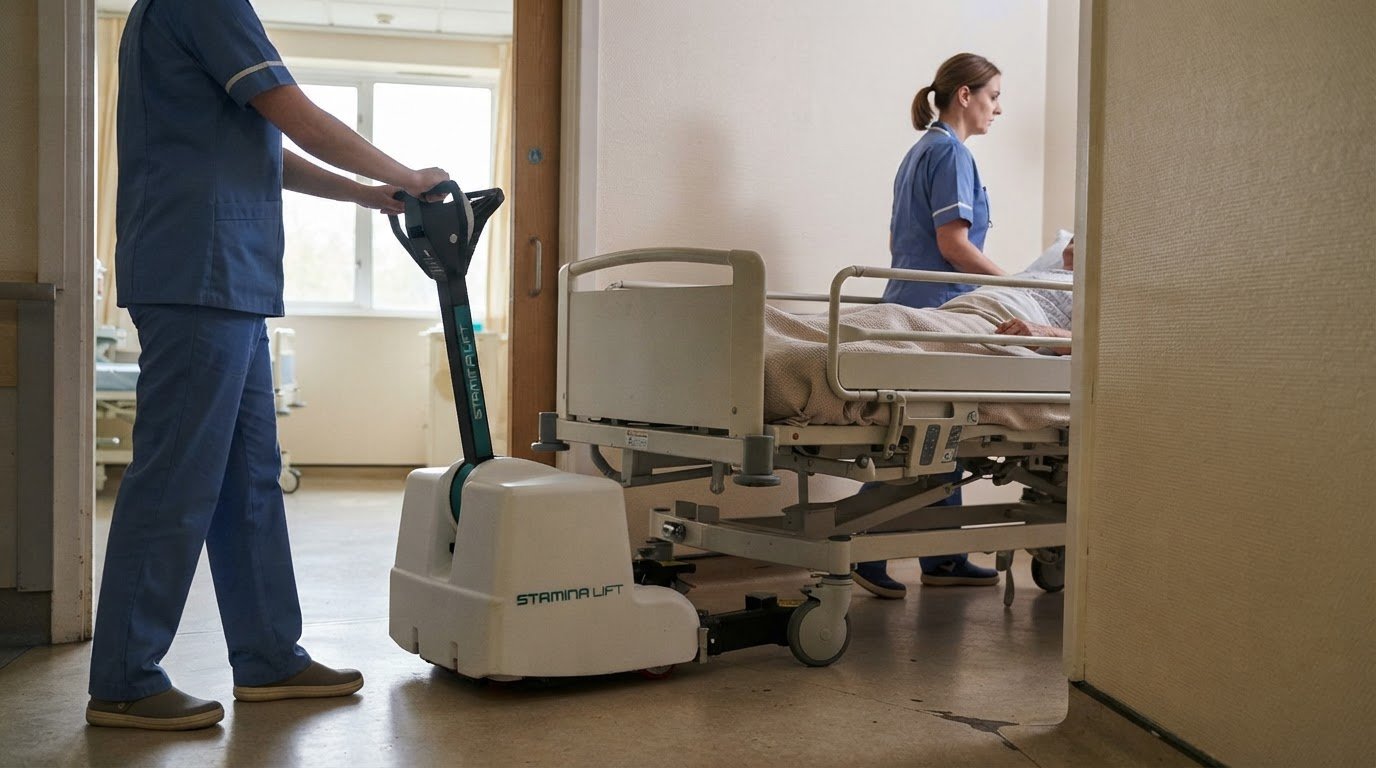
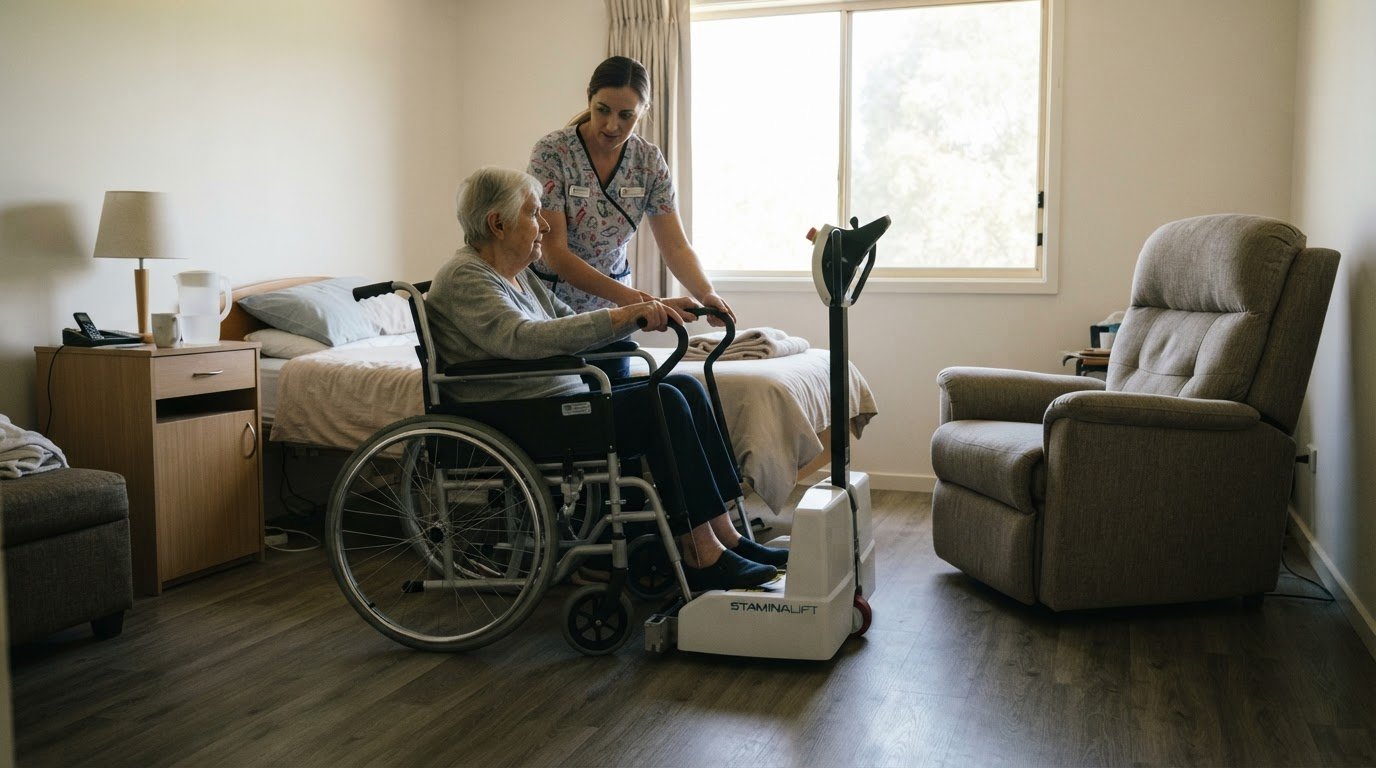
Moving Patients Between Departments: How Transport Supports Care
A transfer is part of care, not simply a trip down the corridor. Moving patients between departments means coordinating the patient’s movement, clinical needs, equipment and handover so care can continue at the destination. The right approach depends on the patient’s condition and the support needed during the journey.
It’s easy to treat transport as a practical task, but delays, equipment problems or gaps in communication can affect the patient’s experience and continuity of care. Careful preparation helps teams support the patient’s wellbeing while keeping the receiving department informed.
This article explains what patient transportation involves and how staff assess and prepare for a move. It also explores the role of assistive devices, why timely movement matters to patient flow, and the risks teams need to manage during transport. Together, these considerations show how a well-coordinated transfer supports care from one department to the next.
Table of Contents
What Is Patient Transportation?
Patient transportation is the planned movement of a person between care areas while maintaining appropriate clinical support. For an internal transfer, preparation, communication and a clear handover connect the sending and receiving teams.
Preparing patients for transport
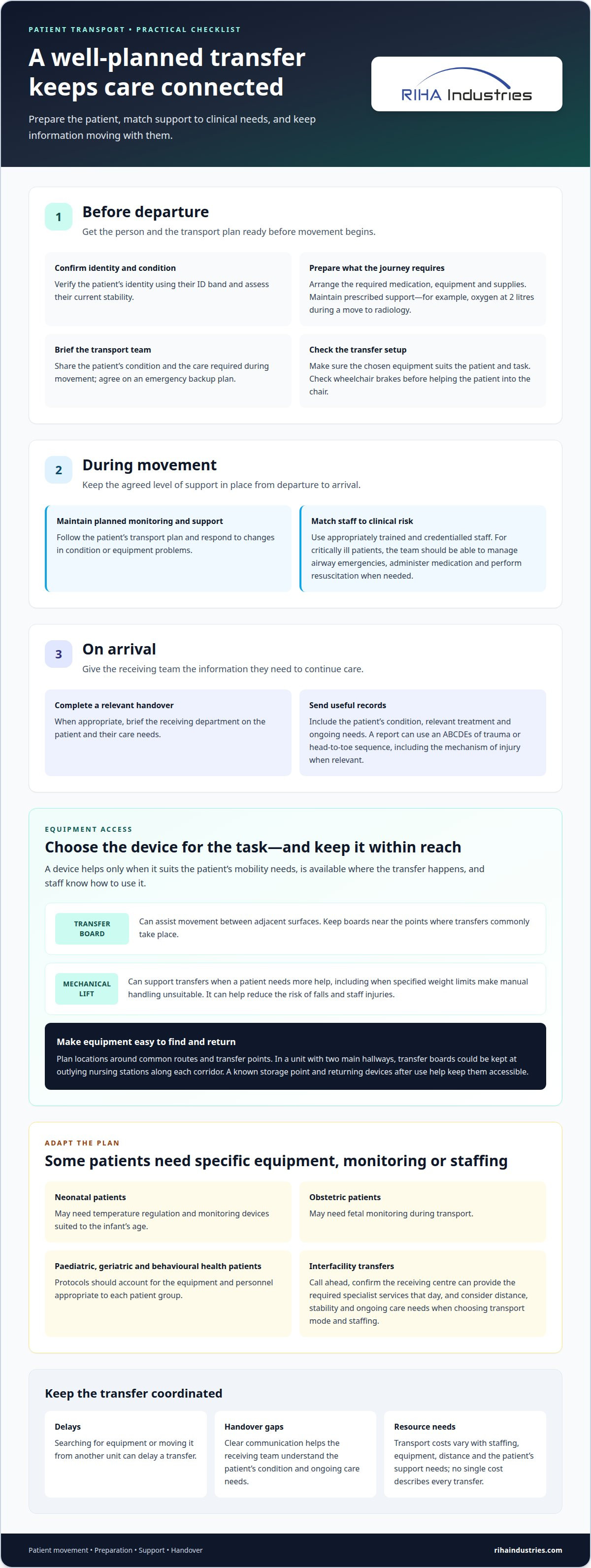
Preparation means assessing the patient’s current condition and arranging the support needed for the journey. Staff verify identity using the ID band, assess stability, and prepare required medication, equipment and supplies. For example, a patient prescribed oxygen at 2 litres needs that therapy maintained during a move to radiology. Staff also agree on an emergency backup plan and check wheelchair brakes before helping a patient into the chair. These steps help the team anticipate needs rather than respond to avoidable problems during movement.
Stages of a patient transfer
A transfer has pre-transfer, movement and post-transfer phases, each with a distinct handover task. Before departure, the sending team prepares the patient and briefs the personnel overseeing transport. During movement, staff maintain the planned level of monitoring and support, responding to changes in condition or equipment problems. On arrival, they give the receiving department a handover when appropriate, so care can continue with relevant information. For interfacility transfers, the referring team calls ahead, confirms the receiving centre can provide the required specialist services that day, and considers distance, stability and ongoing care needs when choosing transport mode and staffing.
Considerations for special populations
Planning for specific patient groups adapts equipment, monitoring and staffing to age and care needs. Neonatal transport may require temperature regulation and monitoring devices suited to the infant’s age; obstetric patients may need fetal monitoring. Protocols should also address paediatric, geriatric and behavioural health patients. These distinctions help teams prepare for needs that a standard transport plan may not cover, including suitable equipment and personnel trained for the patient group.
Intrahospital planning also matches the transport team to clinical risk. Staff overseeing transfers need appropriate training and credentialing. For critically ill patients, the team should include providers able to manage airway emergencies, administer medication and perform resuscitation when necessary. A pre-transfer report can summarise the patient’s condition and the care required during movement.
Within a U.S. hospital, department-to-department transfers follow facility procedures and applicable accreditation requirements. EMTALA covers appropriate medical screening and stabilisation before a patient is transferred to another facility, regardless of their ability to pay. Interfacility planning also includes informed consent, advance coordination and a receiving service able to meet the patient’s needs.
Records accompanying a transfer should explain the patient’s condition, relevant treatment and ongoing needs. A transfer report can organise information using the ABCDEs of trauma or a head-to-toe sequence, including the mechanism of injury when relevant. Documentation should protect confidentiality and comply with privacy regulations such as HIPAA, according to the U.S. Department of Health and Human Services.
Intrahospital transport costs vary with the resources used, including staffing, equipment, distance and the patient’s support needs. The operational cost reflects the work and resources required for that particular movement; no single cost describes every transfer.
Availability of assistive devices
Assistive devices support patient movement when a person’s mobility needs make manual handling unsuitable. Availability means more than having equipment somewhere in a hospital: staff need suitable devices where transfers take place. A mechanical lift may be used when a patient exceeds specified weight limits, helping reduce the risk of falls and staff injuries. The appropriate option depends on the transfer task, the patient’s needs and the equipment available in that care area.
Location affects whether a device is practical to use. If staff have to search for equipment or move it from another unit, the transfer may be delayed. Facilities can plan equipment locations around common routes and transfer points instead of relying on a single central store. A device kept near the ward where it is routinely needed is easier to include in the movement plan.
For example, a hospital unit with two main hallways could keep transfer boards at outlying nursing stations along each corridor. Staff would then have a board nearby instead of fetching one from the opposite end of the unit. This arrangement makes equipment easy to locate and supports access across the ward. Placement should reflect the layout and movement patterns of each unit.
Different devices address different transfer needs. A transfer board can assist movement between adjacent surfaces, while a mechanical lift supports transfers when the patient needs more help. Availability alone doesn’t establish suitability: staff should consider the patient’s mobility and the task before selecting equipment. The device must suit the planned movement, and staff need to know how to use it. A mismatch can make a transfer harder to coordinate.
Equipment planning also involves a clear process for locating and returning devices. A designated storage point, known to the relevant staff, helps teams find a transfer board or lift when a transfer is planned. Returning the device to its agreed location after use keeps it accessible for the next patient. These practical arrangements connect equipment supply with everyday workflow, especially in units where staff move patients along established corridors.
Hospitals can review where transfers occur and whether devices are positioned accordingly. For instance, recurring movement between a ward and a nearby department may make it useful to have appropriate transfer equipment along that route. The aim is to match equipment access to actual patient movement, rather than assuming one location suits every unit. Thoughtful placement lets staff include suitable support in the transfer plan from the outset.
Avoiding unnecessary delays
Timely transfers depend on distinguishing essential preparation from steps that can wait. Procedures or imaging that aren’t needed before departure shouldn’t delay a transfer. Required stabilisation and treatment remain part of safe care, while tasks that don’t affect readiness may be completed later. For example, if a patient is ready for a scheduled specialist assessment, repeating an investigation without a clinical reason can delay movement without helping the receiving team act.
Coordination can reduce waiting between the decision to transfer and departure. The sending team can tell the receiving department the planned arrival time and the patient’s immediate needs. The receiving team can then prepare the appropriate room, staff and equipment. If the destination isn’t ready, the delay may stem from a handover gap rather than the journey itself. A shared update helps both teams identify what remains outstanding and who is addressing it.
Clear responsibilities also prevent tasks from being duplicated or overlooked. The sending team can identify who prepares the patient, arranges transport and contacts the destination. For example, if one staff member assumes another has called radiology, the patient may wait while the teams clarify the plan. Assigning a responsible role to each task makes the sequence visible and supports a smoother departure.
Equipment and route planning can affect transfer timing, too. A suitable wheelchair or other assistive device should be available for the planned movement, and staff should know where to find it. Choosing a practical route through the hospital can avoid unnecessary detours, especially when corridors are busy or access is restricted. If the usual route is unavailable, communicating an alternative early helps prevent last-minute uncertainty.
Some delays are clinically appropriate. A change in the patient’s condition may require reassessment or additional support before movement continues. Staff should distinguish that necessary pause from an administrative delay, such as waiting for information already available in the patient’s record. The priority is not simply speed; it is avoiding idle time without bypassing care the patient needs before departure.
Reviewing recurring bottlenecks can show where the transfer process needs adjustment. A department might find that patients often wait for transport after the receiving team has accepted them. Teams can examine the sequence, identify where communication or equipment access breaks down, and clarify the next action. Recording the reason for each delay helps distinguish isolated disruptions from patterns that affect patient flow.
These practices make moving patients between departments more coordinated by aligning clinical readiness, staff responsibilities and destination preparation. A clear plan reduces avoidable waiting while preserving time for decisions that protect the patient’s wellbeing.
Patient flow and care outcomes
Patient flow describes how people move through care areas to receive assessment, treatment or specialist services. A transfer affects more than the patient’s location: it also coordinates the sending team, receiving department and available resources. For example, a radiology transfer needs the destination to be ready for the patient’s arrival. Clear coordination helps departments continue care without losing sight of the reason for the move.
Structured communication gives teams a shared way to pass on essential information. SBAR and I-PASS can organise details such as the patient’s current condition, recent treatment and outstanding needs. A concise, consistent handover helps receiving staff understand what has happened and what care should follow. It also gives the sending team a practical structure for sharing information, rather than relying on an informal update that may omit important details.
Trauma transfers show how patient flow depends on matching capability to need. In the United States, patients may be transferred to a Level III or IV trauma facility, while those with more severe injuries or specialty-care needs may require a Level I or II trauma centre. Lifesaving care may first be delivered at the scene or at an initial Level III or IV centre. A later move can support definitive care when the patient is ready.
Choosing a transfer destination is a clinical decision, not simply a matter of finding the next available bed. The patient’s injury, stability and need for specialist services shape where care can continue. For example, a patient may receive immediate treatment at an initial trauma facility before moving to a centre with the required specialist capability. This staged pathway links urgent intervention with access to further care, while recognising that the transfer must suit the patient’s condition.
Flow also depends on departments sharing timely information about capacity and readiness. If the receiving service knows the patient’s needs and expected arrival time, it can organise the appropriate people and resources. If details arrive late, staff may need to clarify the plan before care proceeds. SBAR or I-PASS can support this exchange, particularly when several teams contribute to a complex movement.
Organisations can strengthen care by learning from transport incidents. Reviewing incident reports may reveal recurring issues, such as unclear handovers or delays arranging suitable support. Teams can then develop targeted changes that address the specific pattern, rather than applying a broad solution to every transfer. For example, repeated communication gaps between two departments could prompt a shared handover process.
These links between transfer decisions, communication and service capability make patient movement part of the wider care pathway. A well-matched destination and organised handover help the next team understand the patient’s needs and continue appropriate care. In trauma pathways, the distinction between initial lifesaving treatment and later definitive care shows why movement must support clinical priorities, not just operational flow.
Risks and adverse events during patient movement
A transfer can expose a patient to risks that are less visible during stationary care. Their condition may change, equipment may malfunction, medication errors may occur, or communication may fail. For example, a loose connection in equipment supporting a patient can interrupt care during movement. Recognising these risks helps teams plan around the patient’s needs and respond promptly if circumstances change.
Infection is another concern during hospital movement. In the United States, 1 out of 31 hospitalised patients has a hospital-acquired infection. One study found that each intrahospital transfer increased the chance of a nosocomial infection by 9%. These figures highlight why transfers should have a clear care purpose, with unnecessary movement avoided where possible.
A patient’s condition can change between departments, even over a short route. Someone who becomes less responsive or develops breathing difficulty may need immediate clinical attention rather than continued movement. The transport plan should account for the patient’s current support needs, and staff should remain alert to changes. For critically ill patients, the transfer team needs the capability to manage airway emergencies, administer medication and perform resuscitation when necessary.
Equipment problems can interrupt support at a critical point. A wheelchair brake that is not engaged, for instance, can create instability as a patient transfers into the chair. Oxygen or monitoring equipment can also be affected by a fault or a dislodged connection. Staff can reduce avoidable equipment-related risk by confirming that required equipment is ready and functioning before departure.
Medication and communication errors often arise when information is incomplete or misunderstood. A change in the care plan may not reach the receiving team, or medication details may be unclear during handover. Structured communication, such as SBAR or I-PASS, helps teams organise key information consistently. A clear account of recent treatment and ongoing needs gives receiving staff a better basis for continuing care.
Risk management continues after the patient arrives. Documenting an incident allows the organisation to examine what happened and whether similar events recur. For example, repeated reports of equipment faults on one route may point to a need for targeted action. Reviewing incident patterns helps teams focus improvements on the specific failure rather than treating every event as unrelated.
Reducing risk doesn’t mean avoiding every transfer. Movement may be necessary for imaging, treatment or specialist care, and the purpose should guide the plan. Teams can weigh the patient’s stability, required support, equipment and destination readiness before proceeding. This helps keep clinically necessary transfers moving while identifying risks that need attention. To explore equipment options that support patient movement, view patient transfer solutions.
RIHA Industries
RIHA Industries helps healthcare facilities address patient and equipment movement with transfer systems and bed-moving solutions. Its StaminaLift Transfer System 5000 and StaminaLift Transfer System 6000 are designed to integrate with existing hospital equipment, supporting facilities planning patient transfers around their current environment.
The StaminaLift 2100 Bed Mover, Easi Rider and Easi Mover address related movement needs within healthcare settings. These options may be relevant when a facility is reviewing how equipment supports patient transfers and everyday operations. The right fit depends on the movement challenge and the equipment already in use.
For a discussion about patient transfer and movement solutions, contact RIHA Industries.
Plan the next step in patient movement
A considered approach to moving patients between departments starts with understanding movement patterns across your facility. Identify where transfers begin and end, which routes staff use, and where equipment needs to connect with existing hospital systems. These details can help shape a practical discussion about the handling challenges your teams face and the environment in which they work.
It also helps to distinguish routine movement from transfers that place greater demands on staff or equipment. A clear picture of these situations provides a useful basis for considering what support may suit your facility’s operations. The aim is to connect the physical task with an appropriate equipment approach while keeping patient wellbeing central.
For a conversation about equipment options suited to your movement needs, discuss your requirements with RIHA Industries. A thoughtful assessment of the task and setting can help your team take a confident next step towards supporting patient movement.
Frequently Asked Questions
Why Is the Movement of Patients Important?
Patient movement gives people access to assessments, treatments and specialist services that may not be available in their current department. A patient might need imaging before clinicians can decide on the next stage of care, for example. Coordinated movement also helps the receiving team prepare for the patient’s arrival. The purpose of each transfer should guide its timing and destination, keeping the move connected to the patient’s care needs.
What does moving patients between hospital departments involve?
It involves coordinating a patient’s journey within one hospital, from the sending area to the department providing the next service. The move may require staff, a wheelchair or other suitable equipment, and a plan for care needs during transit. For example, a patient travelling from a ward to radiology may need their prescribed oxygen continued. The receiving team needs enough information to understand why the patient has arrived and what care follows.
What are the steps for safely transferring a patient between departments?
A practical sequence helps teams coordinate the move:
Confirm the transfer purpose, destination and patient identity.
Assess the patient’s condition and arrange required medication, supplies and equipment.
Brief the transport personnel and agree on the response if the patient’s condition changes.
Move the patient with appropriate support, then hand over relevant information on arrival.
If the patient’s condition changes before departure, reassess the plan before proceeding.
Who is responsible for coordinating an in-hospital patient transfer?
The care team arranging the transfer coordinates the clinical plan with the personnel overseeing the move and the receiving department. Responsibilities include communicating the destination, patient needs and expected handover. For instance, the sending team should ensure the receiving service knows what support the patient requires. Clear role allocation helps prevent missed calls or duplicated tasks, while allowing the receiving team to prepare for the patient’s arrival.
What equipment and staffing are needed for moving patients between departments?
Equipment and staffing depend on the patient’s mobility, condition and support needs. A mobile patient may need a wheelchair, while another person may require a mechanical lift or transfer board. Staff should be trained for the task and use equipment suited to the transfer. For a patient needing continuous oxygen, the plan must account for that therapy throughout the journey. Critically ill patients need personnel able to respond to urgent clinical needs.
How do hospitals transfer patients who need continuous monitoring or life support?
Hospitals plan transfers around the patient’s monitoring and treatment needs, ensuring support continues during movement. Staff prepare the necessary equipment and medications, and establish what to do if the patient’s condition worsens. For critically ill patients, the transport team should include providers able to manage airway emergencies, administer medication and perform resuscitation when needed. The destination team should receive a clinical handover so monitoring and treatment continue after arrival.
What are the common risks and complications of moving patients within a hospital?
Risks include changes in the patient’s condition, equipment malfunction, medication errors or communication failures. A patient could become less stable during the journey, or a device supporting care could stop working. Transfers can also expose patients to infection risks. Teams can respond by matching staffing and equipment to the patient’s needs, maintaining relevant support and sharing clear information between departments. Recording incidents can help hospitals identify recurring problems.
How can hospitals reduce delays and improve patient flow between departments?
Hospitals can reduce avoidable waiting by coordinating the sending team, transport personnel and destination before departure. Calling ahead helps the receiving department prepare, while clear responsibility for each task reduces missed steps. Unnecessary procedures or imaging should not hold up a transfer. Teams can also review incident reports and recurring delays, then target the process causing the bottleneck. A delay required for clinical assessment is different from one caused by poor coordination.