The Cost of Patient Handling Injuries to Hospitals: An Australian Guide
What if a workers compensation claim is only the most visible part of the cost of patient handling injuries to hospitals? Claims and treatment expenses are easier to record, but staff absence, replacement staffing, overtime, modified duties and disrupted workflows can also affect hospital operations.
It’s understandable to start with direct claim costs. Yet those figures alone may not show the full impact, and overseas estimates may not reflect Australian conditions. A useful assessment starts with local records and clear injury categories, including a distinction between bed movement and other patient-handling tasks.
This guide explains how to identify direct, indirect and operational costs, build a transparent baseline from facility data and evaluate prevention using consistent measures. It also covers a South Australian hospital case study: bed-moving injuries fell from 20 per year to zero within two years of implementing StaminaLift. That result is specific to one facility, not a guaranteed outcome for every hospital. The aim is to help you measure the burden carefully and identify where targeted prevention may make a difference.
Table of Contents
What does the cost of patient handling injuries mean for hospitals?
Which direct and indirect costs can follow a patient handling injury?
How can an Australian hospital estimate its patient handling injury costs?
How should hospitals evaluate prevention without overstating savings?
What does the South Australian StaminaLift case study show hospitals?
What does the cost of patient handling injuries mean for hospitals?
The cost of patient handling injuries to hospitals includes more than the amount recorded against an individual workers compensation claim. It can encompass direct financial expenses, workforce impacts and changes to service delivery after a staff member is injured while handling a patient or moving related equipment. The precise mix depends on the incident, the employee’s circumstances and how the hospital records its response.
Patient handling injury costs are the direct expenses and wider workforce and service impacts a healthcare organisation incurs when a staff member is injured during a handling task. Direct costs may include claim-related or treatment expenses where these are recorded. Wider impacts may include roster adjustments, overtime, modified duties or workflow disruption. These are categories to investigate, not costs to assume for every injury.
This section focuses on injuries to hospital staff. It excludes the separate costs associated with patient immobility, such as care needs or patient outcomes. Keeping those questions distinct helps decision-makers assess worker safety without blending it with a different clinical and financial issue.
It also matters which activity caused the injury. A record that says “manual handling” may not show whether the worker was moving a bed, lifting or repositioning a patient, or completing a transfer. Healthcare settings involve specific hazards related to patient handling, as discussed in Workplace safety in healthcare settings. Clearer task descriptions make local analysis more useful.
Which handling activities should hospitals include?
Separate bed movement from lifting, repositioning and patient transfer activities wherever incident and work activity records support that distinction. These tasks can involve different circumstances and call for different prevention measures. A broad injury category may hide a pattern, such as repeated incidents during bed movement, making it harder to identify where a targeted change could help.
Use the task recorded in the incident report or related work activity data. If the activity is unclear, classify it as unknown rather than assigning it to a specific task. This protects the integrity of the baseline and avoids attributing injuries to bed movement without evidence.
Why do injury costs extend beyond an individual claim?
A claim value captures only the costs represented in that claim. Depending on the incident, a hospital may also need to examine staff absence, roster changes, overtime, replacement arrangements, modified duties and investigation time. Check these potential impacts against facility records. They aren’t guaranteed consequences of every injury.
Operational effects can vary by ward and shift. For example, roster records may show overtime after an absence, while other records may show no measurable change in service delivery. Assess local evidence rather than assuming disruption occurred. Overseas cost estimates can help frame questions, but shouldn’t be treated as Australian hospital benchmarks without considering their population, setting and cost definitions.
Which direct and indirect costs can follow a patient handling injury?
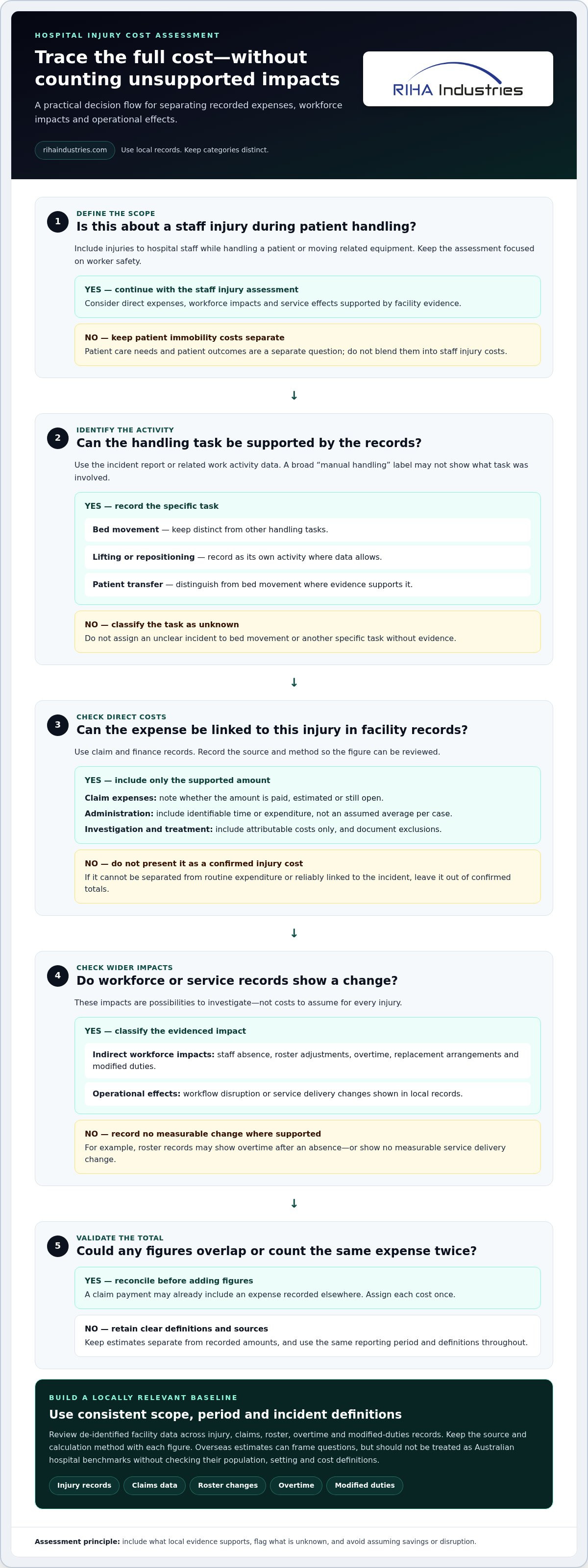
A hospital can build a clearer picture by grouping costs into three categories: direct expenses, indirect workforce impacts and operational effects. This structure helps finance, claims and workforce teams see what their records capture, where information is missing and which items may overlap. Comparisons are more meaningful when the same definitions and reporting period are used throughout.
The cost of patient handling injuries to hospitals shouldn’t be calculated by adding every associated figure together without checking what each one represents. A claim payment, for instance, may already include an expense recorded elsewhere. Assign each item once, note its source and keep estimates separate from recorded amounts.
What direct costs can be recorded in hospital data?
Start with claim-related payments and administration expenses that can be attributed to the injury in finance or claims records. Add investigation and treatment costs only when the facility can access reliable records and link them to that incident. If an expense can’t be separated from routine expenditure, don’t present it as a confirmed injury cost.
Claim expenses: use the amount recorded for the defined period, noting whether it is paid, estimated or still open.
Administration: include identifiable time or expenditure for claim handling, rather than assuming an average cost per case.
Investigation and treatment: record attributable costs only, and document any exclusions.
Set a clear reporting period, such as a financial year or another consistently applied interval. Check that totals don’t combine invoices, reimbursements or internal allocations that represent the same expense. Where records differ in scope, keep the source and method with the figure so another reviewer can follow the calculation.
What indirect operational impacts deserve attention?
Workforce records can reveal impacts that don’t appear in the claim total. Review roster changes, overtime, temporary replacement staffing, modified duties and lost work time as distinct inputs. They describe different consequences, so avoid combining them into a single “productivity” figure unless the method clearly prevents overlap.
Roster and overtime: compare roster records before and after the incident. Attribute additional hours only where the link is documented.
Replacement staffing: distinguish temporary cover from overtime worked by existing staff.
Modified duties and absence: use workforce records to describe time away from usual duties, without counting the same hours twice.
Workflow disruption may matter too, but it’s harder to price reliably. If a ward reports delays or changed task allocation, record the evidence and explain how any estimate was made. Don’t convert a perceived impact into a dollar amount without a transparent basis.
Indirect costs need local measurement because staffing arrangements, record systems and the operational response to an injury differ between hospitals. Overseas estimates may help frame questions about which categories to examine, but differences in jurisdiction, workforce arrangements and cost definitions mean they shouldn’t be presented as Australian hospital benchmarks. Base local calculations on facility records, and explain assumptions for impacts that can’t be measured directly.
Where bed movement is an identified risk, a powered bed mover may be considered as one element of a broader prevention approach. RIHA Industries designs and manufactures patient and equipment movers, and provides service, maintenance and repairs. Explore RIHA’s patient and equipment movers as part of that wider assessment.
How can an Australian hospital estimate its patient handling injury costs?
A useful estimate starts with the hospital’s own records, not an imported average. A consistent method lets finance, claims and workforce teams see what is known, what has been estimated and where data gaps limit comparison. Keep staff information de-identified in analysis, and restrict the scope to handling activities the facility can identify reliably.
Set the period and scope. Choose a reporting period and apply it consistently. Define which workforce groups and sites are included, and specify whether the estimate covers bed movement, patient transfers, lifting, repositioning or another recorded task.
Agree on an incident definition. Decide which events count, such as reported staff injuries linked to a defined handling activity. Document how unclear or unclassified incidents will be treated rather than assigning them to a task without evidence.
Gather and match records. Bring together incident reports, workers compensation records, claims information and workforce absence data. Where available, use roster, overtime and modified-duties records to assess operational effects. Match information using an approved de-identified process, and avoid counting one incident more than once.
Calculate recorded direct costs separately. Use finance and claims records for attributable payments, administration, treatment or investigation expenses. State which categories are included, the reporting period and any exclusions. Keep amounts that can’t be linked confidently to an incident out of the recorded-cost total.
Estimate operational impacts transparently. Review additional overtime, replacement staffing, modified duties and lost work time as separate inputs. If estimating workflow disruption, explain the evidence and calculation method. Present local estimates separately from recorded expenses, with assumptions and uncertainty clearly stated.
Which records can support a defensible baseline?
Incident reports can describe the event and task; workers compensation and claims records can support direct-cost analysis; workforce absence, roster, overtime and modified-duties records can show staffing impacts. Link an event to a specific task only when the documentation supports it. Note missing fields, changes in reporting practice and records that couldn’t be matched, since these can affect the apparent total.
How should hospitals compare costs over time?
Use the same incident definition, workforce scope, cost categories and reporting periods for each comparison. Track injury frequency alongside costs and a relevant exposure measure, such as hours worked or task activity, only where the facility records it consistently. A change in cost may reflect reporting, staffing or other prevention measures, not just equipment. Don’t attribute an outcome to one intervention without evidence to support the conclusion.
Overseas research can help identify questions to ask, but its figures shouldn’t replace facility data or be presented as an Australian hospital estimate. The cost of patient handling injuries to hospitals is most useful for planning when readers can trace each figure to a record or a clearly described local estimate. Keep the calculation method with the results so the next review can reproduce and improve the baseline.
How should hospitals evaluate prevention without overstating savings?
A sound evaluation measures whether an intervention is associated with safer work and workable day-to-day operations, then reports the evidence without promising a financial return. Compare baseline and follow-up periods using the same injury definitions, workforce scope and handling tasks. If records or reporting practices change, document the difference before drawing conclusions.
Assess safety outcomes alongside staffing and service considerations. For example, track injuries related to the specific activity the intervention targets, while also reviewing relevant roster changes, overtime, modified duties and workflow observations. These measures help show whether the approach is practical in the local setting, not just whether a single headline number has moved.
What makes an intervention comparison meaningful?
Describe what the intervention covers: the handling activities, staff groups, locations and equipment involved. Record other changes introduced during the comparison period, such as training, staffing or workflow adjustments. Without this context, a before-and-after difference can be difficult to interpret or attribute responsibly.
A concise comparison can keep the assessment transparent:
Costs: separate recorded expenditure from estimates, and use the same categories in both periods.
Safety outcomes: compare consistently defined incidents and note the activity involved where records allow.
Operating context: record relevant changes in staffing, training, workflow or exposure.
Limitations: identify missing data, changed reporting practices and factors that may have influenced the result.
Equipment should be considered as one part of a broader risk-control and training approach, rather than as a standalone explanation for every outcome. Hospitals assessing handling equipment can use patient handling equipment selection criteria to inform the practical evaluation.
How can hospitals assess a potential return on investment?
Build any return-on-investment assessment from facility-verified costs and clearly defined equipment and service inputs. Separate known expenditure from potential avoided costs. If the hospital models scenarios, state the assumptions behind each one, such as which injury-related costs might change and over what period. Present these as scenarios, not guaranteed savings or a forecast.
Keep the calculation traceable: identify the source for each input, explain exclusions and show how uncertainty affects the result. Don’t count the same staffing impact in multiple categories, and don’t treat a reduction in reported injuries as a dollar saving unless the associated financial change is supported by records.
Procurement decisions also involve operational fit, not just projected costs. A hospital bed mover procurement guide can support consideration of purchasing factors alongside the hospital’s own evaluation criteria. The cost of patient handling injuries to hospitals is best used as one input to prevention decisions, with worker safety and service requirements assessed alongside financial measures.
For hospitals evaluating powered bed movement as one possible component of prevention, explore RIHA’s patient and equipment movers in the context of your facility’s handling tasks and evaluation goals.
What does the South Australian StaminaLift case study show hospitals?
A large South Australian hospital recorded 20 bed-moving injuries per year before implementing StaminaLift. After implementation, bed-moving injuries fell to zero within two years. This is a specific, task-focused result from one facility. It shows the value of tracking a defined injury type over time, but it doesn’t establish that another hospital will achieve the same outcome.
The case study is most useful as a prompt for local measurement, not as a forecast. Hospitals can start by examining their own bed-moving incident records, checking how consistently tasks and injuries have been classified, and considering the operating conditions in which incidents occur. A prevention plan should reflect the facility’s work patterns, equipment and other risk controls.
What can hospital leaders learn from the reported result?
A baseline tied specifically to bed movement gives leaders a clearer point of comparison than a broad manual-handling category. To use the same approach, define which incidents count, identify the relevant period and keep the task definition consistent when reviewing follow-up data. Also note other changes, such as training or workflow adjustments, that may influence the comparison.
That discipline helps hospital teams interpret results without overstating what a case study proves. One facility’s outcome can inform questions to investigate, but it can’t guarantee a similar reduction elsewhere. Leaders can use local records to identify whether bed movement is a distinct source of staff injuries and set measures that reflect their own circumstances.
How can RIHA support safer equipment movement?
RIHA Industries designs and manufactures Australian-made patient and equipment movers. StaminaLift is a battery-powered mover that connects to nearly any bed, stretcher or trolley. RIHA provides national service coverage across Australia, along with service, maintenance and repair support for equipment.
Product-specific details can help a facility assess whether powered movement is relevant to its tasks. The StaminaLift Transfer System 5000 buying guide offers further information for hospitals considering that system. Any equipment decision should sit within a broader prevention approach, with outcomes assessed against a clear local baseline.
RIHA Industries was recognised as Top Hospital Bed Movers and Accessories Manufacturer 2025 by MedTech Outlook. The recognition provides context about the company, while the South Australian result remains a facility-specific case study rather than a universal promise. For hospital leaders assessing the cost of patient handling injuries to hospitals, the practical lesson is to measure bed-moving incidents locally and evaluate prevention using consistent, transparent measures.
Discuss safer equipment movement with RIHA as part of your facility’s prevention planning.
Make prevention part of your next planning cycle
A practical next step is to choose one handling task for closer review and make its risks visible in routine planning. Bring together the people who understand the work on the floor with those who oversee safety, workforce data and equipment decisions. Agree on what you’ll measure, how you’ll record changes and when you’ll review whether the approach is working.
This creates a stronger foundation for decisions about the cost of patient handling injuries to hospitals. Rather than relying on broad assumptions, your team can use facility evidence to identify where an adjustment may support safer movement and more reliable operations. Keep the focus on improving conditions for staff, while assessing financial implications with care.
RIHA Industries works with hospitals on patient and equipment movement through its Australian-made movers, supported by service, maintenance and repairs. Discuss safer hospital equipment movement with RIHA Industries and take a considered next step towards a prevention approach suited to your facility.
Frequently Asked Questions
How much does a patient handling injury cost a hospital?
There’s no single figure that applies to every Australian hospital. The cost of patient handling injuries to hospitals varies with injury severity, treatment and claim expenses, time away from work, replacement staffing and other impacts recorded locally. For a useful estimate, define which incidents are in scope and use facility records rather than applying overseas figures as local benchmarks. Keep assumptions visible so decision-makers can see how the estimate was developed.
Are patient handling injuries a major cost for hospitals?
They can create financial and operational costs, but their scale varies between facilities and incidents. A claim or treatment figure may not show every effect, such as roster adjustments or investigation time. To understand whether the burden is material in your setting, review facility data across a consistent period and compare like with like. Avoid drawing conclusions from one high-cost incident or a total that combines measured and estimated impacts.
Can hospitals calculate indirect costs of staff injuries?
Yes, where records support the calculation and assumptions are made clear. For example, a hospital could compare rostered hours with actual hours after an injury, then identify attributable overtime separately from temporary replacement staffing. Modified duties and recorded absence can also be tracked as distinct measures. If workflow effects can’t be reliably valued, describe the operational impact without assigning an unsupported dollar amount.
What happens if injury records don’t identify the handling task?
The hospital may not be able to tell whether an injury occurred during bed movement, a patient transfer or another activity. Keep the event in a general or unclassified category rather than guessing its cause. Review which fields are often missing and consider improving future incident reporting so staff can record the task and circumstances. This helps later analysis identify patterns without overstating what incomplete records show.
Does a reduction in injury numbers prove that equipment caused the change?
No. Injury figures alone can’t establish that equipment caused a change, particularly if training, staffing, workflows or reporting practices also changed. A large South Australian hospital reported that bed-moving injuries fell from 20 per year to zero within two years of implementing StaminaLift. That is one facility’s reported result, not a guaranteed outcome elsewhere. Interpret comparisons alongside relevant changes and limitations in the local setting.
Should hospitals include patient immobility costs in this calculation?
Not if the calculation is specifically about staff injuries during patient handling. Patient immobility involves different cost drivers and outcomes, so combining it with staff injury costs can obscure what the figures mean. If a hospital needs to assess both, keep the definitions and calculations separate. This allows leaders to review each issue on its own terms and describe any relationship without treating one as a measure of the other.