
The Hidden Cost of Manual Bed Handling: A 2026 Economic Analysis for Australian Healthcare
- Jul 18
- 11 min read
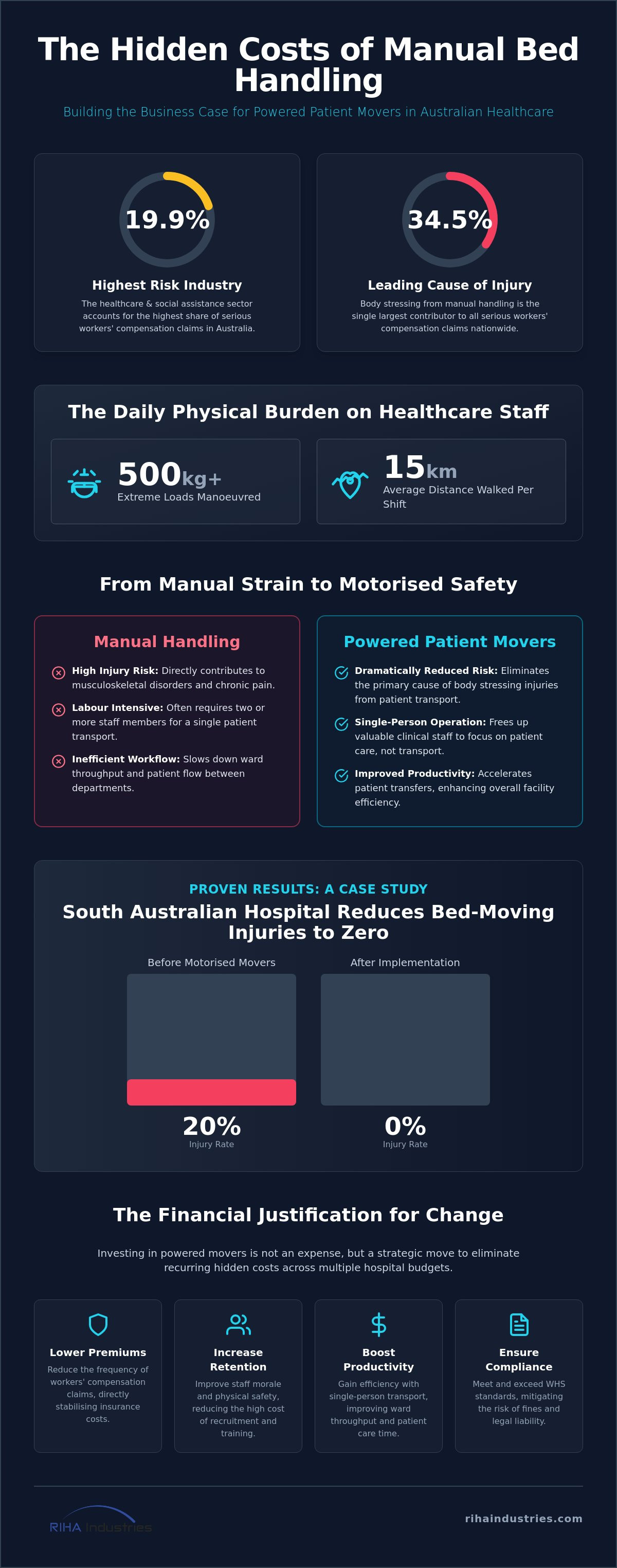
Did you know that the healthcare and social assistance sector now accounts for 19.9% of all serious workers' compensation claims in Australia, the highest of any industry? You're likely all too familiar with the strain this puts on your facility, especially when manual bed handling leads to physical burnout and high staff turnover. It's a heavy burden to carry, both for the porters moving 500kg loads and for the administrators managing rising insurance premiums. We understand that protecting your team while maintaining ward throughput is a complex balancing act that requires more than just traditional lifting training.
In this analysis, you'll discover the true financial and human impact of manual handling and how motorised solutions provide a reliable path to safety. We'll outline the compelling business case for powered patient movers by examining the 2026 economic landscape and the tangible returns of investing in high-quality Australian engineering. By shifting from manual methods to smarter technology, you can reduce workplace injuries, improve staff morale, and secure your hospital's budget for the long term. This guide provides the clear financial justification needed to transform your facility into a safer, more efficient environment for everyone.
Table of Contents
Understanding the True Cost of Manual Bed Handling in Australian Hospitals
Manual bed handling cost is rarely a single line item on a hospital balance sheet. Instead, it represents the cumulative financial impact of every physical push, pull, and steer performed by your staff throughout the day. While the act of moving a bed might seem like a routine task, the long-term expenses are often hidden across HR, WHS, and operational budgets. These costs manifest as increased insurance premiums, high staff turnover, and the slow erosion of ward efficiency. In the current 2026 healthcare climate, understanding these variables is the first step in building a compelling business case for powered patient movers.
The physical reality for healthcare workers is demanding. Porters and nurses frequently walk up to 15km during a single shift while manoeuvring loads that can exceed 500kg. This level of exertion isn't just tiring; it's a significant risk factor for chronic injury. When a facility relies on manual labour for heavy transport, they aren't just moving patients; they're assuming a massive financial and legal liability. Transitioning from manual methods to motorised solutions has shifted from a best-practice recommendation to an absolute economic necessity for modern Australian facilities.
The Distinction Between Equipment Price and Handling Cost
Hospitals often make the mistake of focusing solely on the purchase price of a bed or stretcher. This is a significant financial oversight that ignores the total cost of ownership. Manual handling acts as a recurring tax on your resources that must be paid every time a patient is moved. This tax becomes even more expensive as patient profiles shift. With a rising number of bariatric patients requiring transport, the force needed to initiate movement manually often exceeds safe ergonomic limits. By integrating assistive patient handling devices into daily workflows, facilities can effectively bridge the gap between mechanical capability and human safety, eliminating the hidden expenses of physical strain.
WHS Compliance and the Legal Burden
Legal standards in Australia are becoming increasingly stringent regarding workplace safety. The manual handling code of practice healthcare provides a clear framework for identifying and minimising risks. If a facility fails to provide reasonably practicable safety equipment, such as motorised movers, they face substantial legal liabilities and potential fines. We're seeing a decisive shift toward No Lift environments as the standard for institutional liability. Implementing a strong business case for powered patient movers ensures that your organisation meets its duty of care while protecting the physical well-being of the professionals who keep your wards running. This proactive approach transforms safety from a compliance hurdle into a strategic financial advantage.
Direct Financial Impact: Workers’ Compensation and Medical Claims
Body stressing remains the single largest contributor to serious workers' compensation claims in Australia, accounting for 34.5% of all incidents. Within the healthcare and social assistance sector, this burden is even more pronounced, as the industry holds the highest share of serious claims nationwide at 19.9%. When we examine the business case for powered patient movers, these figures represent more than just statistics; they are a direct reflection of the physical toll manual bed handling takes on a facility's budget. Beyond the immediate medical expenses, hospitals must contend with indirect costs. These include legal fees, administrative hours spent managing complex claims, and the inevitable hike in insurance premiums that follows a high frequency of incidents.
The financial ripple effect of a single injury is extensive. A South Australian hospital case study revealed the transformative potential of motorised assistance, where bed-moving injuries were reduced from 20% to zero following the implementation of specialized equipment. This total elimination of specific manual handling injuries provides a clear blueprint for institutional safety and fiscal responsibility. By removing the 500kg physical burden from the staff, the facility effectively neutralised one of its most persistent financial leaks.
Musculoskeletal Injuries: The Nurse’s Occupational Hazard
Manual bed transport is a leading cause of chronic lower back, shoulder, and wrist injuries among Australian nursing and portering staff. These musculoskeletal disorders (MSDs) often lead to a median time lost from work of 7.4 weeks, creating significant gaps in ward rosters. Even when staff return, the cost of restricted duties and ongoing rehabilitation continues to drain resources. Facilities can significantly mitigate these risks by applying rigorous patient handling equipment selection criteria. Choosing tools designed for 360-degree manoeuvrability ensures that the physical strain of steering and stopping heavy loads is handled by the machine rather than the person.
WorkCover Premiums and Institutional Liability
A hospital’s financial standing is closely tied to its lost time injury (LTI) rates. High LTI rates signal to insurers that a workplace is high-risk, leading to compounding premium increases that can devastate annual budgets. When manual handling tasks exceed safe force limits, the risk of litigation also rises. A robust business case for powered patient movers addresses this by proving that engineering controls are more effective than training alone. Investing in reliable equipment like the StaminaLift or Easi series protects the budget from the volatile costs of workplace injury. You can view our range of Australian-made movers to see how these systems integrate into daily hospital operations.
The Productivity Gap: Labour Efficiency and Facility Throughput
In many Australian hospitals, the "two-person rule" remains a standard necessity for manual bed handling to manage the weight and steering of 500kg loads safely. This practice effectively doubles the labour cost for every single patient transfer. When you factor in the time spent waiting for a second staff member to become available, the productivity loss compounds throughout the shift. This bottleneck is a critical pillar in the business case for powered patient movers; it isn't just about injury prevention, but about optimising the existing workforce to ensure that clinical professionals remain focused on patient care rather than physical transport.
Time motion studies consistently demonstrate that motorised transport is significantly more efficient than manual movement, particularly over the long distances found in modern facility layouts. Manual handling often creates significant bottlenecks in high-pressure environments like the Emergency Department or operating theatres. If a theatre start time is delayed by even ten minutes because porters were unavailable or a manual move was slowed by physical fatigue, the financial impact on the hospital's surgical throughput is substantial. These delays represent a hidden cost that erodes the operational efficiency of the entire ward.
Single-Person Operation vs. Multi-Staff Transfers
The StaminaLift TS5000 is engineered to allow one person to do the work of two safely and with total control. By eliminating the requirement for a second staff member to assist with steering or pushing, hospitals can redeploy those professionals to high-value clinical tasks. For more demanding requirements, the StaminaLift Transfer System 6000 provides the mechanical power necessary to manage bariatric transfers without the need for additional personnel. This transition from multi-staff to single-person operation directly addresses the persistent labour shortages and physical burnout currently facing the Australian healthcare sector.
Manoeuvrability and Facility Throughput
Traditional manual handling often results in slow cornering and elevator delays as staff struggle to align heavy beds in tight spaces. Our equipment features a true 360-degree turning circle, which is essential for navigating the narrow corridors and sharp corners typical of older Australian hospital wings. This precision doesn't just save time; it also reduces "scuffing" and impact damage to facility walls, doorways, and the beds themselves. By minimising these collisions, hospitals can lower unbudgeted facility repair costs while ensuring that patient flow remains steady and bed availability is maximised across the facility.
Staff Retention and the Psychological Cost of Physical Strain
Physical exhaustion is more than just a sore back; it's a primary driver of psychological burnout across Australian nursing and portering sectors. When staff members end every shift feeling physically depleted, their job satisfaction plummets. This exhaustion creates a cycle of fatigue that eventually leads to high staff turnover. Replacing a single experienced nurse or porter involves significant recruitment and training costs, often reaching tens of thousands of dollars. Protecting your team from this avoidable strain is a cornerstone of the business case for powered patient movers.
We're also seeing a concerning "early retirement" trend among veteran healthcare professionals. These individuals possess years of invaluable institutional knowledge, yet many are forced to leave the profession prematurely because their bodies can no longer sustain the cumulative physical strain of manual handling. By providing the right tools, hospitals can transition from a culture of physical endurance to one of professional longevity. This shift not only preserves experience but also strengthens the facility's status as an Employer of Choice in a highly competitive market.
The Cost of Agency Staff and Overtime
When musculoskeletal injuries occur, the resulting absences create immediate gaps in the ward roster. To maintain safe patient-to-staff ratios, facilities often have to rely on expensive agency labour or pay significant overtime to remaining employees. This creates a ripple effect where the remaining staff become even more fatigued, increasing their own risk of injury. A strategic approach to implementing a no lift policy healthcare is essential for breaking this cycle. By ensuring that no staff member is required to manually move heavy loads, you retain your experienced workforce and stabilise your operational budget.
Empowering the Ageing Workforce
Motorised aids are transformative for an ageing workforce. These tools remove the physical barriers that might otherwise prevent diverse teams from performing portering or nursing roles effectively. There's a profound psychological benefit to "effortless" movement, especially in high-stress environments like the ED or theatre. When a porter can move a 500kg bed with a single finger on a joystick, the mental burden of the task disappears alongside the physical one. This sense of empowerment leads to improved morale and a more resilient team. To see how our equipment supports your staff's well-being, you can explore our Australian-made transfer systems.
Calculating the ROI: Transitioning from Manual to Motorised
A comprehensive business case for powered patient movers relies on a three-year ROI model that balances initial capital outlay against long-term savings. While the purchase of specialised equipment represents an upfront investment, it effectively eliminates the recurring costs of workplace injuries and excessive labour requirements. In the modern healthcare environment, "doing nothing" is often the most expensive strategy a facility can adopt. Every month of delay allows for the potential of another serious injury claim or the loss of another experienced staff member to physical burnout.
To begin this transition, we recommend conducting a facility-wide audit of your current manual handling risks. This involves identifying high-frequency transfer routes, assessing the manoeuvrability of corridors, and reviewing the physical requirements of your specific patient profile. Whether your facility focuses on acute care with high-turnover wards or long-term aged care, selecting the right equipment is vital. High-volume hospitals often benefit from the universal compatibility of the StaminaLift TS5000, whereas smaller facilities might find the Easi Mover more suitable for specific trolley and chair transport tasks.
Future-Proofing with StaminaLift Technology
Choosing Australian-made engineering provides a level of reliability and support that cheaper imports simply cannot match. Because our equipment is designed and manufactured locally, you benefit from 24-hour parts shipping and specialised technical support. You can further protect your investment by following a structured hospital bed mover repair service and preventative maintenance schedule. This ensures that your fleet remains operational for years, maximising the return on your initial expenditure. Additionally, the universal compatibility of the StaminaLift TS5000 means it integrates seamlessly with 95% of global hospital beds, protecting the investment you've already made in your existing bed fleet.
Taking the First Step Toward a Safer Facility
The most effective way to understand the efficiency gain is to witness it in person through a hands-on demonstration. This allows your staff to experience the 360-degree manoeuvrability and ease of use that defines our range. To assist with board-level justifications, we provide an ROI calculator that quantifies the savings based on your facility's specific injury rates and labour costs. This data-driven approach ensures that your business case for powered patient movers is grounded in tangible, proven results. Contact RIHA Industries today to discuss your facility’s needs.
Securing the Future of Australian Healthcare Safety
The evidence is clear: manual bed handling represents an unmanaged financial leak that impacts every level of hospital operations. By addressing the hidden costs of physical strain and the productivity gap of multi-staff transfers, facilities can decisively transform their economic outlook. We've demonstrated how a robust business case for powered patient movers rests on more than just equipment; it's about protecting the long-term well-being and professional longevity of your workforce.
Transitioning to motorised solutions means investing in proven, Australian owned and manufactured technology designed for the specific challenges of local wards. With Red Dot awarded designs and a track record of reducing injuries to zero in a two-year hospital study, RIHA Industries provides the reliability needed for high-stakes environments. You don't have to accept rising premiums and staff burnout as inevitable costs of care. Empower your team with the tools they deserve and build a more resilient, safer facility starting today.
Frequently Asked Questions
What is the most common injury caused by manual bed handling?
Musculoskeletal disorders (MSDs) are the most frequent injuries, often resulting from repetitive body stressing and high-force tasks. These typically manifest as chronic lower back pain, shoulder strains, and wrist injuries. Because moving a 500kg bed requires significant initial force to overcome inertia, staff are at high risk of soft tissue damage that can lead to long-term physical disability.
How much does a typical back injury claim cost an Australian hospital?
While the total financial impact varies, the median time lost for a serious injury claim in the healthcare sector is 7.4 weeks. This absence creates a massive financial burden through direct compensation, administrative management, and the immediate need for expensive agency backfills. When you add the inevitable hike in WorkCover premiums, a single back injury becomes a significant unbudgeted expense for any facility.
Does a "No Lift Policy" actually save money in the long run?
A "No Lift Policy" is a proven cost-saving measure because it prioritises engineering controls over less effective manual handling training. By removing the physical requirement for pushing and pulling heavy loads, hospitals see a sharp decline in WorkCover claims and associated legal liabilities. This proactive approach is a central pillar of the business case for powered patient movers in modern healthcare management.
Can one person safely move a bariatric bed without motorised assistance?
Moving a bariatric bed manually with only one person is not safe and almost always violates ergonomic safety limits. The force required to initiate, steer, and stop such heavy loads far exceeds what a single individual can manage without risking a serious musculoskeletal injury. Motorised equipment is the only way to ensure these complex transfers are handled safely and efficiently by a single staff member.
How long does it take for a motorised bed mover to pay for itself?
Most facilities see a full return on investment within the first 18 to 24 months of operation. This payback is achieved through the elimination of the "two-person rule" for transfers and a measurable reduction in injury-related expenses. By redeploying staff to clinical duties, the equipment effectively pays for itself through improved operational efficiency and lower insurance overheads across the organisation.
What are the hidden costs of manual handling that most hospitals miss?
Hospitals often overlook the cumulative cost of facility damage, such as scuffed walls and broken doorways caused by poor manual steering of heavy beds. Other hidden expenses include theatre start-time delays and the psychological impact of burnout on staff morale. These factors contribute to a slow erosion of the hospital's budget that only becomes apparent during deep financial and operational audits.
Is manual bed handling still compliant with 2026 WHS regulations?
Under 2026 WHS regulations, relying on manual handling training alone is no longer considered sufficient if engineering controls are available. Employers have a legal duty to eliminate or minimise risks as far as is reasonably practicable. Failing to provide motorised assistance for heavy bed transport can leave a facility vulnerable to significant regulatory fines, improvement notices, and potential litigation.
How does staff turnover relate to manual handling equipment?
There's a direct correlation between the lack of proper equipment and high staff turnover rates in the nursing and portering sectors. When staff feel physically exhausted and at risk of injury, they're far more likely to leave the profession or seek employment at modern "No Lift" facilities. Providing motorised movers improves retention by demonstrating a genuine commitment to staff well-being and long-term career safety.


