
2026 Hospital Bed Mover Procurement Guide
Updated: Aug 3
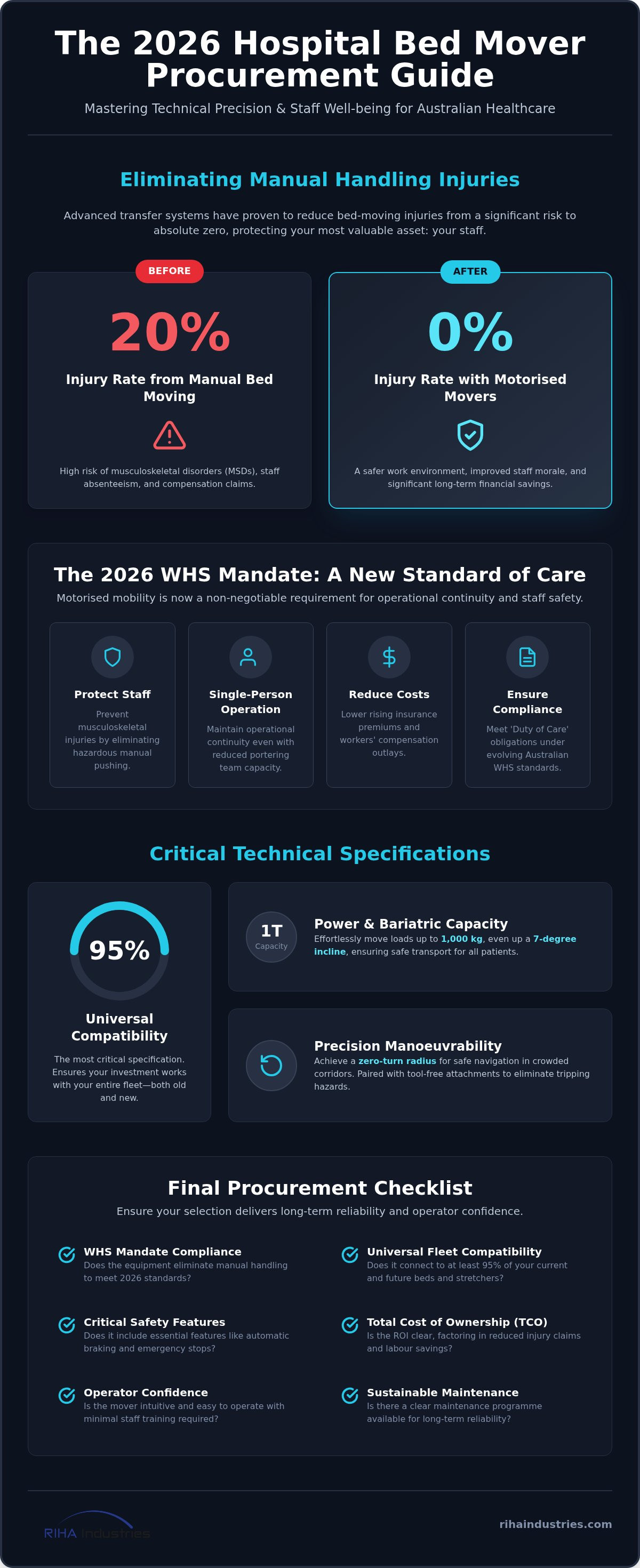
Did you know that clinical environments adopting advanced transfer systems have successfully reduced bed-moving injuries from 20% to absolute zero? You likely recognise the immense physical strain your portering and nursing staff face when manoeuvring heavy, modern beds through crowded wards. It's a high-stakes challenge where a single equipment mismatch can lead to a costly workplace injury or a significant bottleneck in patient flow. This 2026 hospital bed mover procurement guide is designed to help you master these complexities by focusing on technical precision and staff well-being.
We understand that your procurement strategy must balance immediate budget constraints with a clear, long-term return on investment. This guide explores the latest WHS compliance requirements, the necessity of universal attachment mechanisms for older fleets, and the implementation of sustainable maintenance programmes. You'll gain the insights needed to protect your team while achieving a seamless, efficient mobility solution for your entire hospital. By the end of this article, you'll be equipped to select equipment that ensures 100% fleet compatibility and supports a future where manual handling risks are completely eliminated.
Table of Contents
Navigating the 2026 Landscape of Hospital Bed Mover Procurement
The 2026 healthcare environment demands a radical rethink of internal logistics. As hospital administrations face unprecedented staff shortages, the transition from manual handling to motorised mobility has evolved from a recommendation to a Work Health and Safety (WHS) mandate. Every hospital bed mover procurement guide must now address the reality that portering teams are often operating at reduced capacity. This makes single-person operation a non-negotiable requirement for operational continuity across Australian wards.
Retaining your experienced, often ageing, clinical and support staff requires a proactive approach to ergonomics. By removing the physical burden of manual pushing, you extend the careers of your most valued professionals while reducing the risk of career-ending injuries. The financial burden of musculoskeletal disorders (MSDs) remains a primary driver for this shift, as Australian healthcare providers seek to stabilise rising insurance premiums and workers' compensation outlays. Investing in the right technology isn't just about moving beds; it's about protecting the people who move them.
The Hidden Cost of Manual Bed Handling
Manual handling remains the leading cause of workplace injury in Australian hospitals. Beyond the immediate physical pain of a back injury, the direct costs of workers' compensation claims are compounded by the indirect costs of recruitment and retraining. Data from clinical settings shows that implementing motorised solutions can reduce bed-moving injuries from 20% to zero. This dramatic improvement is achieved by integrating specialised patient handling equipment into daily workflows. When staff feel safe and empowered, absenteeism drops and morale improves, creating a more stable care environment for patients.
Evolving WHS Standards for Australian Healthcare
Current Australian standards for manual handling emphasise the elimination of risk rather than just its management. Procurement teams hold the key to meeting 'Duty of Care' obligations by providing equipment that removes the need for physical exertion. In modern hospitals, 'hand-pushing' is rapidly becoming a legacy practice associated with high risk and low efficiency. This hospital bed mover procurement guide highlights that meeting these evolving standards is no longer just about compliance. It's about building a resilient workforce. By prioritising motorised movers, you ensure your facility meets the highest safety standards while future-proofing your operations against the physical demands of increasing patient weights and facility sizes.
Critical Technical Specifications for Healthcare Mobility
Selecting the right equipment requires a deep dive into the mechanical capabilities that facilitate safe movement. A comprehensive hospital bed mover procurement guide must prioritise universal compatibility to ensure the equipment isn't rendered obsolete by a diverse fleet. While basic transporters might work for specific models, high-performance systems like the StaminaLift Transfer System 5000 provide 95% compatibility with global bed designs. This versatility is essential for facilities managing a mix of older stretchers and new smart beds. For heavier requirements, the TS6000 model provides the power to move nearly one tonne up a 7-degree incline, ensuring bariatric patients are transported with the same level of safety as standard admissions.
Universal Compatibility and Attachment Mechanisms
The efficiency of a portering team often hinges on how quickly they can connect to a load. Patented universal attachment mechanisms are the gold standard because they offer tool-free coupling, allowing for rapid ward transfers without mechanical delays. By using an under-bed connection design, these systems eliminate the protruding 'tripping hazards' common with older towing methods. Adhering to OSHA safe patient handling guidelines is much simpler when your equipment naturally integrates with your existing infrastructure. This seamless integration ensures that staff aren't struggling with complex hitches during critical patient movements.
Precision Control and Manoeuvrability
Hospitals are high-traffic environments where every centimetre counts. Achieving a zero-turn radius is a vital specification for bed movers in narrow hospital corridors, as it allows operators to pivot in place without striking walls or other equipment. While throttle controls are common, joystick interfaces often provide more intuitive precision in crowded lifts and bays. Programmable drive modes further enhance safety by allowing managers to set speed limits for different floor surfaces or inclines. This level of control empowers the operator, turning a potentially dangerous task into a smooth, predictable process.
Reliability is further enhanced by modern battery technology. Lithium-ion performance ensures that the mover remains operational through back-to-back shifts without significant power drops. Integrated retractable reels simplify the charging process, keeping cables off the floor and reducing maintenance needs. If you're looking to upgrade your facility's mobility standards, you might consider exploring the technical specs of the TS5000 as a starting point for your next upgrade. This hospital bed mover procurement guide highlights that these technical details are what ultimately determine the longevity and safety of your investment.
Comparing Bed Movers and Tugs: A Procurement Framework
Procurement success relies on a clear understanding of the operational environment. A common hurdle in any hospital bed mover procurement guide is the confusion between dedicated patient transfer systems and multi-purpose tugs. While both provide motorised assistance, their applications differ significantly. Dedicated bed movers are engineered specifically for clinical settings where patient safety and bed compatibility are paramount. In contrast, multi-purpose tugs are the workhorses of facility logistics, designed to move linen, meals, and waste trolleys through non-clinical corridors.
Analysing the bed transport system hospital trends for 2026 reveals a shift towards fleet specialisation. Hospitals are increasingly moving away from "one-size-fits-all" equipment. Instead, they're deploying a tiered approach: using specialised movers for patient wards and high-capacity tugs for back-of-house operations. For large metropolitan campuses, the introduction of ride-on platforms has become a game-changer. These units allow porters to maintain productivity over long-distance facility transfers without the fatigue associated with walking several kilometres per shift.
Specialised Patient Transfer Systems
Clinical governance requires equipment that meets rigorous safety standards. The StaminaLift 2100 Bed Mover is specifically designed to integrate with Australian-made bed frames, providing a reliable solution for local ward configurations. When bariatric care is a priority, the StaminaLift Transfer System 6000 offers a staggering one-tonne capacity. This ensures that even the heaviest loads can be moved safely by a single operator up a 7-degree incline. These systems are FDA-registered, which serves as a critical benchmark for Australian hospitals. This registration ensures that the equipment has undergone stringent quality management assessments, providing peace of mind for clinical risk managers who prioritise patient and staff safety above all else.
Multi-Purpose Tugs for Facility Logistics
Non-clinical workflows require a different kind of versatility. The Easi Mover is an ideal choice for transporting meal and linen trolleys, featuring adjustable hitches that can accommodate a variety of equipment types. For facilities looking to optimise their non-clinical supply chains, integrating turnkey procurement solutions from global experts like Infinity Hotel Supplies can ensure that linen and textile management remains efficient and high-quality. For facilities with expansive layouts, the Easi Rider allows porters to stand on the unit, significantly increasing the speed and efficiency of trolley movements across the campus. Choosing between pin hitches and adjustable hitches depends on your existing trolley fleet. A well-rounded hospital bed mover procurement guide should always recommend an audit of your facility's hitch requirements to ensure seamless integration. This methodical approach ensures that your logistics team is empowered to perform their duties with minimal physical strain and maximum reliability.
Evaluating Total Cost of Ownership and ROI
Procurement decisions often hinge on the initial capital outlay, but a robust hospital bed mover procurement guide looks far beyond the purchase date. True value is found in the total cost of ownership, which encompasses maintenance, operational efficiency, and the mitigation of workplace risks. While comparing the hospital bed mover price across various models, it's essential to factor in the speed of support. Being Australian-made in South Australia allows for 24-hour shipping on critical parts, ensuring your fleet remains operational rather than sitting idle in a repair bay. This local support infrastructure is a vital component of long-term sustainability.
A comprehensive ROI calculation should include more than just the equipment's lifespan. By using an ROI calculator that tracks beds moved per day against staff hourly rates, managers can see the immediate impact on the bottom line. Reducing the labour required for a single transfer from two people to one provides a significant productivity gain. This allows your team to focus on direct patient care while the motorised system handles the heavy lifting. Investing in Australian-made quality also means that even discontinued machinery can often be maintained and serviced, extending the life of your assets and reducing electronic waste.
The ROI of Injury Prevention
The financial impact of a single nurse or porter's back injury can be devastating to a departmental budget. Beyond the direct workers' compensation costs, there are the indirect expenses of agency staff cover and reduced ward morale. By implementing ergonomic patient transfer solutions, facilities can shift from a high-risk manual push to a controlled, motorised move. This shift significantly improves staff retention by protecting the physical health of your workforce. When staff feel that their safety is a priority, the facility becomes a more attractive place to work, directly addressing the challenges of a competitive healthcare labour market.
Maintenance and Support Infrastructure
Sustainability is achieved by extending the lifecycle of your equipment through proactive care. A dedicated hospital bed mover repair service and preventative maintenance contracts prevent minor wear from becoming a major failure. For rural facilities, modern tools like 3D-viewer guides for in-house servicing and Bluetooth diagnostics allow for high-level fleet management without waiting for a technician to travel. This proactive approach ensures that your equipment continues to meet the safety standards required for clinical use. If you're ready to justify your next fleet upgrade with hard data, request a personalised ROI calculation to see the tangible benefits for your facility.
The Procurement Checklist: Finalising Your Selection
Finalising a procurement project requires a methodical approach to ensure the chosen equipment integrates perfectly with daily ward operations. This hospital bed mover procurement guide concludes with a critical checklist designed to verify that your selection meets both technical and human requirements. Before signing off on a significant capital investment, you must confirm that the equipment is fit for purpose in your specific clinical environment. A mismatch here can lead to underutilised assets and continued injury risks.
Compatibility Audit: Confirm the mover fits 95% or more of your current bed fleet, including older frames and new smart beds.
Safety Systems: Verify the presence of automatic braking, emergency release mechanisms, and safety lockouts.
Compliance Benchmarks: Ensure the unit is FDA-registered and CE-certified to meet Australian clinical governance standards.
Support Infrastructure: Check for national service coverage and the availability of locally held spare parts for rapid repairs.
Choosing a partner who offers Australian-made reliability provides a distinct advantage. When spare parts are shipped within 24 hours from a South Australian facility, your downtime is minimised and your "Duty of Care" to staff is upheld. This level of support turns a simple equipment purchase into a stable, long-term partnership. It ensures that your investment continues to provide relief to your team for years to come.
Organising a Facility Trial
Hands-on testing is far superior to a traditional sales pitch because it reveals how the equipment performs in your facility's tightest corners. Organising a trial allows you to gather direct feedback from the portering and nursing teams who will use the equipment daily. Their insights into ease of use and physical relief are invaluable. A successful trial often bridges the gap between administrative approval and staff acceptance, ensuring the equipment doesn't sit unused in a storage bay. It's about empowering your team to move heavy loads with confidence and precision.
Training and Long-Term Adoption
Sustainable adoption relies on structured certification programmes that ensure every operator is competent and compliant with WHS standards. Modern systems now utilise Bluetooth connectivity to provide proactive fleet management, helping managers identify specific training needs based on usage patterns. This data-driven approach allows for targeted support rather than generic sessions. At the heart of this technology is RIHA Industries' commitment to "Improving the lives of healthcare professionals." By providing the right tools and the necessary training, you create a safer, more efficient workplace where physical burden is replaced by thoughtful engineering.
Empowering Your Workforce Through Technical Excellence
Transitioning to a motorised fleet is no longer a luxury; it's a fundamental commitment to the safety and longevity of your healthcare team. This hospital bed mover procurement guide has highlighted how technical precision and universal compatibility can transform ward logistics. By choosing equipment that fits 95% of global beds, you eliminate the operational friction of incompatible fleets and ensure every staff member is protected. It's a strategic move that turns complex physical challenges into seamless, controlled movements.
The shift from manual handling to advanced mobility has already proven its value in clinical settings, successfully reducing injury rates from 20% to zero. You're securing a long-term partnership with a global leader that provides FDA-registered reliability and Australian-made quality. With 24-hour shipping for parts from our South Australian facility, your operations remain resilient and your staff remain empowered. Book a hands-on demonstration of the StaminaLift series for your facility today to experience the physical relief and precision control first-hand. We're here to help you build a safer, more efficient future for your entire hospital.
Frequently Asked Questions
What is the most important factor when choosing a hospital bed mover?
Universal compatibility remains the most critical factor to ensure your investment works across your entire facility. A high-quality mover must adapt to various bed and stretcher designs, including older models and modern smart beds. This versatility prevents equipment from sitting idle and ensures that staff always have the right tool available, regardless of the patient's ward or the specific bed frame in use.
How do motorised bed movers improve WHS compliance in Australian hospitals?
Motorised units improve WHS compliance by eliminating the physical exertion required to push and pull heavy loads. By automating the movement of beds, facilities directly address the risk of musculoskeletal injuries, which are a primary cause of workers' compensation claims. Implementing these systems demonstrates a proactive approach to 'Duty of Care' by providing engineered solutions that remove the hazard of manual handling entirely.
Are StaminaLift bed movers compatible with all hospital bed brands?
The StaminaLift series is designed for universal application, offering compatibility with approximately 95% of hospital beds found in global healthcare settings. This is achieved through patented universal attachment mechanisms that secure to the bed's frame without requiring specialised tools or permanent modifications. This high rate of compatibility makes this hospital bed mover procurement guide essential for managers looking to standardise their transport equipment across diverse fleets.
Can one person safely move a bariatric bed using a motorised mover?
Single-person operation is a core benefit of these motorised systems, even when transporting heavy bariatric beds. For instance, the StaminaLift Transfer System 6000 is engineered to move nearly one tonne up a 7-degree incline with ease. This capability allows one staff member to perform a task that would otherwise require multiple porters, significantly increasing ward efficiency while ensuring the operator's safety remains uncompromised.
What is the typical ROI period for a motorised bed mover fleet?
The return on investment for a motorised fleet is typically realised through a combination of reduced injury claims and improved labour productivity. By reducing bed-moving injuries from 20% to zero in clinical settings, facilities save significantly on workers' compensation and insurance premiums. Additionally, enabling one person to move beds instead of two doubles the efficiency of your portering team, allowing for more patient transfers per shift.
Do motorised movers require specialised electrical work for charging?
Most modern motorised movers are designed to charge via standard Australian power outlets, requiring no specialised electrical infrastructure. Features like integrated retractable reels keep cables tidy and off the floor, reducing trip hazards in busy corridors. This plug-and-play approach ensures that charging stations can be established in existing bays or storage areas without the need for costly facility modifications or electrical upgrades.
For broader healthcare infrastructure projects that go beyond simple equipment installation, it can be beneficial to explore Fixed-Price Design-Build and MEP Construction Contracts from HHM as a strategy to manage complex engineering requirements and maintain budget control.
How often should hospital bed movers undergo preventative maintenance?
Preventative maintenance should be scheduled at regular intervals, typically every six to twelve months, depending on the frequency of use within your facility. Regular servicing ensures that safety features like automatic braking and emergency releases remain in peak condition. Implementing a structured maintenance contract helps identify minor wear before it leads to equipment downtime, extending the total lifecycle of your motorised fleet.
Are spare parts for StaminaLift movers readily available in Australia?
Spare parts are readily available and held locally at the manufacturing facility in South Australia. This proximity allows for 24-hour shipping on critical components, ensuring that any necessary repairs are completed with minimal delay. Having a local supply chain is a significant advantage for Australian hospitals, as it avoids the long lead times and logistical complexities associated with sourcing parts from overseas manufacturers.


